Better late than never, we turn our attention to two novels that are among the finest published in the past year: Ocean Vuong’s The Emperor of Gladness and In My Eyes I Wear Clouds by psychiatrist Forugh Karimi. We also discuss two films about, among other things, the roots and consequences of addiction: Urchin and The Chronology of Water. Together with Vuong’s novel, these films are a nice addition to the latest edition of the Dutch Journal of Literature and Medicine, which focuses on addiction. We hope to make this edition available in English before February 1, 2026.
Final editing/correction: Cathri van de Haar
Comments, questions, tips, criticism, and/or praise can be sent to: scoop0329@gmail.com
Novel
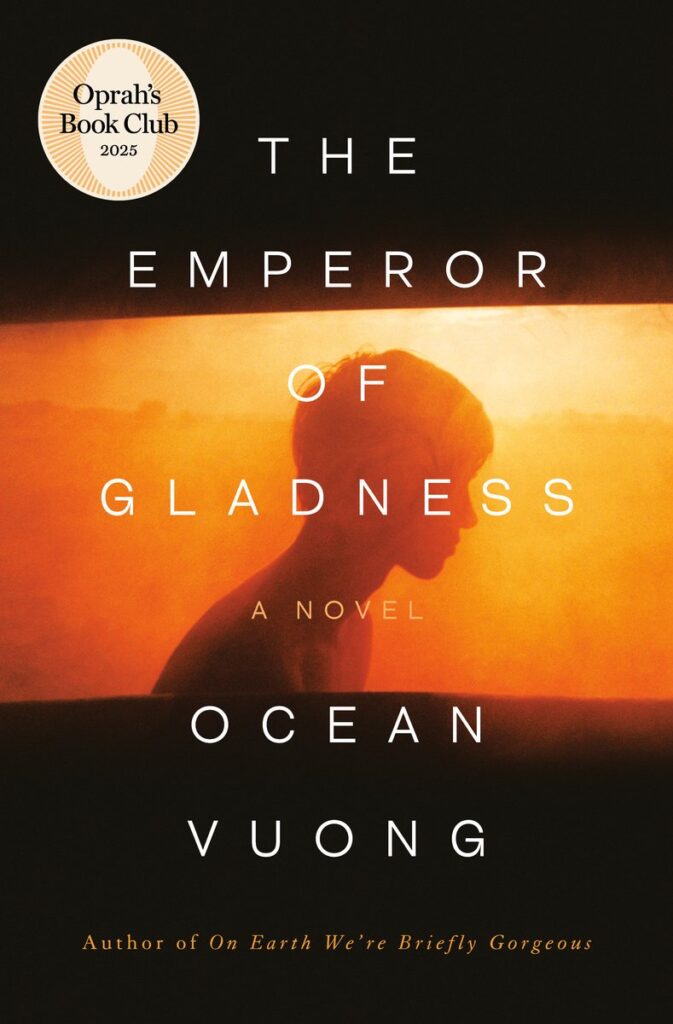
The Emperor of Gladness, Ocean Vuong
Surviving thanks to informal care
It begins in September 2009 on a bridge. There stands Hai, 19 years old, planning to jump off. We don’t know why yet. But we do know that he doesn’t jump. Because an old woman calls out to him and invites him into her dilapidated house. It soon becomes clear that she is alone, over 80, and suffering from dementia: frontotemporal dementia, middle stage. Her live-in caregiver has just left and has not yet been replaced, so she asks Hai to stay with her. He does. Hai and the old woman, whose name is Grazina, become attached to each other. He becomes her caregiver, she becomes his anchor in his fragile, volatile existence, which we follow over several seasons.
That is the premise of The Emperor of Gladness, the new novel by poet/writer and essayist Ocean Vuong (1988), which was published in mid-2025 and is the successor to his superlative novel On Earth We’re Briefly Gorgeous (2019).
No development
Despite Grazina’s strict regimen of pills for nerve pain, cognitive decline, high blood pressure, and elevated cholesterol, her condition deteriorates, albeit slowly. She is regularly plagued by hallucinatory flashbacks of events during World War II in her homeland of Lithuania. The way Hai deals with this shows empathy; he proves to be a very skilled amateur nurse.
A lot else happens in this novel, yet the plot remains strangely static; there is no development, certainly not in the material lives of the various protagonists. They move but do not get anywhere. Hai has convinced his mother that he is still studying medicine, while he keeps his head above water financially by working in a fast-food restaurant. He also has to deal with an aunt who is in prison, his cousin Sony who is autistic and has an obsessive hang-up about the American Civil War; in short, with a heterogeneous group of invisible people who live on the margins of American society because they are migrants (Hai and his cousin are Vietnamese), neurodiverse, queer, or old and vulnerable, working in low-paying jobs, and—last but not least—struggling with addiction: Hai resignedly endures the consequences of the opioid crisis, which claimed the life of his beloved Noah.
Lie
All these people live in the lie of the American dream, because the “only truly egalitarian wing of the American dream, where the past is nothing more than what it has done to you” is the nursing home, as Vuong Hai points out. In an intense, emotional interview with The New York Times, the author showed that he harbors no illusions about his country: “I wondered if I could write a book without points for improvement, because it matches my observations of my communities. (….) We want stories about change, but American life is often static. You drive the same car, people live in the same apartment, but that doesn’t mean their lives are worthless. It’s no spoiler to say that in this book, no one gets a better job, no one gets a raise. So what happens? I’ve been interested in the idea of kindness without hope.”
Decent human being
The result is a book like a 400-page ballad by Bruce Springsteen or Tom Waits, whose underlying tone is best expressed by Grazina: ‘Living and trying to be a decent human being without making it into something big or important is the hardest thing there is.’
And yet Hai wants ‘more’. He reads Dostoyevsky, he reads Kurt Vonnegut. He wants to write. Will he succeed? We don’t know. But perhaps The Emperor of Gladness is the answer to that question.
Henk Maassen
Novel
In mijn ogen draag ik wolken (In my eyes I carry clouds), Forugh Karimi, Meridiaan publishers, 528 pages, €26.99 (language: Dutch)

The guilt of the successful refugee
There is a lot that is wrong with the world today. Among my peers, I sense a great deal of disappointment because we are apparently still unable to suppress what is perceived as primitive aggression. It is therefore not easy to read novels in which that aggression is an important, if not dominant, element. In my eyes I carry clouds by Forugh Karimi is such a novel.
Psychiatrist
The author fled Afghanistan at the age of 25, heavily pregnant, and ended up in the Netherlands. There she studied medicine and specialized as a psychiatrist. Her first novel, The Mothers of Mahipar, dates from 2022, and a year later the novella Nargis was published. The main character in In My Eyes I Carry Clouds is Widá, a girl born in Kabul. The book begins in 2023 when Widá, who works as a psychiatrist in the Netherlands, sets off for Athens with a Dutch journalist. The reason for her journey to visit a number of Afghans in Europe only becomes clear at the end of the novel. The account of that journey is interspersed with chapters set in the past in Kabul. It is these chapters that take the reader into the horrific spiral of violence that has engulfed Afghanistan. Militias fighting each other to the death, foreign powers fighting each other on Afghan territory, and the Taliban allowing women no freedom whatsoever.
A better fate
Amidst the constant rocket attacks, Widá lives there with her mother and grandmother. Her father has disappeared without a trace. A distant relative and her daughter also live in the house. Her mother decides that Widá, like her brother, Widá’s uncle, must flee if she wants to have a chance at a good life. Widá is smart and deserves a better fate. She escapes via Russia, together with her uncle, his unpleasant wife, and their little daughter. The story clearly gains power when it becomes apparent that not all Afghans who flee are nice people.
They eventually end up in the Netherlands. Widá is then 15. Gradually, the story shifts more and more to 2023.
Widá struggles with feelings of guilt towards the people she left behind in Kabul and towards the man she loves in the Netherlands. I won’t reveal exactly how that works out here; it’s one of the reasons to read this book.
Despite its 500 pages, it’s a quick read because it’s a well-written novel. I quickly made an association with the novels of Abraham Verghese, also well written, also about a doctor and set in Ethiopia and India, among other places. Another association is with fellow writers in the Netherlands, such as Kader Abdolah, Sholeh Rezazadeh, and Yasmin Namavar, who share Karimi’s bicultural background. But none of these writers have described the cruelty that forced them to flee as powerfully as she has.
Price
In an interview published in de Volkskrant, Karimi was pictured in front of a large house. I assume that this is her house, and if so, the photo shows that in a certain sense her flight to the Netherlands has been a great success—a success she can be proud of. But her novel shows that a heavy price had to be paid for this. A book to read in one sitting.
Arko Oderwald
Film
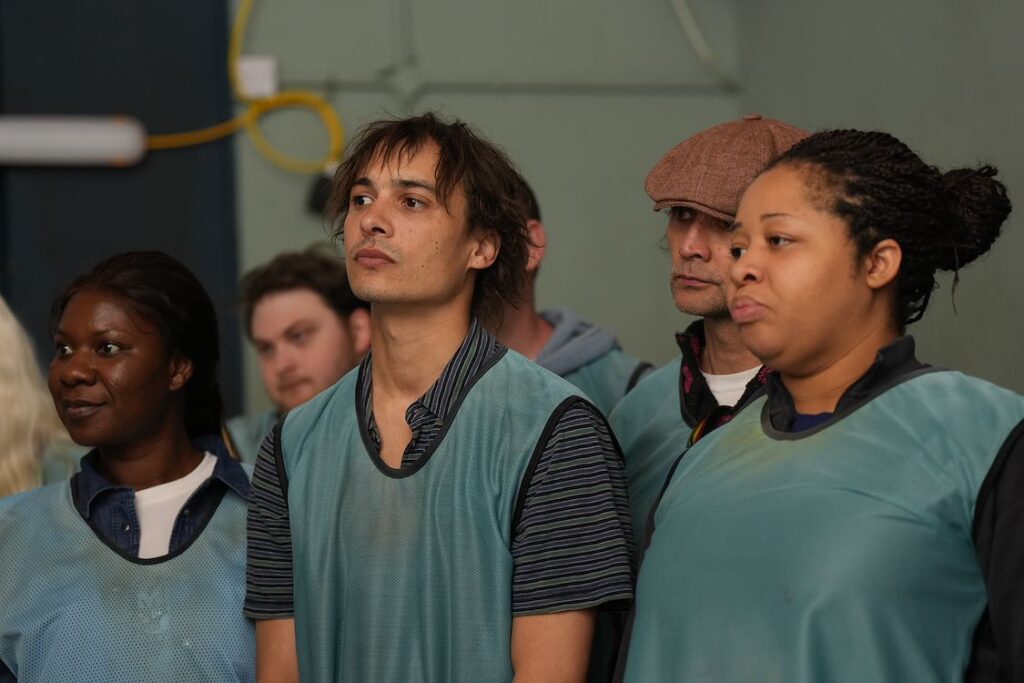
Urchin, now in theaters.
The surreal nature of addiction
Mike, a drug addict, arouses a kind of sympathy in those around him that makes people want to save him, or at least help him get his life back on track, but at the same time he repeatedly rejects the kindness of those around him – despite himself, you are certainly inclined to think at first. We follow his life in Urchin, the directorial debut of 29-year-old British actor Harris Dickinson. Early on, the film shows how things are really going when a friendly passerby wants to buy Mike lunch, but Mike runs off with his Good Samaritan’s watch. This lands Mike behind bars for seven months – not for the first time, incidentally.
Cycle of crises
Dickinson leaves Mike’s motivations open to interpretation – he hardly, if at all, delves into a psychological explanation of how Mike became the way he is. Rather, the filmmaker tries to make us part of the self-perpetuating cycle of crises that define Mike’s life and his mental state through cinematic excursions in a surrealistic idiom. When Mike is in the shower in prison, the camera focuses on the drain and, after a long journey, we disappear through that drain into a kind of cave, or rather a black hole. It will not be the last time that we catch a glimpse of Mike’s “inner self” in this way – and very effectively at that – as if Dickinson wants to transport us into the essence of the addict, or at least of this addict.
Hopeless life
After his imprisonment, Mike is determined to finally stay clean. He takes a job at a cheap hotel, and later at a cleaning company. Things go well for a while, but he struggles with rules and discipline, and suffers from outbursts of anger. He tries to coach himself with tapes of meditation exercises, but relapse is inevitable. What’s more, the “care system” is not helpful.
Urchin, like Ocean Vuong’s novel discussed above, paints a bleak picture of the hopeless life on the fringes of society, where (unlike in Vuong’s novel) even fellow sufferers cannot be trusted.
You wonder whether Mike can really be helped. At the end, he seems to disappear into nothingness: a kind of redemption?
Henk Maassen
Film
The Chronology of Water,

Healing in water
Another film about the roots of addiction and the desire for oblivion in drugs, alcohol, and this time also sex: The Chronology of Water, and again a directorial debut. Actress Kirsten Stewart directed this film, which is as raw, physical, and elusive as its source: the memoir of the same name by Lidia Yuknavitch, about her life marked by sexual abuse, drug and alcohol addiction, and her difficult, ongoing search for identity. Yuknavitch helped herself get back on her feet through competitive swimming and later as a writer.
Traumatic memory
Unlike in Urchin, psychology is not off-limits here. On the contrary: Stewart gives the audience a glimpse into Lidia’s mind. And she brilliantly translates what Yuknavitch refers to in her memoir as a “poetics of the body” into an overwhelmingly inventive cinematic form. In her own words, she wanted “a film that pulsates with immediacy,” and she achieves this through sharp, sometimes abrupt, brusque editing of image and sound, which—again according to Stewart—is meant to reflect how her protagonist’s traumatic memory works. Memory dictates the form here, not the actual chronology of events: ‘I thought about starting at the beginning but that’s not how I remember it.’
The memories and associations are never random: images and events become intertwined, recur, explain each other – as in a poem in which motifs are repeated and only then acquire meaning. Consider, for example, how water becomes a refuge for Lidia, how being in the water – I can’t put it any other way – promotes her sense of wholeness. All in all, Stewart’s approach has an almost physical, visceral effect on the viewer.
Liquid mind
Someone wrote that with this film, Stewart “communicates on an almost subatomic level with the liquid mind of a woman who only became whole by allowing herself to dissolve into the smallest essences of her being – over and over again until it seemed impossible that she would ever regain a recognizable form.” I couldn’t have said it better myself. And let’s not forget lead actress Imogen Poots: she carries every scene, giving a phenomenal, Oscar-worthy performance.
Henk Maassen