Paris
In Paris, the Foundation for Literature and Medicine is offering two courses. Paris is so rich in medical-literary material that we can fill not only two courses, but also many episodes of this column. The classification for this is somewhat arbitrary. We will focus on novels, medical and literary figures, and the many old hospitals that still stand in Paris and are still in use. Some of these hospitals are the setting for novels.
On the spot – Paris (3) – Palais-Royal
Address: Rue Saint Honoré/Place Colette
Admission: free
How to get there: Metro 1, Palais-Royal/Musée de Louvre stop, Rue Saint Honoré exit Comédie Française
The Palais-Royal plays an important role in (medical) novels, such as in The wild ass’s skin by Honoré de Balzac, Le malade imaginaire by Molière, and The Bells of Bicêtre by Georges Simenon. We take Metro 1 to Palais-Royal and get off at Rue Saint-Honoré.
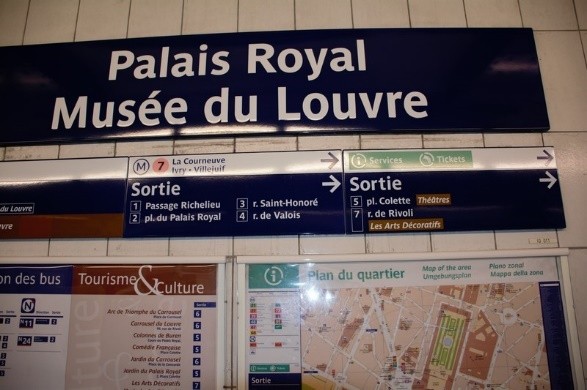
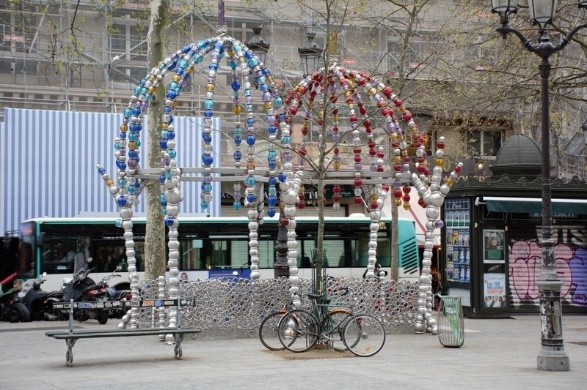
When we emerge from the strikingly decorated metro exit, we find ourselves in front of the Comédie Française.
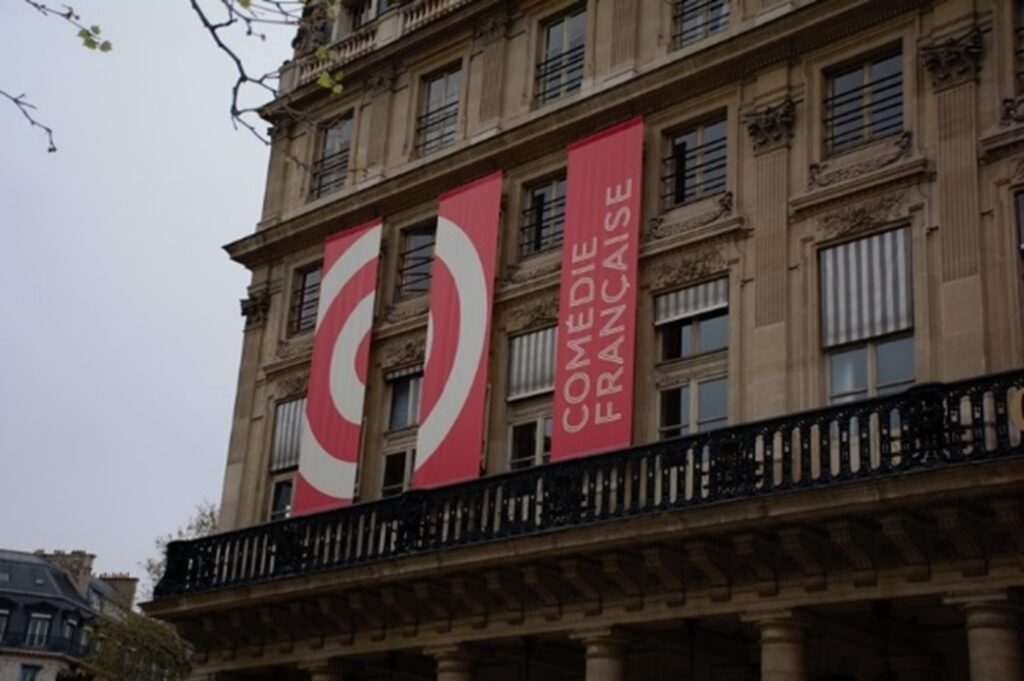
The Comédie-Française or Théâtre-Français is France’s leading state theater and the only one with a permanent theater company. It is located in a prestigious building on the rue de Richelieu in the center of Paris. The Comédie mainly stages classic French plays, although foreign performances are occasionally held. The company is managed by the permanent actors and actresses (sociétaires) under the leadership of the longest-serving member, the doyen. Actors who are not (yet) sociétaires are called pensionnaires. Virtually all of France’s important actors of the past have been associated with the Comédie-Française for a short or long period of time.
Now walk through the gate to the right of the Comédie. You will then enter the Palais-Royal.
The Palais-Royal is a former royal palace and now a garden in Paris. Today, it houses the French Ministry of Culture, the French Council of State, and the Constitutional Council.
In 1624, Prime Minister Cardinal Richelieu bought a mansion near the Louvre with a piece of land that stretched to the city wall of Charles V. In 1632, he commissioned architect Jacques Lemercier to build the huge mansion that would become known as the Cardinal’s Palace.
In 1642, on his deathbed, the cardinal left the palace to Louis XIII, who, however, would not survive him for long. His widow, Anne of Austria, left the Louvre and, together with her son, King Louis XIV, moved into the Palais Cardinal, which offered much more comfort than the Louvre. The palace was now called the Palais Royal.
Louis returned to the Louvre and the Palais Royal was made available to various members of the family. Philippe d’Orléans created the arcades that now define its appearance. It had and still has 60 ‘pavilions’, each with three arches and four floors. Philippe sold them for exorbitant prices. He had a large wooden hall built in the middle of the garden, which was called the Galeries de Bois. It became the center of life in Paris and a huge commercial success, as well as the model for all other galleries and passages that were yet to come.
Today, wealthy citizens can still rent or buy an apartment for a lot of money, while the ground floor houses expensive shops.
Almost all French revolutions (1789, 1830, 1848) were prepared here. Victor Hugo called the Palais Royal The Eye of the Comet Revolution. In the 19th century, Honoré de Balzac spent hours here, coming to eat and gamble away his money. The famous grocer Chevet, whose name appears more than twenty times in the Comedie humaine, also had a real shop here at number 22. Balzac regularly smuggled the chic restaurant Very into his novels, where people with well-filled wallets still dine today. In this way, Balzac paid his ever-increasing bills.
Honoré de Balzac in Illusions perdu about Véry:
When Lucien de Rubempré arrived from Angoulême, unhappy and humiliated, he set off for the Palais-Royal, after first asking for directions because he was not yet familiar with the topography of his neighborhood. He entered Véry’s, ordered a dinner that would comfort him in his despair, in order to initiate himself into the pleasures of Paris. A bottle of Bordeaux, oysters from Ostend, a fish, a partridge, a macaroni dish, and fruit. He enjoyed this lavish feast with the thought that in the evening he would be able to show his wit to the Marquise d’Espard and compensate for the shabbiness of his strange attire by displaying his intellectual riches. He was brought back to reality by the amount of the bill, which deprived him of the fifty francs with which he thought he could get very far in Paris. The price of that dinner could have kept him living in Angoulême for a month.
Characters from Balzac’s work, such as Rastignac, Rubempre, and Valentin, come here to try their luck in the gambling houses with varying degrees of success.
‘Spain may have its bullfights, and Rome its gladiators, but Paris can boast of its Palais-Royal, where the thrilling roulette wheels offer the pleasure of seeing blood flow without the feet of the parterre running the risk of slipping into it.’ (Balzac: The wild ass’s skin)

At the end of October 1829, Raphael de Valentin, the protagonist of The wild ass’s skin, enters the Palais-Royal just as the gambling houses open. He gambles away his last pennies. Discouraged, he flees under the arcades of the Palais-Royal and strolls ‘indecisively through the gardens of the Tuileries’. The idea of suicide lurks in his mind. It does not come to that, because fate will magically lend him a hand at an antique dealer’s on the other bank of the Seine.
However, so many young people commit suicide after losing everything at gambling that Louis-Philippe closes the gambling houses at midnight on December 31, 1836.
In our time, the wooden palace has made way for a beautifully landscaped garden with fountains, where many people sit in the summer.

But before you get there, you first pass Daniel Buren’s striped columns on your right. In summer, they are a source of entertainment for small children. Does that say something about this form of art? This controversial project was pushed through by Jack Lang, François Mitterand’s Minister of Culture.
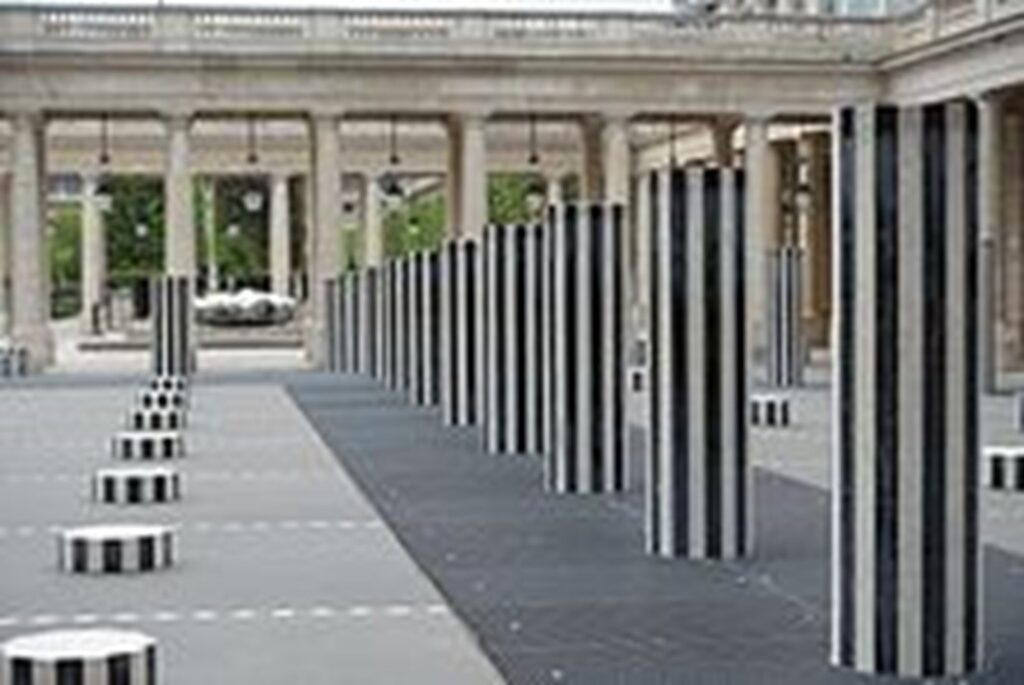
We now walk to the left under the arcades past the shops. Some have been modernized, but others are in deplorable condition.

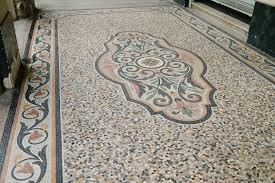
Also note the mosaic you walk over. It has almost disappeared in places, but then suddenly there is a pristine section again.
At the very end of the arcades is a famous restaurant, Le Grand Véfour.
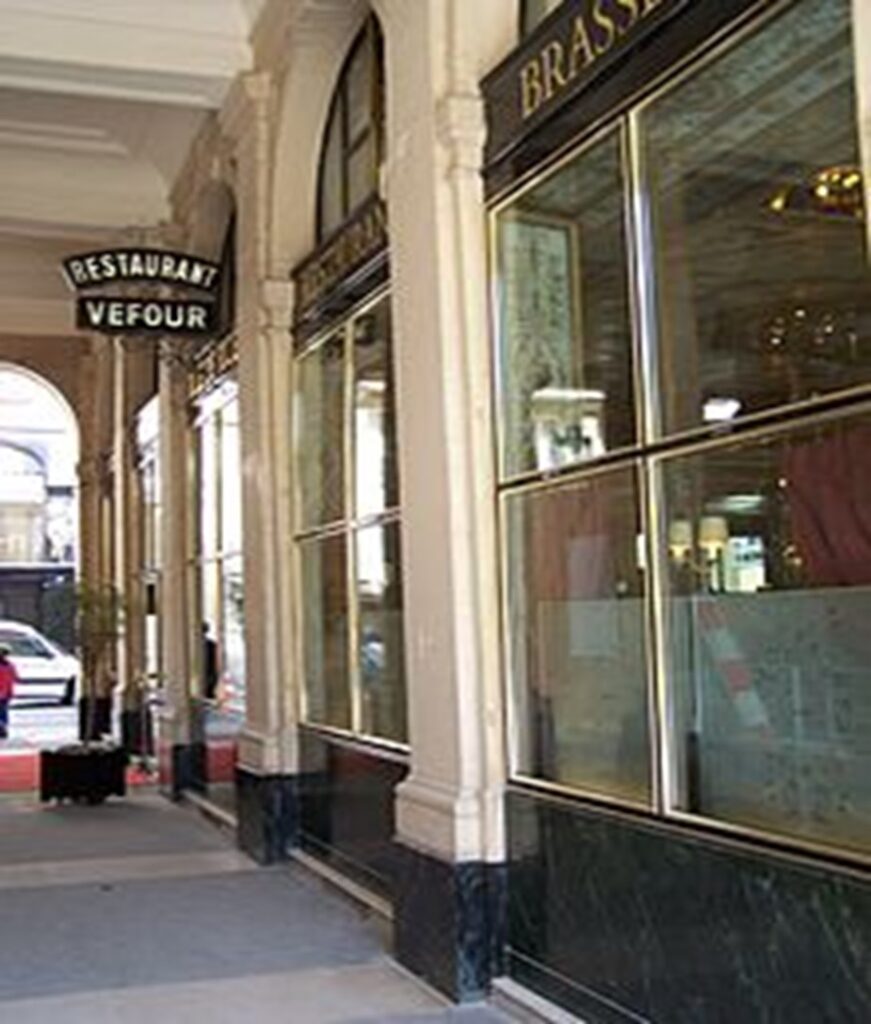
Le Grand Véfour, the first grand restaurant in Paris and France, was opened in 1784 in the arcades of the Palais-Royal by Antoine Aubertot, as the Café de Chartres, and was bought in 1820 by Jean Véfour, who sold it again within three years to Jean Boissier.
A list of regular customers over the past two centuries includes most of the immortal heavyweights of French culture and politics. In 1948, Grand Véfour came under the celebrated chef Raymond Oliver. Jean Cocteau designed its menu. The restaurant still has its early nineteenth-century neoclassical décor of large mirrors in gilded frames and painted supraports. When it lost one of its three Michelin stars, it was big news.
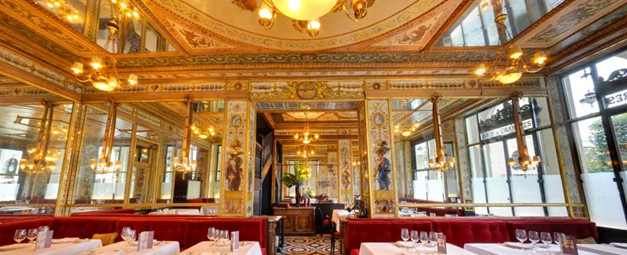
Given this history, it is not surprising that Le Grand Véfour has also found its way into literature. The main character in Georges Simenon’s The Bells of Bicêtre, whom we will also encounter in another episode of On the spot, eats here every month with a group of friends, all of whom are important people. When he goes to make a phone call and then to the toilet, he suffers a stroke. He wakes up in the hospital.

The professor is no longer wearing a skirt and he is not wearing his white coat. He is sixty years old; he has a particularly handsome face, refined manners, is always courteous and always dresses with the utmost care.
“How are you feeling? … Don’t try to speak yet … Lie still . . . I can see from your expression that you have coped very well with the shock …”
What shock? And why does his friend Pierre feel the need to speak in the unctuous tone he always uses with his patients?
“You don’t remember anything, do you?”
He would have liked to answer: ‘Yes, of course!’ Because just now, suddenly, the little room in Le Grand Véfour came back to his mind, the little room on the mezzanine, at the top of the spiral staircase, where they have lunch together every first Tuesday of the month, formerly with thirteen of them, nowadays, because some have died, with ten.
How much time has passed since that moment? He couldn’t possibly say whether it was a day or a week. There was no sun like this morning, because he can see from the light, from a certain freshness in the sunlight, that it is tomorrow. He is not yet at the point where he cares about the exact time, but near his room women are sweeping and he can hear buckets being moved.
They were gathered at Le Grand Véfour and could see the garden of the Palais-Royal with its galleries under the fine drizzle through the crescent-shaped window.
Besson sat opposite him and almost everyone was present: Clabaud, the lawyer; Julien Marel, member of the Académie Française, whose latest play was being performed in the theater opposite them; Couffe, also a member of the Académie; Chabut.
He could list them all, say exactly how they were seated at that moment, and he can still see Victor, the cellar master, who has been serving them for more than twenty years, going from one to the other with a large bottle of Armagnac. He then got up to call the office of his newspaper.
The telephone is located between the ladies’ and gentlemen’s restrooms. He spoke to Fernand Colère, his editor-in-chief, who, despite his name, is as gentle as a lamb. When he leaves the office, even if only for an hour, he always feels the need to call and give precise instructions in a curt and somewhat sharp tone.
“No. Don’t change anything on page one… The third column on page three has to go… Tell the Interior Ministry that there’s nothing we can do about it and that we can’t possibly keep this incident quiet…”
Besson d’Argoulet, who is still smoking his cigarette, feels compelled to explain: “We were all sitting at the table, at Le Grand Véfour… You left for a moment to make a phone call while the cognac was being poured… Then you went to the restroom, and you must not have felt well because when Clabaud went there too, about ten or fifteen minutes later, he found you lying unconscious on the floor…”
Why all this fuss, this patient verbosity? He is being treated like a child, or like someone who is seriously ill. Yes, more like someone who is seriously ill, which in reality he is.
The professor is mistaken on one point, despite his self-assurance.
And that too is remarkable, so remarkable that Maugras, if he had been able to speak, would not have said anything about it. It is true that, after hanging up the phone, he went to the toilet. He stood in front of a urinal in the ridiculous but familiar posture of all men. He thought of Colere and of the attempt by the Ministry of the Interior when, without feeling anything that could have been a warning, he suddenly staggered.
He remembers an unpleasant detail. He tried with all his strength to keep himself upright with both hands against the sticky enamel of the urinal before he fell down.
What did Besson just say?
“When Clabaud went there ten or fifteen minutes later, he found you lying unconscious on the floor…”
Those words reveal nothing about the position in which he was found. But he himself can still see exactly how he was lying, across the narrow space on the tiled floor, making desperate attempts, not to get up, not to call for help, but to button his pants. What is a mystery to him is that he actually sees himself lying there as someone else must have seen him, that he sees himself from the outside, as Clabaud must have found him. Is such a doubling of the self possible?
We now walk to the right, along the short side of the Palais Royal, and arrive at the place where Colette lived.
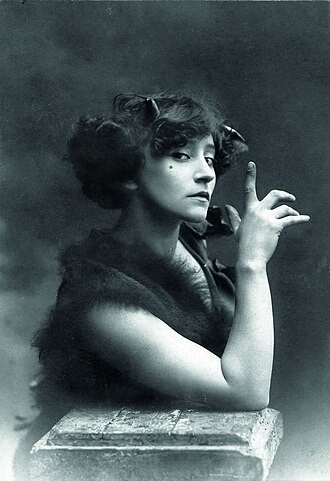
Colette was a writer and actress. She married several times and had affairs with women and much younger men. This was certainly controversial at the time, but by the time of her death she was widely appreciated. In 1954, she was the first French writer to receive a state funeral. Colette wrote about the Palais-Royal, describing it as a small provincial town in Paris. Everyone knows each other and talks to each other.
After two marriages, the birth of her daughter, and 15 moves in Paris, Colette becomes the “lady of the Palais-Royale.” She arrived here in 1926, albeit in the basement. Until January 1930, she stayed there in what she called her ‘tunnel’. She said about it: it is always dark here, we needed light all day long. It’s so narrow here that you can only eat eel. It was actually a lookout post for ladies of pleasure, a place where these ladies waited for their clients behind a window. In fact, it was a brothel. Later, Colette moved upstairs to a sunny apartment where she lived for a long time.
In Paris, many women undress without making love and many men make love without undressing.
We walk on and see the former shop of Stella McCartney, daughter of Paul McCartney and world-famous fashion designer, on the corner. Anyone who wants to enjoy her work (without animal products) should go to 231 Rue Saint Honoré. There is a much more modest shop there than there ever was in the Palais-Royal.
We walk back a little and go through the Passage Du Perron and arrive at Rue de Beaujolais. We turn left and after the left turn we see the Théâtre du Palais-Royal, originally from 1784, but built on the site of an older theater.
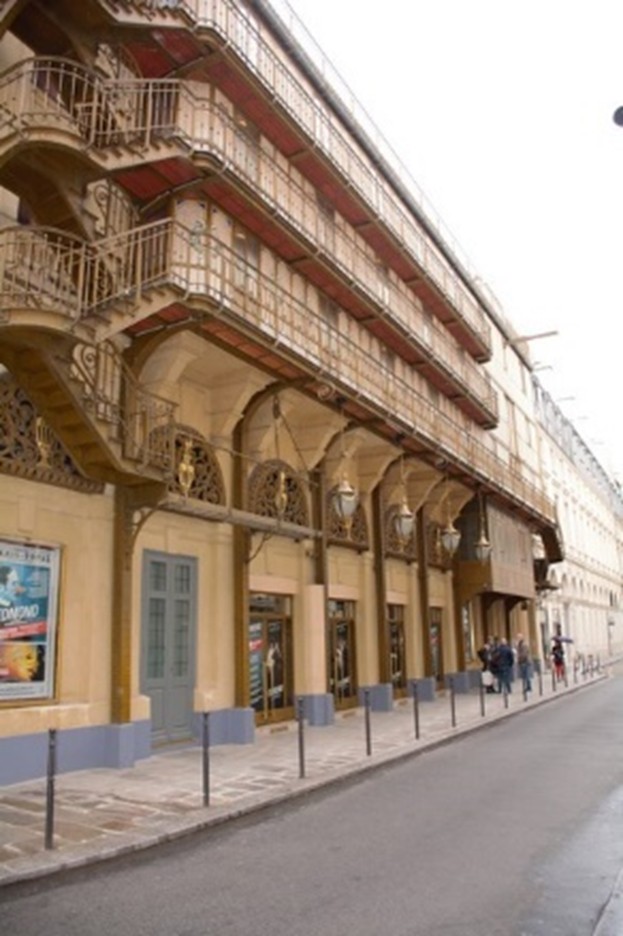
The first Théâtre du Palais-Royal opened on January 14, 1641. The theater was used by Molière’s company from 1660 to 1673. Almost all of Molière’s famous works were performed here, including Le malade imaginaire on February 10, 1673.
Molière (pseudonym of Jean-Baptiste Poquelin) was born in Paris in 1622. After studying law in Orléans for some time, he founded a theater company called L’illustre Théâtre with several others in 1643. However, this theater company went bankrupt a few years later, in 1645, causing Molière to spend a short time in prison. He then traveled around the country with a new theater company. In the 1640s, Molière began writing plays. His comedies, which were highly critical of various groups (doctors, scholars), were very successful and earned him the praise and support of King Louis XIV. Tartuffe (1664), Dom Juan (1665), and L’Avare (1668) are particularly well known. Molière’s last play was Le malade imaginaire (1673). During a performance of this comedy, in which Molière played the role of the hypochondriac Argan, he became ill; that same evening, Molière, who suffered from tuberculosis, died at the age of 60.
Le malade imaginaire is about Argan, who suffers from hypochondria. Anxious as he is, he takes his doctors very seriously. Although Argan is in perfect health, the doctors do not shy away from making a lot of money from him. To reduce costs, Argan wants to marry his daughter Angélique to a young doctor—after all, his medical treatments will then be free. In the end, however, everything turns out well. Argan’s maid Toinette and his brother Béralde succeed in freeing Argan from his hypochondria, allowing his daughter Angélique to marry Cléante, the man she truly loves. Argan’s second wife Beline is also unmasked: it turns out that she only married him for his money.

Argan: Dear brother, I think you are mocking me. Can I still study medicine at my age?
Béralde: What, study? You are wise enough. Besides, many doctors are no more competent than you.
Argan: But I have to learn to speak Latin, diagnose and treat diseases.
Béralde: Once you have the doctor’s hat and coat, you will understand everything immediately and then you will be more competent than you think.
Argan: What? Can one discuss illnesses as soon as one puts on a doctor’s coat?
Béralde: Yes. One can only talk about medicine when dressed in a doctor’s coat and wearing a doctor’s hat. All the gibberish is then learned and every folly becomes sensible.
Toinette (maid): In fact, your beard alone would almost suffice. After all, a beard is half a doctor.
After Molière’s home theater, the theater became an opera house from 1673 to 1763. In 1763, it was destroyed by fire. It was rebuilt and reopened in 1770, but eleven years later it was destroyed again by fire.
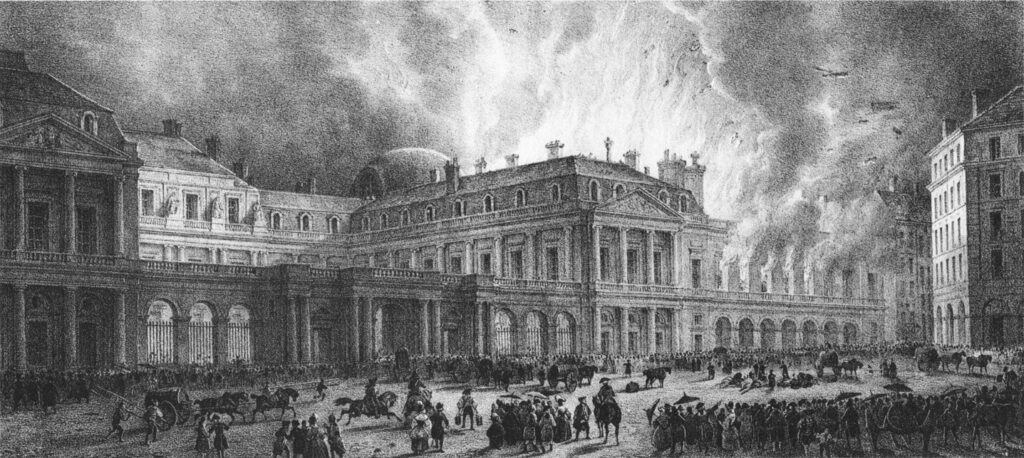
Fire of June 8, 1781
In 1784, another theater was built in its place, which is still in operation today.
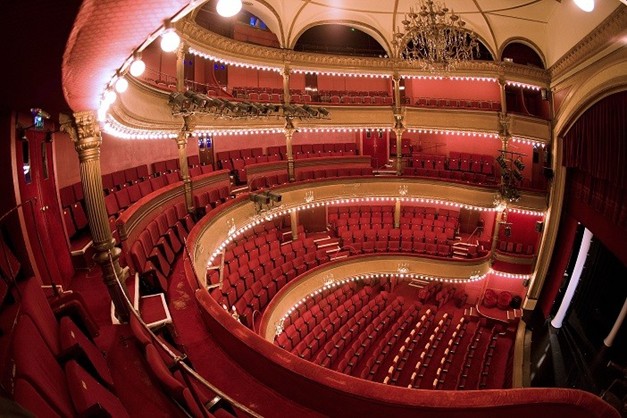
We now turn right through the Passage de Baujolais
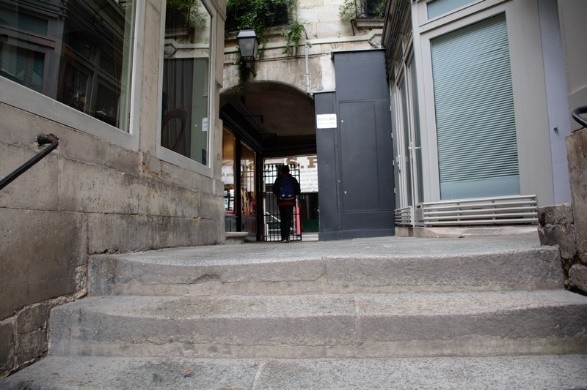
and arrive at the Rue de Richeleu. There we continue our journey in the next episode about the passages of Paris.
Arko Oderwald en Sofie Vandamme