In Paris, the Foundation for Literature and Medicine is offering two courses. Paris is so rich in medical-literary material that we can not only fill two courses, but also many episodes of this blog. The layout for this is somewhat arbitrary. We will focus on novels, medical and literary figures, and the many old hospitals that still stand in Paris and are still in use. Some of these hospitals are the setting for novels.
On the spot – Paris (2): The Catacombs
Please note: due to the Christmas holidays, the next episode will be in three weeks, on Saturday, January 10.
Address: Avenue du Colonel Henri Roi-Tanguy number 1
Visiting hours: except on Mondays, from 9:45 a.m. to 8:30 p.m.
How to get there: Metro 4, Denfert-Rochereau
Cost: approximately 30 euros
Highly recommended: buy your ticket online in advance, make sure you visit the correct website
Information: https://www.catacombes.paris.fr/
Tickets: www.billetterie-parismusees.paris.fr
NB: According to the website, closed for renovation until spring 2026.
This contribution is partly based on a previously written essay: Arko Oderwald. Arrête! C’est ici l’Empire de la Mort! About cemeteries, In: Arko Oderwald, Koos Neuvel, Willem van Tilburg, and Abel Thijs (eds.). The Last Word. Death in Fiction. Utrecht: De Tijdstroom, 2015. (The essay is in Dutch.)
Everywhere you can go above ground in Paris, you can also go underground. The first thing that comes to mind is, of course, the metro/RER network, but there are many more tunnels that can be walked through and crawled through. Handy during the war, as a place to hide or store weapons. A nice account of such an underground route in Paris can be found in:
In Paris, these tunnels were created, among other things, by excavating stone to build houses. And they also proved to be very useful in solving a serious health problem: that of cemeteries within the city walls.
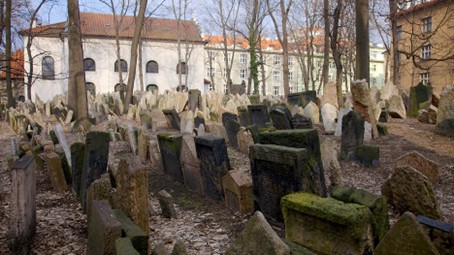
Contrary to what is said, the rich and the poor are also separated in death. Nowadays, even the poor can afford a headstone or an urn, although the mortuary of the Catholic cemeteries remains out of reach for them. But that headstone or urn is an improvement compared to the times before 1800. Although burials took place in the middle of the city, a simple hole in the ground was often sufficient. When it was full, earth was poured over the existing graves and new people were buried. And this continued for hundreds of years. This is the case, for example, with the famous Jewish cemetery in Prague.
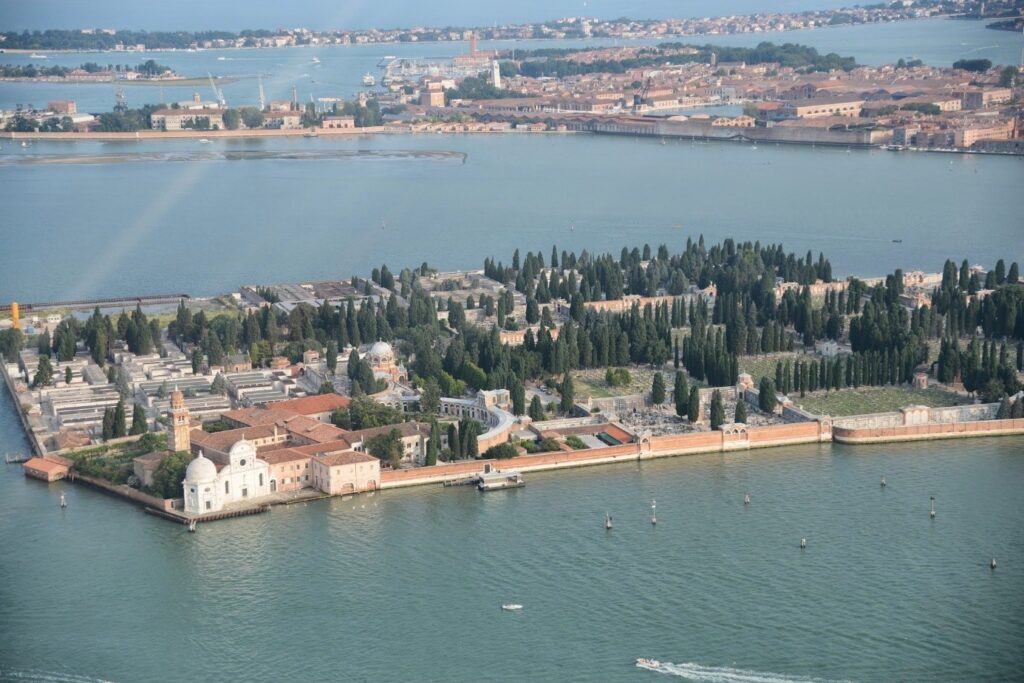
It is remarkable that this cemetery still exists, because around 1780, measures were taken throughout Europe not only to ban burials in cities, but also to clear existing cemeteries. Some of today’s cemeteries have their origins in this, such as the San Michele cemetery on an isolated island in Venice, where Joseph Brodsky, Ezra Pound, Igor Stravinsky, Sergei Diaghilev, and Tine, the first wife of Eduard Douwes Dekker, a famous Dutch writer called Multatuli, are buried.
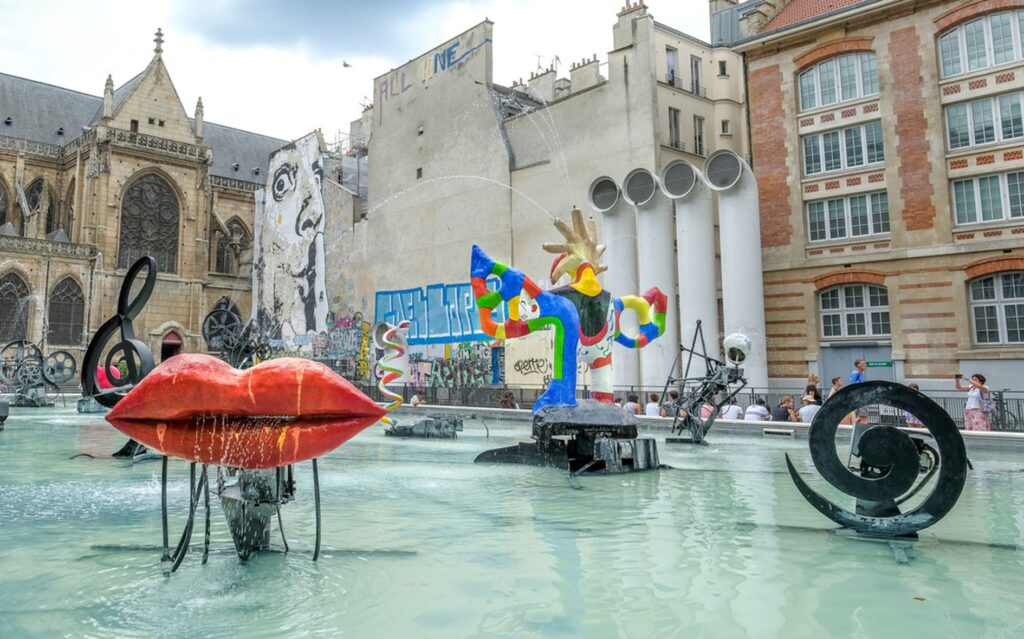
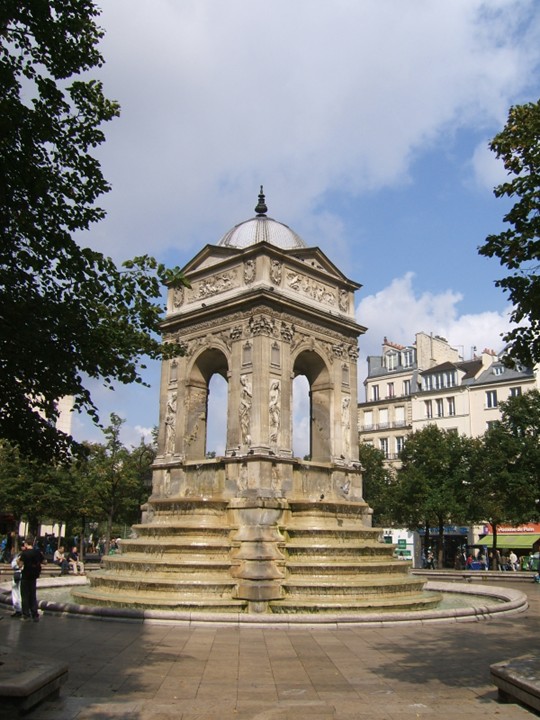
The reason for these clearances was that these uncontrolled cemeteries had become a threat to public health. In Paris, just before the French Revolution, the decision was made that most cemeteries in Paris had to be cleared. One of the largest cemeteries was Le Cimetière des Innocents, near the Saint Eustache church, which is close to the former Halles. If you stand on the square in front of the Centre Pompidou with the Centre on your left, walk straight ahead, past the Fontaine Stravinsky, the 1983 artwork by Ives Tanguely and Nikki de Saint Phalle,
you will arrive at the Fontaine des Innocents. This is where the cemetery used to be.
For longer than anyone can remember, this cemetery absorbed the corpses of Paris. Even in ancient times, when the city consisted of little more than the islands. At that time, the situation was probably quite acceptable. A piece of land with little or nothing around it. But the city grew. The city enclosed that piece of land. A church was built on it. And walls around the cemetery. And around those walls: houses, shops, taverns. All of life. The cemetery became well-known, famous, a place of pilgrimage. The mother church made a fortune from burial rights. So much for a place inside the church. A little less for a place in the colonnades outside. The pits were free, of course. You can’t ask someone to pay to have their remains stacked on top of others, like a slice of bacon.
I have been told that during one outbreak of the plague, fifty thousand bodies were buried at Les Innocents in less than a month. And so it continued, corpse upon corpse, the hearses lined up in the Rue Saint-Denis. Even at night, burials took place by torchlight. One corpse on top of another. A number that defies estimation. Legions packed into a piece of land no bigger than a potato field. Yet no one seemed to mind. There were no protests, no one expressed their disgust. Perhaps it even seemed normal. And then, about a generation ago, the first complaints began. Some people who lived near the cemetery began to find its proximity unpleasant. Food spoiled quickly. Candles went out, as if they were being snuffed out by invisible fingers. People fainted when they walked down the stairs in the morning. And there were moral excesses, especially among the young. Young men and women who had led blameless lives until then…
When the decision was made in 1785 to clear this cemetery of poor stinkers, it had already been in use for more than ten centuries. Sometimes, as it turned out later, there were more than 22 meters of corpses piled on top of each other.
Andrew Miller writes about this period in his novel Pure, in which we are transported into the mind of engineer Jean Baptiste Baratte, who is hired by a minister of Louis XVI to carry out the clearance work. It is this minister who speaks in the above quote from the novel.

Andrew Miller previously wrote Ingenious Pain about a doctor who cannot feel pain, set in England at around the same time. He is well versed in the eighteenth century, and so the reader is effectively immersed in the pervasive stench of the cemetery, where Flemish miners have been hired by the young engineer to do the job.
This is no easy task, as it turns out. There is the confrontation with the thought that these were all once living people:
Jean-Baptiste prefers to forget that bones have owners, names. If he has to treat them as former people, farriers, mothers, perhaps even former engineers, how will he ever dare to stick a spa in the ground and separate a foot from a leg, a head from its neck, for the rest of time?
Even more pervasive are the noxious fumes that rise from and into the excavation pits, which are sometimes 22 meters deep.
At certain moments, the men—all the men—seem to be overwhelmed by waves of disgust. With their eyes closed, they stand trembling, hesitating, then one spits into his fist, lets a boot or clog fall more resolutely onto the blade of a pickaxe, and the rhythm is restored. By the time the city bells strike four, the light disappears and the men, whose bowed heads now disappear below ground level, have been transformed from above into mining shadows. Torches are stuck into the walls of the pit. Now it is truly a spectacle: a group of men in a red hole, prying bones from under their feet. The wall of bones runs the entire length of one side of the pit and reaches shoulder height. The last hour feels like a day in itself. Jean-Baptiste holds the cognac bottle in the grass beside him. At intervals—intervals that are getting shorter and shorter—he passes it down, watches it go from one to another, and gets the lighter bottle back in his hands. At a quarter to six, he calls it a day. He knows he will have to demand that they work through the night later, but not now. He couldn’t do it himself; he can’t ask them to.
It is therefore not surprising that some of the men fall ill. Fortunately, there are also a number of curious doctors involved in this work. One of them is the then unknown young doctor Guillotin, indeed, the inventor of the Guillotine.
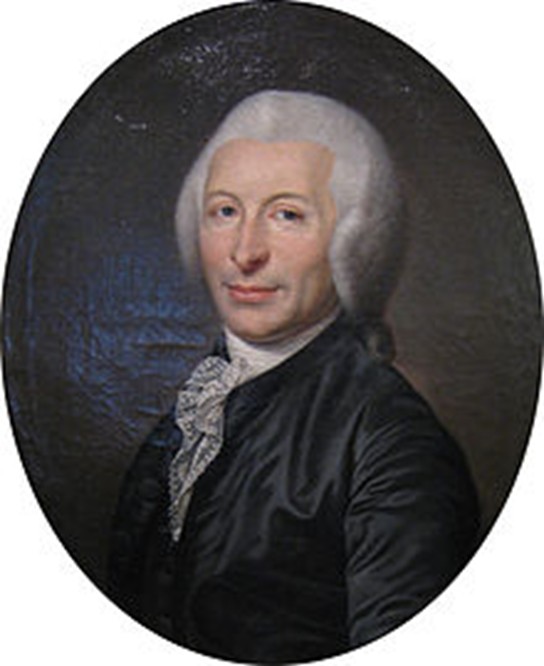
In this novel, he comes across as a very humane doctor, who, although primarily interested in what the excavated bones can teach him, also assists the living with advice and practical help.
Guillotin steps closer. He looks, but like most of his colleagues, he is reluctant to touch anyone. He nods: “You may pull down his shirt. Thank you, Monsieur Block. We will find something to help you, all right?”
When they are a few steps away from the tent, the doctor says: “He has been poisoned by something that entered his body when he fell. The wounds must be cleaned immediately with a sulfur solution. As for the fever, he should take cinchona bark powder dissolved in a little cognac. However, I am not in favor of suppressing the fever entirely. Fever is not the enemy. Fever is the fire in which the disease burns: He stops, looks sharply at Jean-Baptiste. “Even when we are in perfect health,” he says, “we are constantly being renewed by a heat that we ourselves generate. Are you familiar with the theory of phlogiston?”
‘I know something about it: ‘Phlogiston, from the Greek, “to set on fire.” The combustible element in all things. The latent fire. The potential fire. Passive until it is summoned.
‘Summoned by a spark?’
‘Or by a shock or friction. Or simply a gradual increase in heat.
“Is it possible that Block’s infection was caused by a disease that has persisted in the bones?” asks Jean-Baptiste. “That the bones still carry a residue of the diseases they once suffered from? I mean, that the people to whom they once belonged suffered from?”
“What an unusual suggestion,” says Guillotin. “You speak as if our bones are mere possessions, like a horse or a watch. But to answer your question, I consider it unlikely that a disease would survive its victim for so long. On the other hand, I would advise you and your men not to bring the bones into contact with open sores or wounds. As a general disinfectant, I recommend vinegar. And purified alcohol. Ethanol. Very effective. Although you must be careful where you store it. A powerful drink. Also highly flammable. Even the vapor. Especially the vapor.
Jean-Baptiste asks whether it would be better to take the patient to a hospital.
The doctor flares his nostrils. “Hospitals are very dangerous places. Especially for someone who is already weakened by illness.”
The bones that are unearthed during this work are then taken at night, accompanied by priests, in carts across the Pont Neuf to quarries on the south side of the Seine to be piled up. This is when all those corridors come in handy. Now, almost 250 years later, the result of this can still be visited in Paris. The entrance to these Parisian catacombs with their extensive walls of skeletons is located at 1 Avenue du Colonel Henri Roi-Tanguy and is open from 09.45 a.m. to 8.30 p.m., except on Mondays.
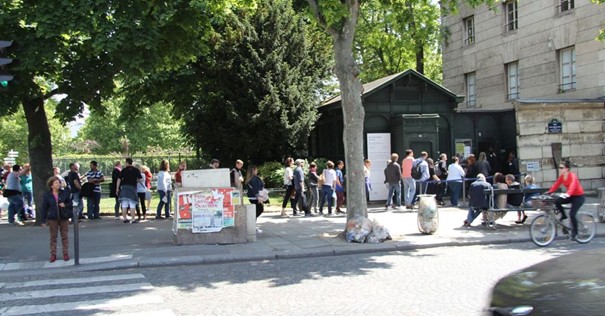
Not that it’s easy if you haven’t bought a ticket online in advance. And that’s not easy either, because it’s only possible a week in advance. The entrance is in an inconspicuous building in the middle of a round square, surrounded on all sides by speeding cars. Upon arrival, you see the line of people without tickets. If you don’t have a ticket, you are asked to join the circular line. It takes two hours to get back to the entrance. What strikes you most as you shuffle along is the relatively large number of children under the age of ten. What edifying message do their parents hope to impart to these children down there?
Once inside, you descend 25 meters via a spiral staircase. This is followed by a long walk through low corridors, with the children in front of and behind me chattering away. But then we arrive: “Arrête! C’est ici l’Empire de la Mort’, it says above the entrance gate.
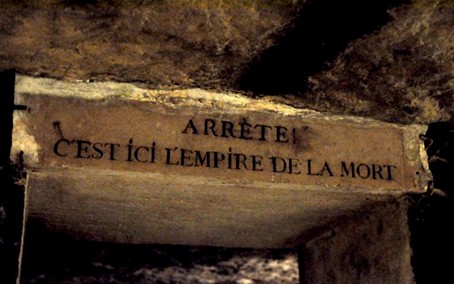
But of course, no one stops. I don’t think most of the people around me can read French anyway. Then follows a winding walk through seemingly endless corridors and rooms filled with bones and skulls, neatly stacked along the walls.
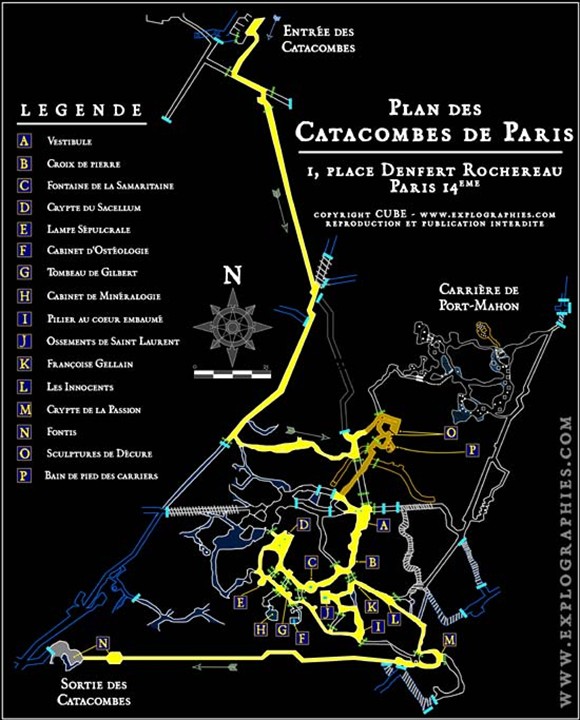
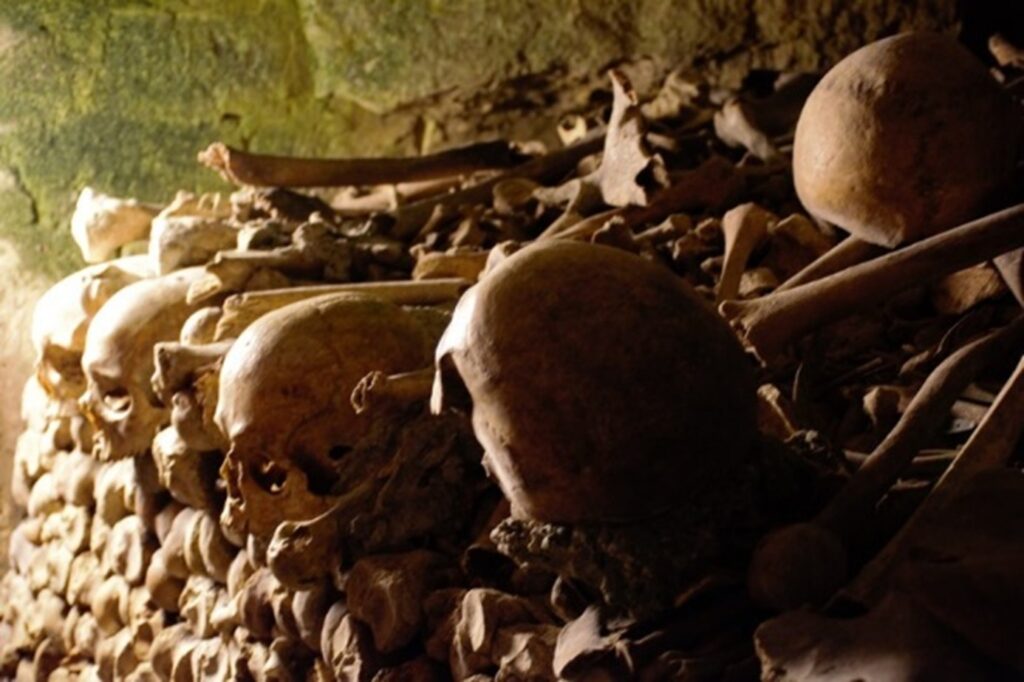
The chatter stops. There is also a sign saying that these must be the bones from Cemetière de L’Innocents. We trust it.
Since then, more cemeteries have been emptied and brought here. I saw signs mentioning 1859. The bones of L’Innocents are only a fraction of the total. And not just of the total of what you get to see, because there are many more corridors that are not accessible. There is also an underground chapel and a water basin.
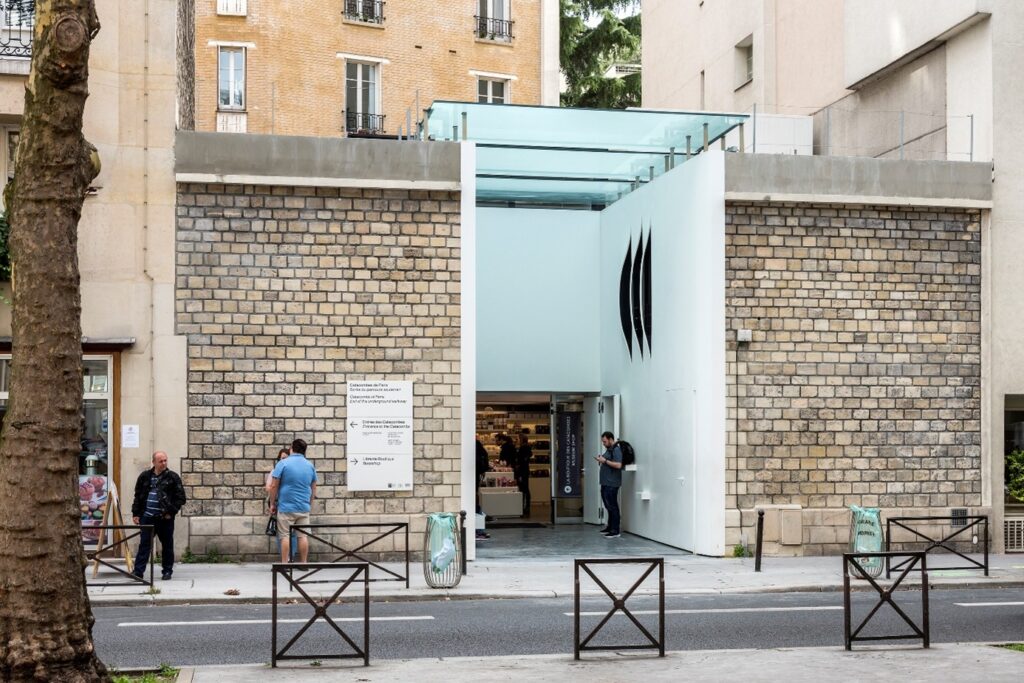
Three quarters of an hour later, I climb back up the same kind of spiral staircase and emerge in a neat street, the Rue Rémy Dumoncel. Rémy died as a member of the resistance in 1945, I read on the street sign. No coincidence, I think, because the catacombs were used by the resistance at that time. It is, in the middle of the usual souvenir shop, this time with skeletons, a strange exit from the strangest and most impressive cemetery I have ever seen.
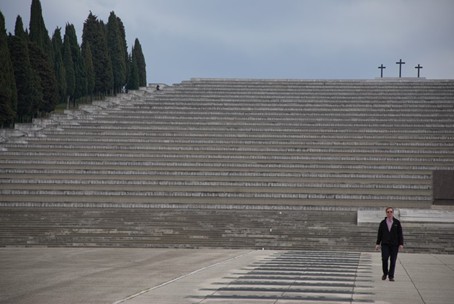
The Zentralfriedhof in Vienna, also the result of the relocation of bones, may be much larger, but it does not match this underground ossuary in terms of the number of people buried there. Mussolini’s First World War memorial, Sacrario di Redipuglia, also does not match these catacombs in terms of numbers.
But it is not the number that colors my experience the most. Finally, I see here what all our cemeteries try to hide: here, in death, everyone is equal. Except for the rich stinkers, of course.