This episode features three films. Second Victims is about how a doctor can become the “second victim” after making a medical error, Die My Love is about a young woman who loses her mind after the birth of her child, and On Vous Croit is about how child abuse disrupts lives.
Final editing/correction: Cathri van de Haar
Film
Second Victims, in theaters starting December 4
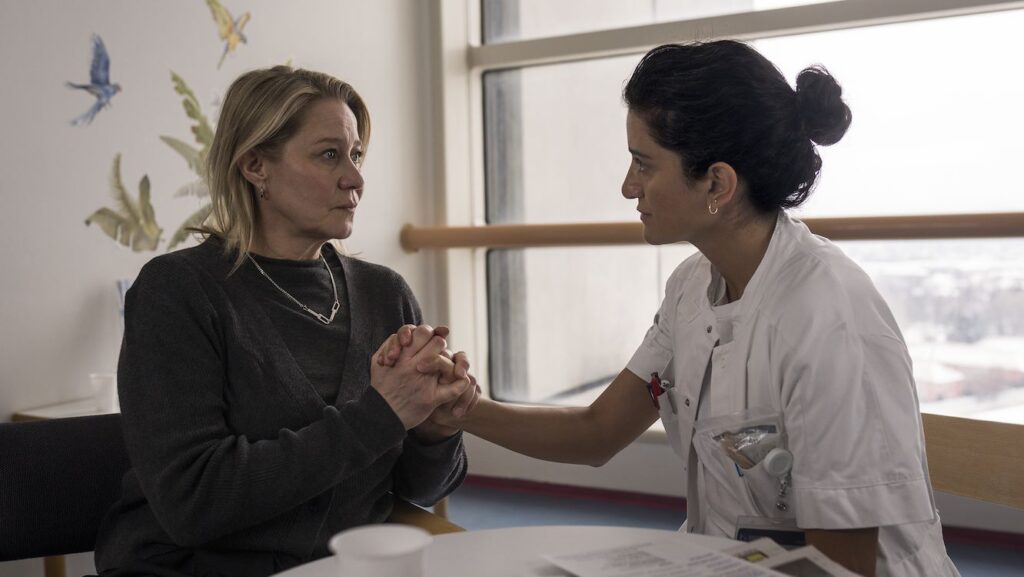
The second victim of a medical error
Every medical error affects at least two people: first and foremost, of course, the patient, but also the treating physician, now often referred to as the second victim. The phenomenon of the ‘second victim’ has been the subject of considerable scientific research, as evidenced by this article on the website of The British Medical Journal. Among other things, it examines the risk factors – often cited as systematic understaffing and time pressure – how to prevent it, and, above all, the impact on the healthcare provider.
Stroke
The Danish film Second Victims by Zinnini Elkington revolves around such a ‘second victim’. You could call it a case study. In the film, we follow neurologist Alexandra (shortened to Alex) in the same way as the stressed nurse in the recently discussed film Heldin. Like that nurse, Alex also has to juggle numerous tasks at the same time, especially now that a colleague is off sick and digital patient files are inaccessible due to an IT malfunction.
When an 18-year-old boy arrives at the emergency room with his mother, complaining of persistent, severe headaches, a nervous intern wants to have an MRI scan done, but Alex thinks that is completely unnecessary. She thinks it’s a hangover. But when the boy and his mother want to leave the hospital, he suffers what later turns out to be a life-threatening stroke. The subarachnoid hemorrhage cannot be coiled, according to the neurosurgeon. The boy is declared brain dead.
Growing doubt
The initially confident Alex becomes increasingly hesitant and doubtful as the hours pass, amid the chaos of colleagues, patients, and (difficult) family members who also demand her attention. Did she indeed overlook something when she made the diagnosis? Did she rely too much on her “gut feeling”? Was it tunnel vision? Was the intern (or resident) right? Did she give the parents false hope, as a colleague accuses her of doing? Did she prepare the parents in time for the possibility of organ donation? Is she – to use the big word – to blame for his death?
Second Victims does not provide clear-cut answers to these questions, which is precisely why it feels so realistic. The style—long takes, claustrophobic scenes—also reinforces the feeling of increasing stress, tension, and, above all, moral complexity.
Admittedly, the scenario is sometimes a bit schematic: opposite the 18-year-old boy is an older lady, also with a stroke, who recovers thanks to Alex’s adequate intervention (read: a thrombolysis). It’s as if the film wants to say, “She’s a professional; she’s quite capable.” And don’t be a medical nitpicker, something that doctors and other healthcare providers are sometimes prone to when it comes to these kinds of films. Because yes, we do witness an MRI being performed very quickly. Don’t be tempted to criticize those kinds of details, because this film is primarily about conveying an experience, about a case that aims to stir your emotions and your morals, possibly even your sense of ethics. How do you make decisions under high pressure, and what mistakes can lurk there? In conveying that, this film, which was shot in an actual hospital, is entirely successful.
Film
Die My Love, now in theaters and also available on picl.nl from February 12, 2026

The mental breakdown of a young mother
Ariana Harwicz’s novella Die, My Love is a stream of consciousness from a young mother struggling with postpartum depression and psychosis. That’s good to know, because it takes a while to realize that Lynn Ramsay’s film adaptation—Die My Love, without the comma—is exactly that, or at least wants to be. The focus is on Grace (convincingly played by Jennifer Lawrence), a new mother. She and her husband Jackson (Robert Pattinson) have moved into the house of his uncle, who committed suicide. Grace’s aspirations to write have been extinguished, as have Jackson’s ambitions to make it as a musician, it seems. As a construction worker, he is often away from home, while Grace spends her days in idleness, living in a mental prison, even though the endless landscape of Montana outside suggests the opposite, and longing for sex with Jackson. Her existence has degenerated into a sickly form of ennui. Jackson, meanwhile, is shocked by her behavior, but he doesn’t really help her. His character remains remarkably flat.
Through her labyrinthine montage of present, past, and delusions (a dark motorcyclist who occasionally appears, a dark horse), Ramsay makes us part of what is going on in Grace’s head and body. She is aided in this by the sophisticated music score, with predominantly existing, sometimes hard-hitting songs that underline, counteract, or anticipate delusions and feelings.
One thing is clear: Grace is losing touch with reality, and perhaps also with herself, although not with her baby, it seems. And as you watch, you wonder: is this an accurate portrayal of postnatal depression? Is it really? Because at times, the film resembles a grotesque mood board of how you might depict mental breakdown as a result of the constraints of motherhood. On the other hand, that could indeed be how it goes.
Film
On vous croit, now in theaters and available on picl.nl
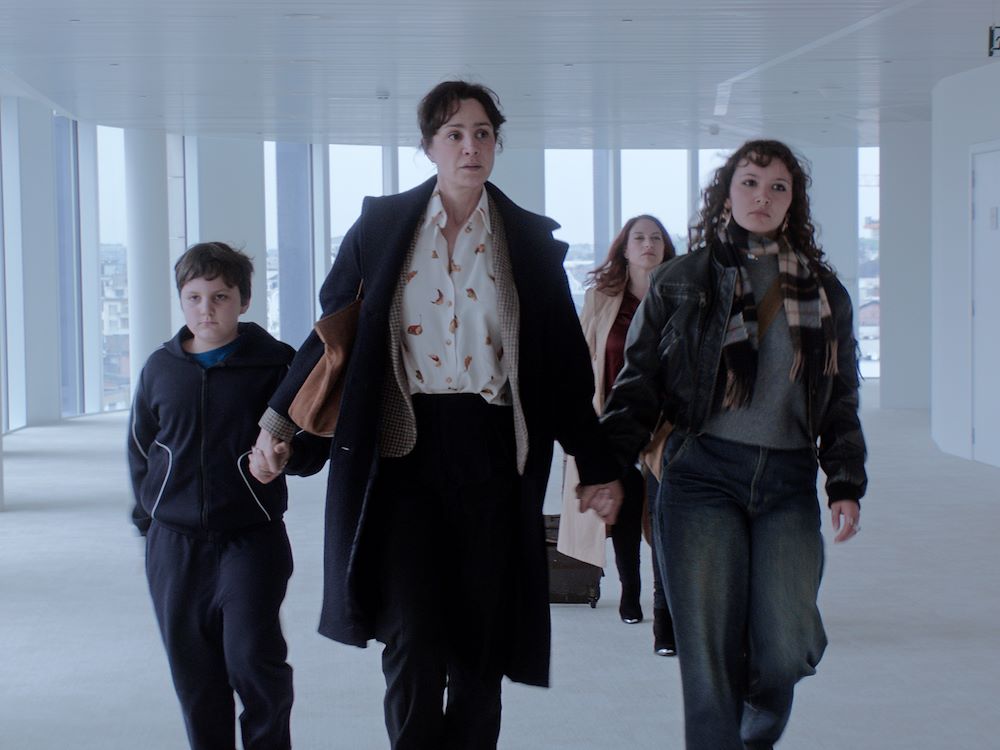
Trauma after abuse
On vous croit, the directorial debut of Walloon filmmakers Charlotte Devillers and Arnaud Dufeys, is a soberly staged film about two divorced parents fighting for custody of their two children. The story is told from the perspective of mother Alice, who fights like a lioness for the safety of Etienne (10) and Lila (17). Etienne suffers from encopresis and is visibly traumatized; according to Alice, he has been abused by her ex. But he denies this and says that he has not seen his children for two years because of his ex-partner, who he believes is wrongfully slandering him.
Court case
One of the film’s most powerful choices is the decision to show the nearly hour-long court hearing in real time. This proves very effective: the camera stays close to the action, in intense close-ups, with the filmmakers focusing primarily on the reactions to what others, often off-screen, are saying. The tension is created not by action, but by words, glances, and the unbearable uncertainty that hangs in the courtroom.
The script clearly benefits from Devillers’ professional background: she previously worked in the care of victims of sexual violence. This realism contributes to the credibility of the characters and the nuance of the situation. What also helps is that the film mixes professional actors with people playing themselves.
Voice of the child
Devillers and Dufeys emphasize that it was never their intention to tell a story about guilt or innocence. They are concerned with the more serious question: is it worse to be mistaken about an adult’s guilt or to expose a child to a potentially much greater danger? On vous croit invites the viewer to explore that moral gray area. According to both of them, the title of the film reflects that vision: adults have a responsibility to take children seriously, to listen to their voices, and to protect them.
The film places all this in a broader context and shows that, according to the World Health Organization, 24% of girls and 11% of boys worldwide are affected by incest. Only a fraction report it, and even fewer ever receive justice. This makes On vous croit a must-see for any healthcare provider who deals with child abuse and its consequences.
Henk Maassen