This time, the lives of two patients: the novel Il male che non c’`e, (The Evil That Is Not There) is about a young hypochondriac, the film Nino is about a young man of almost the same age who is suddenly diagnosed with throat cancer.
Novel
Il male che non c’`e, (The Evil That Is Not There) Giulia Caminito,

The hypochondriac suffering of a misfit
The life of 30-year-old Loris is at a standstill, and the novel about that life, Il male che non c’`e, (The Evil That Is Not There) by Giulia Caminito, is therefore also at a standstill. Describing such a status quo is no easy task, as boredom is always lurking, but the Italian author gets away with it thanks to her great talent for style and, above all, composition. She portrays Loris as an insecure, fragile young man who is convinced that he is suffering from a physical illness, even though doctors believe he is in perfect health. Loris entrenches himself in his suffering, and more literally in his apartment, at work, and later even in his parents’ house. They do not understand him: they expect achievements from him—especially his father—while his mother is too indulgent. Loris doesn’t go to the gym, doesn’t take care of himself, has no friends, and regularly calls in sick at the small publishing house where he has a poorly paid internship. Jo, his girlfriend, is his opposite in every way: a doer, athletic, and energetic. You wonder what she still sees in him—in fact, their relationship has also come to a standstill.
According to Loris, there are people who take action and don’t let the world scare them, and people like him who are ready to throw in the towel at any moment. “And it’s awful to be part of that second category, to know it, but have no idea how to get to the other side (…).” He’s not shy: when he has to, he can be brutally assertive. But it doesn’t help him come out of his shell, or rather, out of his suffering.
Alert
Because part of his brain is constantly alert, drawing attention to every tiny change or disturbance in his physical well-being, and then magnifying it to such an extent that he eventually gives in to it, even at work. After which he eagerly searches the web for information, videos, and painful images of all his supposed ailments: “One video automatically leads to another and then another and so on, until at some point the algorithm only shows him people with strange, rare skin diseases, live streams of operations in hospitals, farewell videos of cancer patients. Every click brings a new horror, every horror a new click.”
Visiting doctors has a numbing effect on him. “As long as he is there,” he thinks, “nothing can happen to him. As long as he is in the hands of a white coat, his life is not in question. If he does collapse, someone will immediately take care of him. Help will be there right away, in the blink of an eye.” But doctors find no cancer, no infections, no stomach ulcers, no allergy to lactose or gluten – to his dismay, he is simply not sick at all.
Corpus alienum
Caminito proves herself a master at describing Loris’ hypochondria. The opening of her novel immediately sets the tone in this regard. It feels as if a corpus alienum has taken possession of Loris: ‘The pain is like an egg with a hard shell, you feel that you have swallowed it and that it is looking for a way down – throat, oesophagus, stomach – finding a place to settle and not caring about the day or the moment, wanting to make itself heard at any time. The pain is oval, made of concrete, it is unimaginable that it exists and takes up space. The pain is there and presses, presses and becomes a lump, a hard clot, you can feel it under your skin, until the shell cracks and something emerges. No traces of egg yolk, no slippery egg white, but a small, pale creature—a tadpole—that swims around and is unstoppable, that pulls through your body from your shoulder blades to your heels.
Caminito’s empathetic mastery must have something to do with her own self. In interviews, she has said that for years she has had a problem with her body ‘in terms of perception and imagination’. That it seems as if she can never interpret herself correctly, and ‘reads’ major, incurable problems between the lines of minor symptoms. She therefore, in her own words, searched in her novel for “a new vocabulary, full of precise words that, like a scalpel, could isolate parts of the body—to give voice to tendons and small bones that are part of us, but which remain strange and unknowable to us.”
Catastrophe
Guiding Loris’ hypochondria is an imaginary figure he calls Catastrophe: a demonic girl who appears in different guises and outfits. She gives voice to his deepest fears; she is a nightmare, but also an erotic fantasy, a source of support, a friend. She follows him everywhere, embodies what he does not dare to say to others, and often abruptly interrupts his actions and thoughts. She is the bringer of his physical pain, the personification of his somatization. Thus, Catastrophe points out—at different moments in his life—parts of his body that he must pay attention to and fixate on.
Reading
There is a remedy: reading. Loris has always read compulsively; as a child, his parents even consulted a psychologist about it. He reads to escape, to numb himself, and to shut himself off. He finds refuge in books, or more generally in texts; it is not for nothing that he has made it his work, or at least tries to. The sicker he feels, the more and more intensely he reads: ‘For years he managed to control this unhealthy relationship with books, but now that he feels more lost than ever, now that his work worries him, now that Jo is far away, now that his body is ready to suffer from any ailment, now his need for words has returned. (….) However, his reading time can turn into a difficult-to-control disorder, into a malicious metronome, a pointer from right to left, from left to right.“ Reading thus becomes a symptom of his ”illness.”
Idyll
Twenty years earlier, things were different. In his childhood, Loris spent many weekends and summers with his grandfather Tempesta. This was an important episode in his life and, in fact, the second storyline in the novel. The time with his grandfather was idyllic: ‘When he returned to school in September, he often tried to tell his classmates what he had learned from Tempesta, about the rats they had seen running through the basement, about the cockroaches with their bellies up (…), but no one showed any interest in that world, that reality he loved so much. They all thought only of the cartoons on TV, the Game Boys, games in which you could shoot, but not for real, and in which people died in moats without even screaming.”
Traumas
As the novel progresses, the alternation between Loris’ past and present becomes more intense, and little by little the traumas of his life fall into place, until an image emerges that the reader must piece together for themselves. The core, I think: Loris is a man who has fed on fiction his entire life, and that has turned into a narrative in which he is the only one who suffers, the only one who is unable to remain within the narrow confines of society. He is, deeply and very differently from Jo, unzeitgemäß, he does not fit into this era. Quote: “He is crazy, he sees ghosts, he is someone who more often provokes hilarity than concern or pity, causes resentment; he has achieved nothing, he is suffocating with privileges he does not use, he is a whiner, a pain in the ass, they would like nothing more than to rub his nose in the real evil, to show him the real pain instead of his little plays, his cries of ‘help, help, a wolf, a wolf’ when there is never a wolf to be seen, he would only have to open his cell phone to be immersed in the big bad world, with its wars and deep wounds, its destroyed roads and factory-gray skies, its earthquakes and floods, the dust that settles after a collapse and a bomb that explodes in a market square. But he doesn’t. He is a misfit, an escapist; he has escaped ‘his’ time.
Mirror
Will Loris be all right? I don’t know: there is much to be said about the interpretation and the surprising, brief change of perspective at the end of the novel. It is as if Caminito is looking in the mirror for a moment. In this context, those who wish to can also search for the meaning of the unemphatic, sometimes contrarian Christian symbolism: doves, a lamb, the Dies Irae. But whatever the case, her novel convincingly shows that suffering cannot always be “explained” medically.
Film
Nino, now in theaters
Throat cancer: the shock of the diagnosis
He goes to the doctor for a sick note because of his persistent sore throat, but it is immediately clear that an administrative error has been made, as a complete medical process has already been set in motion for him. Nino, just 28, is stunned: his doctor assumes that he is already aware of the seriousness of his condition. It is a painful scene at the beginning of Nino, Pauline Loquès’ highly successful feature film debut. Nino has throat cancer, caused by HPV. Quick action is required. It is now Friday, and he is asked to report on Monday for the start of six chemotherapy sessions and twelve radiotherapy sessions. And oh yes, would he perhaps like to have his sperm frozen quickly, because infertility is a likely side effect.
Keys
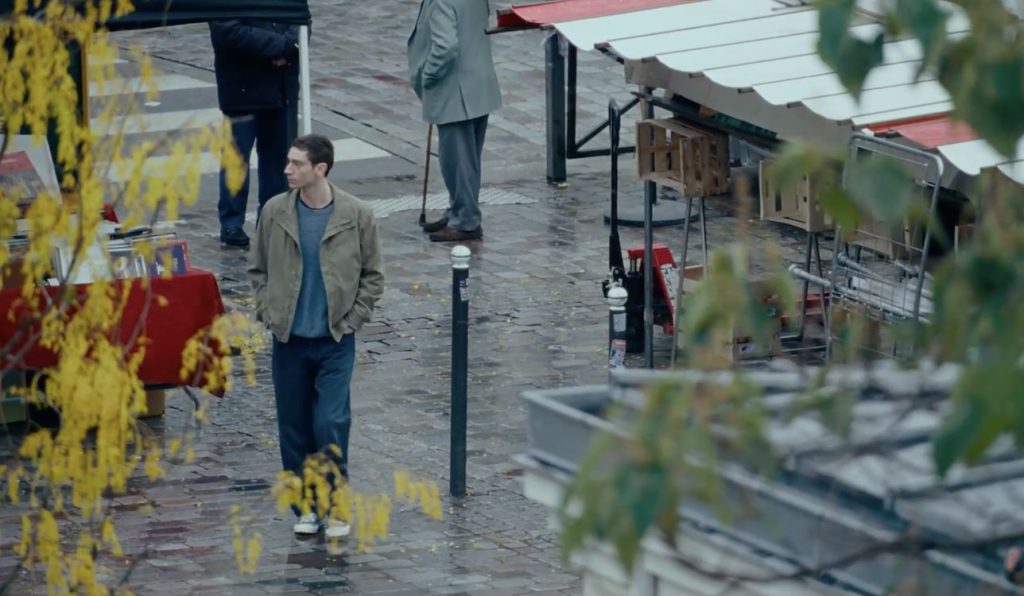
To make matters worse, Nino has also lost the keys to his apartment. The concierge won’t open the door, so he embarks on a journey through Paris, which is very reminiscent of Agnes Varda’s 1962 classic Cléo de 5 à 7, with the difference that the main character in that film only wanders through Paris for two hours, awaiting a potentially serious diagnosis. Nino keeps this up for an entire weekend. And just like Cléo, he meets various people from his circle: a former classmate with a child, his mother, an ex, a friend who organizes a party for him because it’s Nino’s birthday that weekend. The handheld camera follows Nino, observing him closely as he walks and cycles through Paris, until he reports to the hospital early on Monday morning (you’ll have to see for yourself why so early).
Communication
He tries to share his devastating news with his friends, but communication breaks down time and time again, causing them to misunderstand his message and give him all kinds of advice that makes no sense. It is precisely this that gives this film, despite all its tragedy, a strangely light-hearted tone, as, once again, Cléo de 5 à 7 had. As if it were a comedy of errors. The highlight is the scene in which Nino tries to explain to his mother what is wrong with him. He stammers and speaks so vaguely that she assumes he is ‘in transition’, which she says she has no problem with. Nino, who is no stranger to bottling things up, denies this: he is depressed. His mother believes him.
And, as a final similarity, just like Varda’s film, in which numerous well-known figures from French cinema of the day made cameo appearances, Nino also has such an appearance: in the bathhouse where he goes to shower, he meets a nice, somewhat older man. We recognize the French star Mathieu Amalric. It is a beautiful scene, especially because of the photo of his deceased wife that Amalric shows Nino: we recognize another film star from earlier times: Romy Schneider (1938-1982).
Support
Nino is a beautiful, accurate, and truthful film about how a well-balanced young man deals with sudden bad medical news and—ultimately—is supported by those around him, a film that never sensationalizes the drama. Canadian actor Théodore Pellerin excels in the lead role and received the Rising Star Award at the Cannes Film Festival for his performance. The closing song by the band Fontaines DC underscores the basic feeling of the film: In the modern world/I don’t feel/No, I don’t feel/I don’t feel bad.