On the spot – Saint Rémy de Provence – Vincent van Gogh (2)
Maison de Santé Saint Paul
How to get there: About a 20-minute walk from the center or 5 minutes by car
Cost: 9 euros
Here is the pdf
After Vincent van Gogh suffered attacks in Arles that he believed to be epilepsy, he voluntarily admitted himself to Maison de Santé Saint Paul in Saint Rémy de Provence, a psychiatric institution. He remained there for a year, from May 1889 to May 1890. In terms of his condition, it was not his best year, but at the same time it was one of his most productive years. Here he made more than 150 paintings. The exact number of pencil and chalk drawings, as well as his watercolor paintings, is unknown, but there are still about 130 known. He felt comfortable in the institution at first. On May 9, 1889, just a few days after his arrival, he wrote to his brother Theo:
I wanted to tell you that I believe I did well to come here, first of all because now that I see the reality of the lives of all kinds of madmen and fools in this menagerie, I am losing my vague fear and anxiety about it. And gradually I am coming to regard insanity as an illness like any other. Furthermore, I think the change of environment is doing me good.
As far as I know, the doctor here is inclined to consider what I had as an epileptic seizure. But I haven’t asked him about it.
Saint Rémy de Provence is a small town with (according to Wikipedia) 9,547 inhabitants. That is about 40% of the village where one of us lives, but there are significant differences. That village has perhaps six restaurants and as many cafés. Saint Rémy has five times as many; it is full of restaurants and cafés with their terraces. And it is not deserted in the evening like our village, but Saint Rémy attracts quite a lot of tourism at the end of July, when we are here. My village is dead quiet during the holidays, precisely because of those holidays.
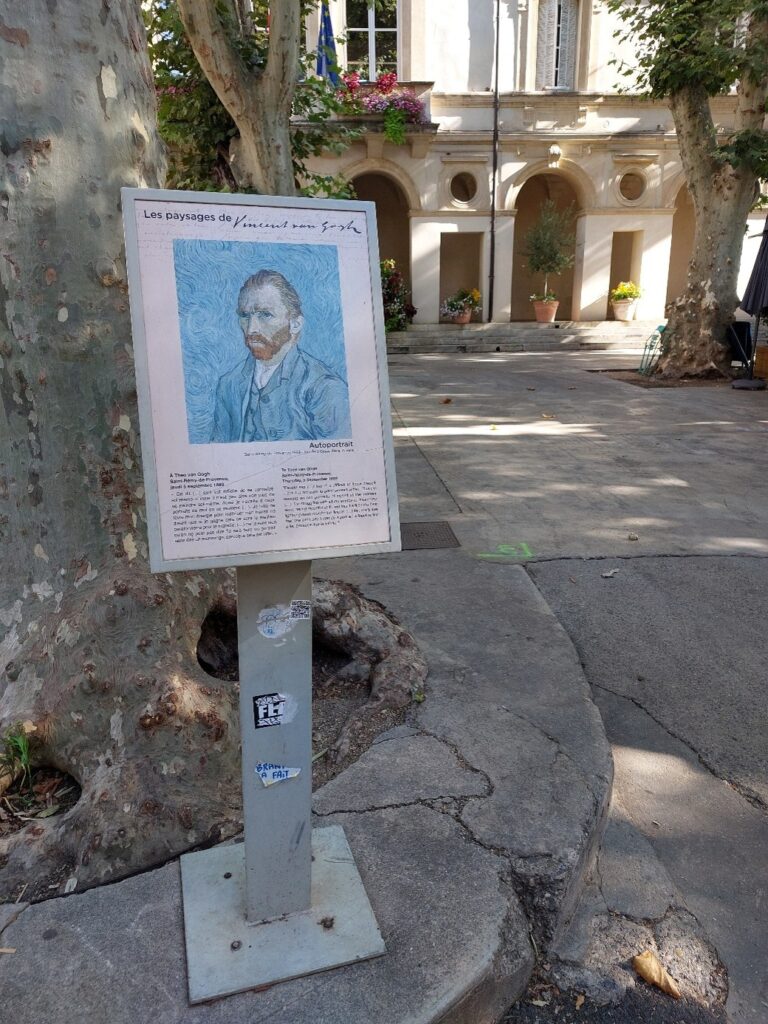
Saint Rémy has also been affected by the Van Gogh virus, with signs displaying his paintings in the center.
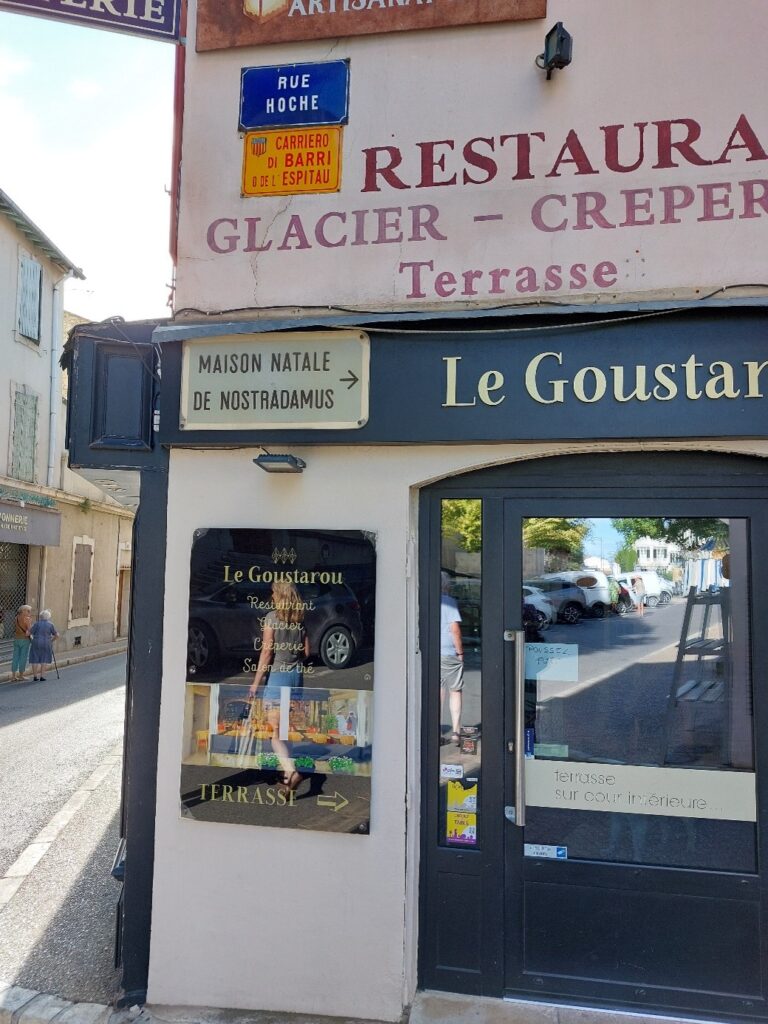
However, Saint Rémy is also known because Nostradamus was born here in 1503. Nostradamus, a pharmacist, fits well into our era of fake news, which he spread as an astrologer.
But we are here for Vincent van Gogh. A straight road from the city leads to the psychiatric institution outside the city, which still exists today. La Maison de Santé St Paul is now divided into the institution itself and a museum section dedicated to Vincent van Gogh.
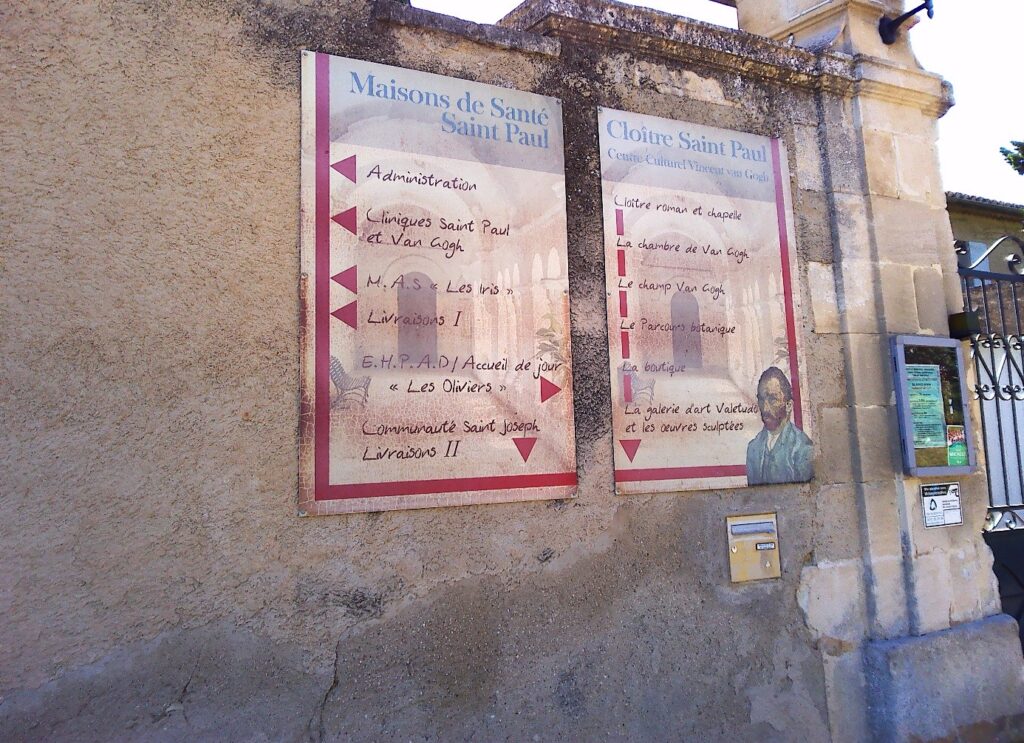
It is quiet when we arrive. We walk down an avenue with walls on the left and right, displaying photos of paintings that van Gogh made here, including the world-famous blue irises. We suspect that behind the walls are the gardens where van Gogh found inspiration.

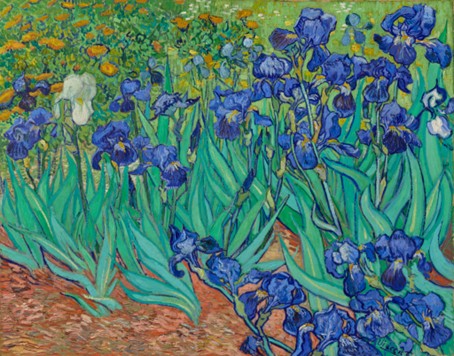
Irises. Oil on canvas. 71.0 x 93.0 cm. Saint-Rémy: May, 1889. Los Angeles: Getty Center
We are truly surrounded by the sound of crickets. Vincent had already noticed the cicadas. On July 18, 1888, he wrote to Theo from Arles:
The cicadas—not like ours, but like this one
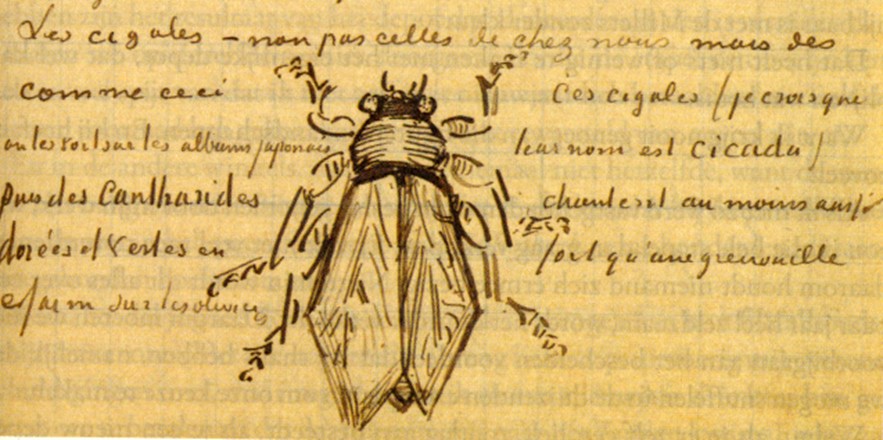
you see in Japanese albums. Also Spanish flies, gold and green, swarming in the olive trees. These cicadas (I believe they are called cicadas) sing at least as loudly as a frog.
But to our right, behind the wall, we also hear a completely different sound, a rather bloodcurdling scream. This takes us back 136 years in time. In the same letter of May 9, 1889, Vincent writes to Jo, his brother’s wife:
Although there are some very seriously ill people here, the fear and horror I used to have for madness has greatly diminished.
And although you constantly hear terrible screaming and shrieking here, like animals in a zoo, the people here know each other very well despite this
and help each other when they have an attack. When I work in the garden, they all come to watch and I assure you that they show more modesty and politeness in leaving me alone than, for example, the good citizens of Arles.
Later, through a small window on the first floor, we can see part of the walled garden, which is part of the still-existing clinic and is closed to us. We see someone standing and walking who, to the trained eye, clearly has a lot of neuroleptics in his body.
Before entering this building with the window, we saw a statue of Joseph Thoret, one of the founders of paragliding in the early 20th century, as well as a sculptor and poet. He died in Saint Rémy de Provence, but it is unclear whether he was also a resident of the institution. Probably not, because after 1910, no more men were admitted here.
We enter the building. It is a former monastery, founded in 1082. It has long been used as an institution for mental illness. Before the French Revolution, Franciscan monks cared for what we would now call psychiatric patients. In 1807, Dr. Mercurin started a psychiatric practice there. In 1855, the prefect of Bouches-du-Rhone decided that the monastery would be used to care for 50 men and 50 women who were Aliénés.

Advertisement from 1875
The sisters of Saint Jean de Vesseaux ran this institution until 2017, after which it was taken over by the Association Vivre et Devenir.
We turn right and pass through the sisters’ dining room and then into the kitchen, which was renovated for a film. An appropriate film, namely Camille Claudel 1915 from 2012. Camille Claudel, the sculptor, spent 40 years of her life in a psychiatric institution. However, it was not here. This building, including its residents, was used for the film. Unlike Vincent van Gogh, Camille Claudel was not satisfied with her forced stay in the institution. The film portrays her as the only normal person among complete imbeciles, which is not very convincing.
There is another reason why this film is appropriate. In the film, we are clearly in the women’s ward, which is what this part of the building is, the original women’s ward. It is important to realize that van Gogh probably never set foot here.
Then we go up the stairs and turn left to find the rooms of van Gogh’s attending physician, Peyron, and the head nurse, Sister Epiphane.
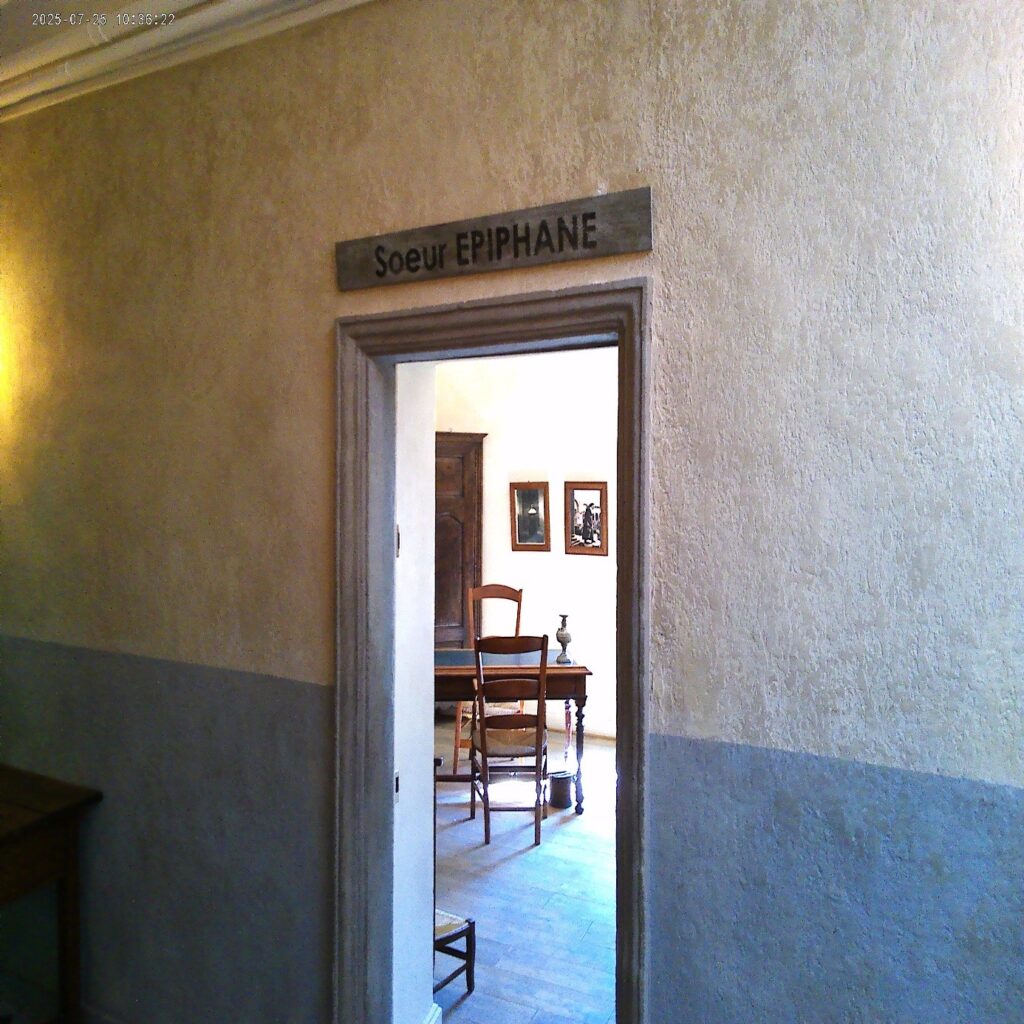
Then we come to the room of a second doctor, a certain Dr. Schweitzer. Schweitzer? Indeed: Albert Schweitzer was interned here at the end of the First World War. Schweitzer was born in Kaysersberg, now French (Alsace) but then German. Did he also work here as a doctor? The room suggests so, but we don’t know. Official information is vague on this point. It is probably made up.
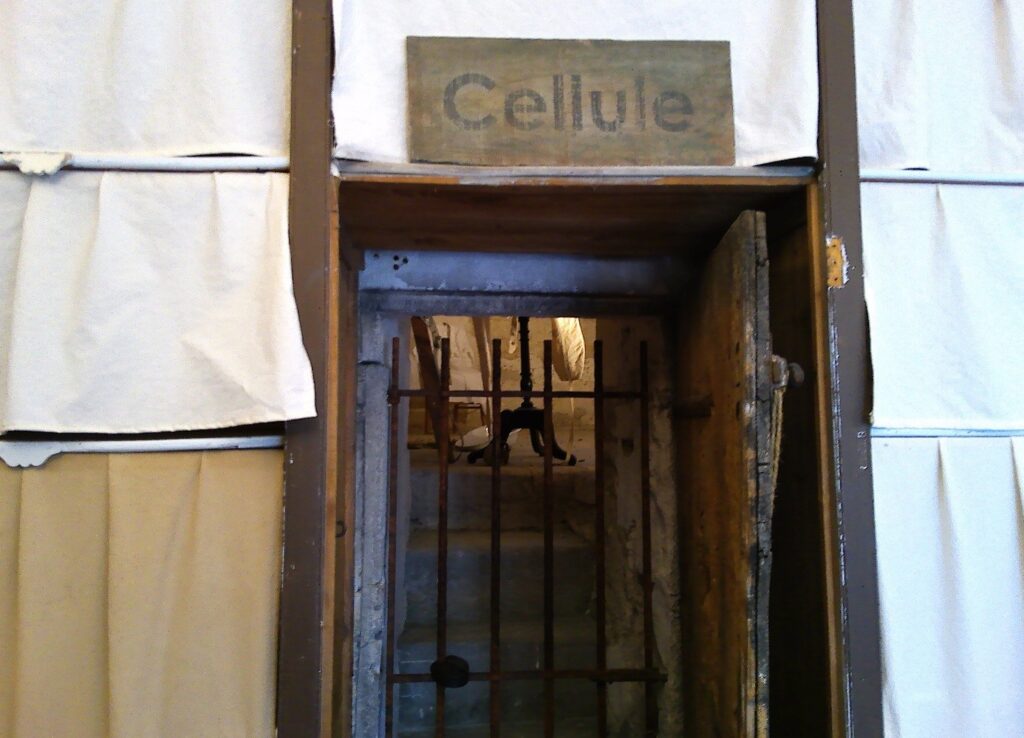
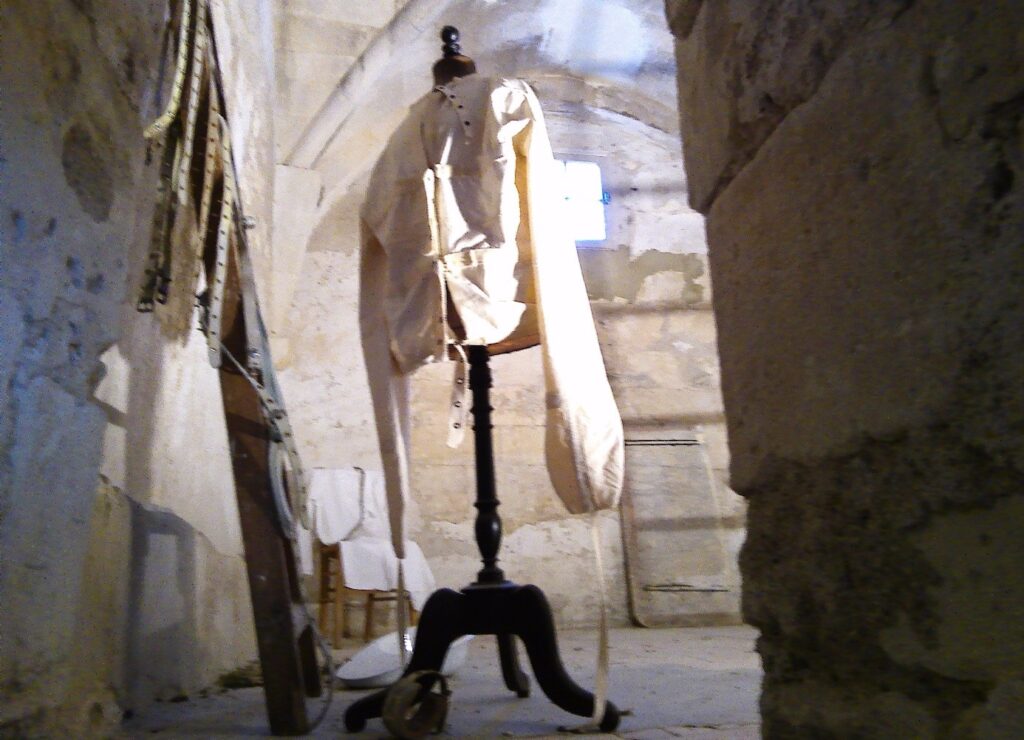
Next comes a corridor with pharmacy cabinets and the isolation cell with the inevitable straitjacket.
And finally, we arrive at the bathroom. Vincent writes that he takes a bath twice a week for two hours and that it does him good. In this case, it is a normal bath, but forced (cold or lukewarm) baths were still in widespread use in psychiatric institutions until 1950.
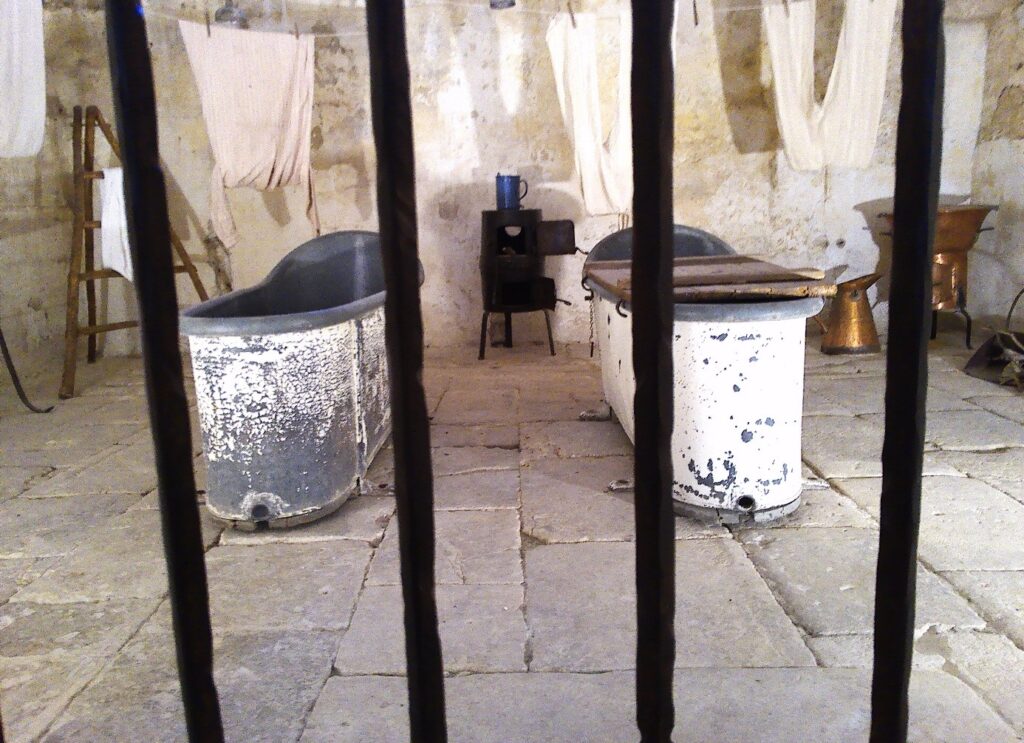
Vincent did not bathe in this tub, but in the one below.

We continue on and arrive at Vincent’s room. On May 23, he writes to Theo:
I assure you that I am happy here and that I see no reason at all to move to a boarding house in Paris or the surrounding area for the time being. I have a small room with green-gray wallpaper and two water-green curtains with a pattern of very pale roses, enlivened with fine blood-red lines. Those curtains, probably the legacy of a ruined and deceased rich man, have a very nice pattern. Probably from the same source is a very worn armchair with a spotted upholstery à la Diaz or à la Monticelli, reddish brown, pink, cream white, black, forget-me-not blue, and bottle green.
Through the window with iron bars in front of it, I can see a walled cornfield, a vista like that of Van Goyen, above which I see the sun rise in all its glory in the morning.
Moreover, because there are more than 30 rooms available, I have an extra room to work in.
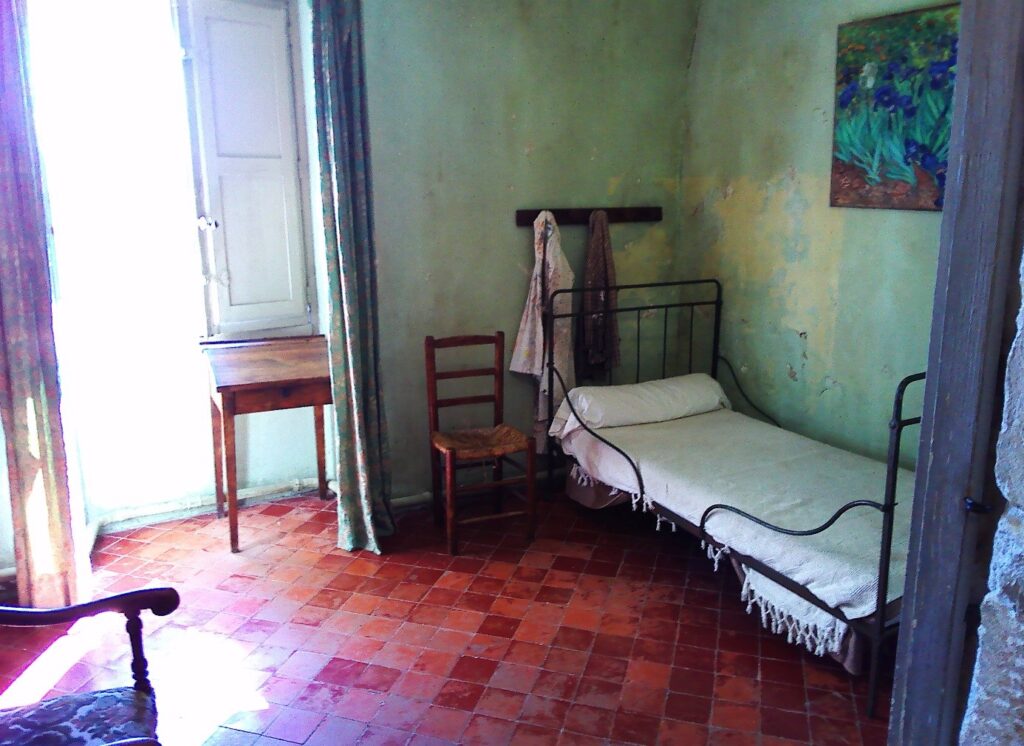
Vincent’s actual room had a different view, which is very similar to this view,
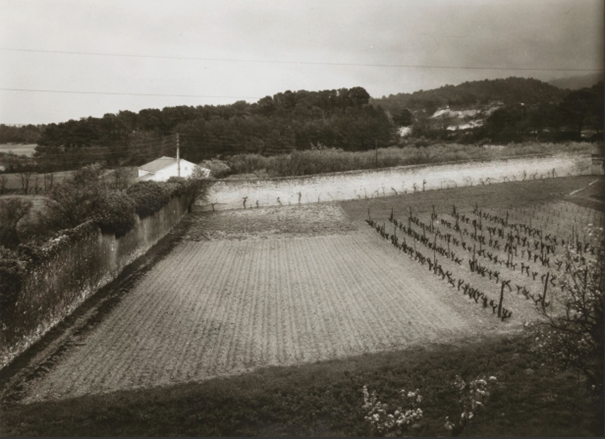
He writes that there are thirty rooms available, so apparently the institution was not doing very well. A graph of bed occupancy, taken from a book by Evelyne Duret, confirms this.

So it is quiet in the institution, and that will certainly have contributed to Vincent’s recovery. What does he do every day? Initially, he has to stay inside the institution, but that does not prevent him from painting.
Since I’ve been here, the overgrown garden with large pine trees under which tall, poorly maintained grass grows mixed with all kinds of ryegrass has given me enough work, and I haven’t been outside yet.
Nevertheless, the landscape of St.-Rémy is very beautiful and I will probably gradually start going on excursions. But because I have stayed here, the doctor has of course been able to see better what is going on and he will, I hope, now be more confident that he can let me paint.
Van Gogh painting in the garden
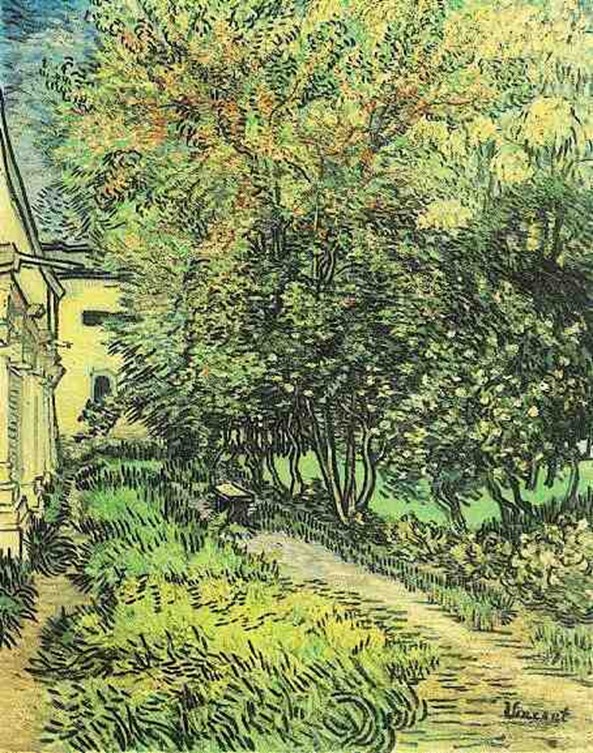
The garden of the Saint-Paul hospital. Oil on canvas. 95.0 x 75.5 cm. Saint-Rémy: May, 1889. Otterlo: Kröller-Müller Museum.
and what he sees from the window.

At the foot of the mountains. Oil on canvas, 37.5 x 30.5 cm. June 1889. Amsterdam: Van Gogh Museum.
What news can I tell you? Not much. I am working on two landscapes (30 cm canvases) of vistas, painted in the hills.
One is the landscape I see from my bedroom window. In the foreground, a ruined cornfield that has been flattened by a storm. A wall as a fence and on the other side gray foliage of a few olive trees, huts, and hills. Finally, at the top of the canvas, a large white-and-gray cloud, sinking into the azure blue. It is an extremely simple landscape—also in terms of color. It could be the counterpart to that study of the bedroom that has been damaged.
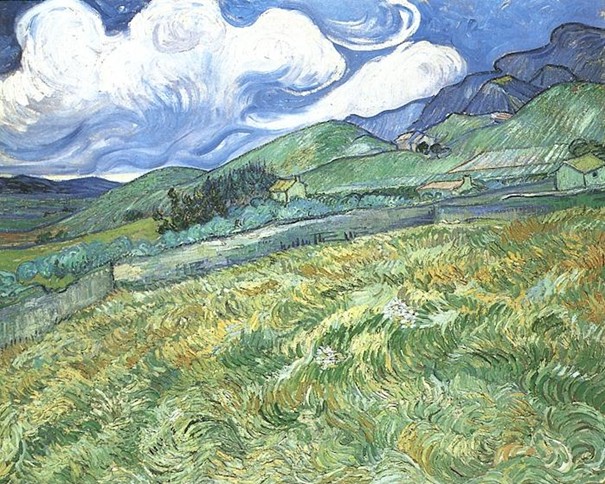
Mountain landscape behind Saint-Paul hospital. Oil on canvas. 70.5 x 88.5 cm. Saint-Rémy: June 1889. Copenhagen: Ny Carlsberg Glyptotek
This garden is not open to the public in 2025. The area to the right of the wall on the right-hand side is accessible to visitors. The tool shed on the other side of the wall is still there. Here, too, there are many images of paintings on the walls.
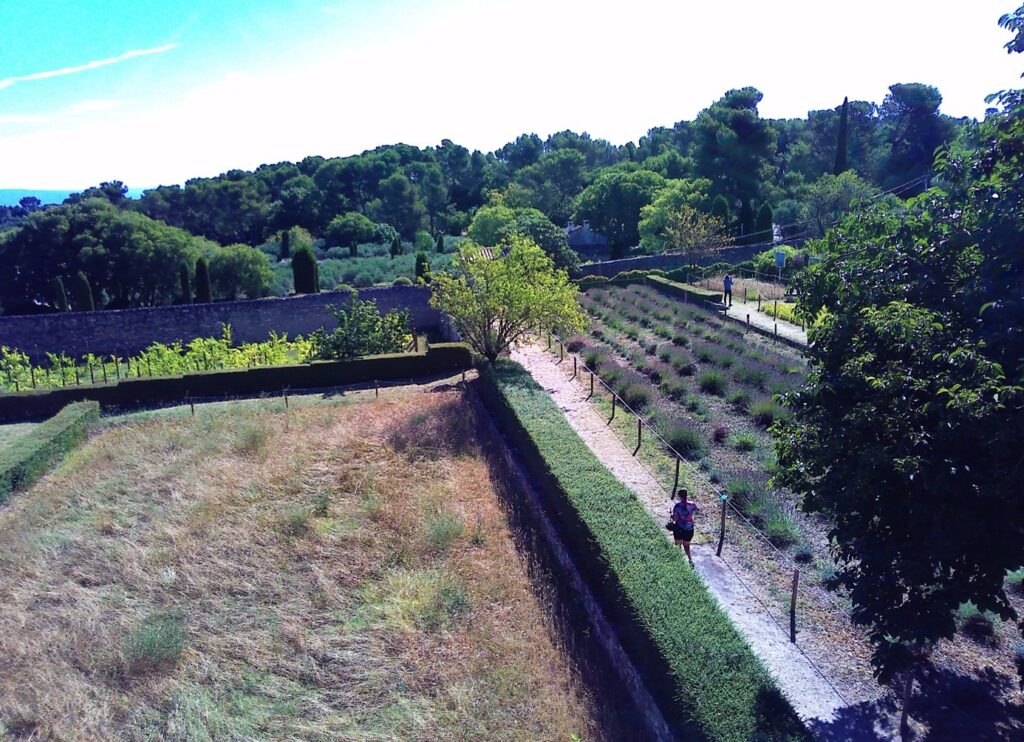
At the back of the garden, there is another beautiful view of the complex with, on the left of the photo, two pomegranate trees, or are they quinces?
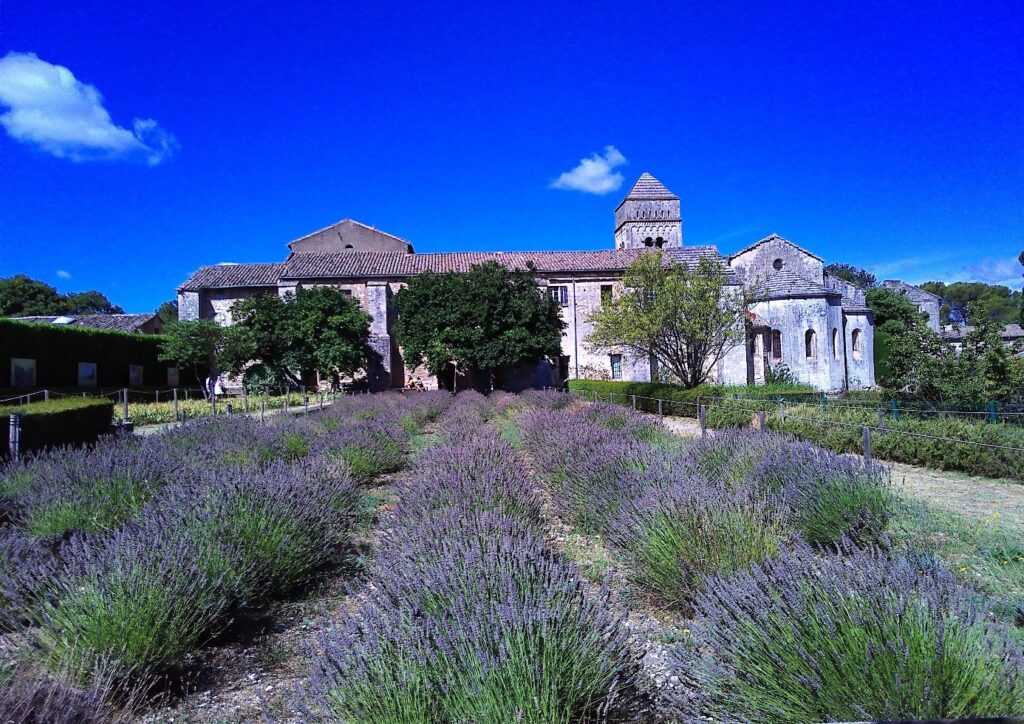
After walking through the garden, there is the inevitable shop with trinkets, (almost) always located in front of the exit. But in this case, it’s not just trinkets; you can buy works of art made by patients here. The proceeds go to the Valetudo Foundation to help maintain the studio, such as money for materials. There are some very nice works of art among them.
We then walk on to the cloister (‘cour’). And then we take a look at the simple church that belongs to the complex, on the right in the photo above.
Vincent said he felt at home here. When he arrives, he says:
I may well stay here for quite a long time; I have never been as calm as I am here and in the guest house in Arles, so that I can finally do a little painting. Nearby are small gray or blue hills, with very green cornfields and pine trees at their foot.
(….)
Speaking of my condition, I am also very grateful for something else. I notice that others, like me, have heard strange noises and voices during their attacks, that things seemed to change for them too. And that softens the fear I initially had of the attack I had, which, when it happens unexpectedly, can only make you immensely afraid. Once you know that it is part of the disease, you take it as something normal. If I had not seen other mad people up close, I would never have unlearned to always think about it. Because when you have a seizure, it is no fun to be tormented by fear. Most epileptics bite their tongues and injure them. Rey told me that he had known of a case of someone who, like me, had injured his ear, and I think I heard a doctor from here who came to see me with the director say that he had also seen it before. I dare to assume that once you know what it is, once you are aware of your condition and that you can have a seizure, you can do something yourself to prevent yourself from being overwhelmed by fear or horror. Well, it has been getting better for five months now, and I am hopeful that I will overcome it or at least not have such severe attacks anymore.
More than 150 paintings were created here, plus many drawings in pencil and chalk, and watercolor images. They are scattered all over the world, because every museum wants to have a Van Gogh in its collection. A number of those oil paintings give an impression of the interior.
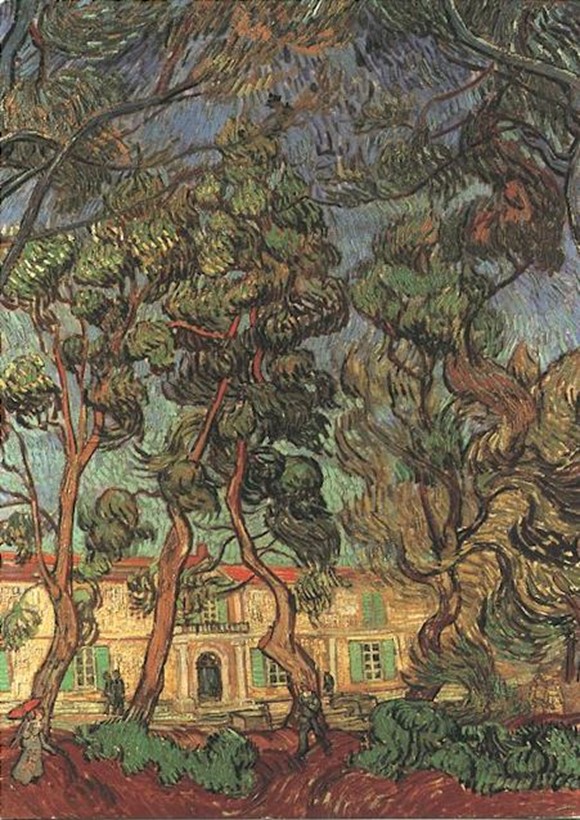
Trees in the garden of Saint-Paul Hospital. Oil on canvas. 90.2 x 73.3 cm. Saint-Rémy: October, 1889. Los Angeles: The Armand Hammer Museum of Art
The rest are landscapes. First from the window and then from places close to the institution, but there are also copies of prints.
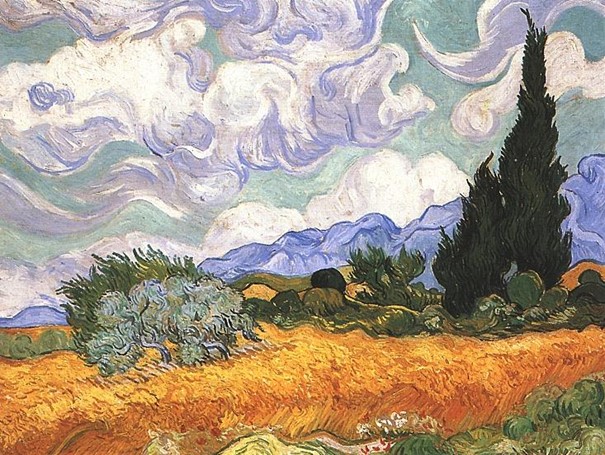
Cornfield with Cypresses. Oil on canvas. 72.5 x 91.5 cm. Saint-Rémy: early September, 1889. London: National Gallery.
And finally, he also painted patients and people who worked at the institution. There are only a few, but they are poignant images. Van Gogh got along well with Trabuc, a nurse. He painted him in September 1889.
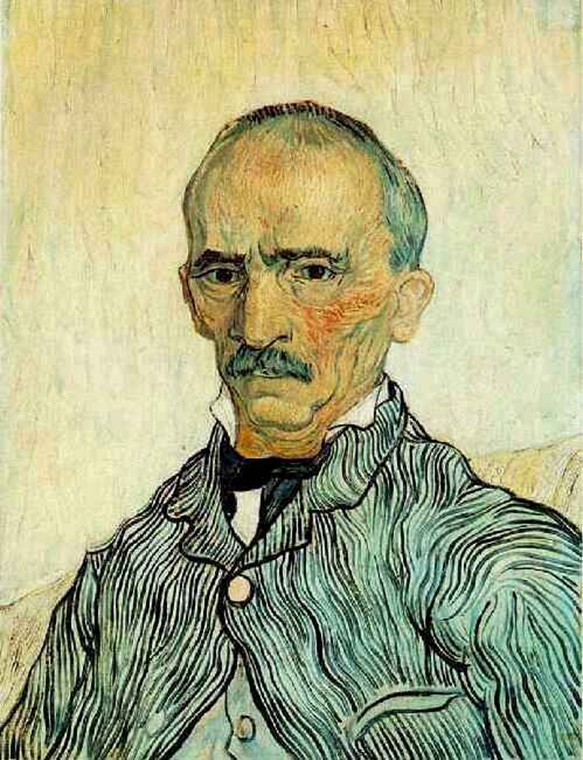
Portrait of Trabuc, a nurse at Saint-Paul Hospital. Oil on canvas. 61.0 x 46.0 cm. Saint-Rémy: September, 1889. Solothurn: Kunstmuseum Solothurn, Dubi-Muller Foundation.
And he painted the painting below of another patient, who somehow reminds us of the neuroleptic man we saw: a bridge between now and then.

Portrait of a patient at Saint-Paul Hospital. Oil on canvas. 32.5 x 23.5 cm. Saint-Rémy: October, 1889 Amsterdam: Van Gogh Museum
It is certainly an impressive visit, leaving you with the feeling that you have gone back in time. That does not alter the fact that history has been somewhat distorted. Fortunately, it is not overloaded with educational information, and despite everything, it still makes an authentic impression. Well worth the (long) detour!
Sources
Leo Jansen, Hans Luijten, and Nienke Bakker. Vincent van Gogh. The Art of the Word. His Most Beautiful Letters. Amsterdam: Carrera Publishers, 2014.
Evelyne Duret. An Asylum in Provence. The Saint-Paul House in Saint-Rémy from the 17th to the Early 20th Century. Aix-en-Provence: Presse Universitaires de Provence, 2020.
Paintings by van Gogh
https://vggallery.com/international/dutch/paintings/main_az.htm
Arko Oderwald and Aafke de Groot
with many thanks to Teio Meedendorp