On the Spot – Paris 9 – Le Marais
Start: Musée Carnavalet, 23 Rue Madame de Sévigné
Cost: Musée Carnavalet: free for the permanent collection; Musée Victor Hugo: unclear. Sometimes free, sometimes 9 euros. The website does not provide a definitive answer.
This walk begins at the Musée Carnavalet, the museum dedicated to the history of the city of Paris. The museum has recently been beautifully restored. It is housed in two adjacent buildings formerly known as the Hôtel Carnavalet and the Hôtel Le Peletier.
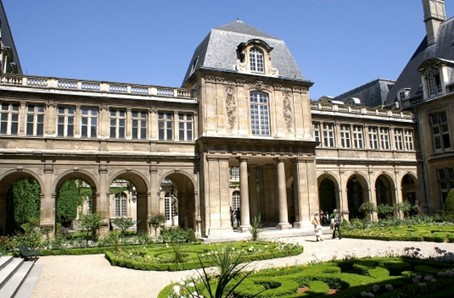
The former was built in 1548 by Nicolas Dupuis. The other building was also constructed in the mid-16th century and was once owned by a famous Parisian aristocrat, Madame de Sévigné, wife of the Marquis de Sévigné. She is best known for the letters she wrote to her daughter, which were copied so often that she became a celebrity throughout the country. We’ll come back to her later.
Admission to the permanent collection is free, and it’s definitely worth a visit, even though, like quite a few French museums, it’s sometimes not laid out very clearly. The founding of Paris on the Île de la Cité, where this walk is headed, the French Revolution, the Commune of 1870, Marcel Proust’s famous room with cork on the walls, and all sorts of period rooms—it’s all to be found in this museum. It’s easily worth at least 1½ hours, so the question is whether to visit now, before the walk, or at a later time. You’ll likely exit the museum onto Rue de Sévigné. Walk to the right to the intersection with Rue des Francs Bourgeois and turn left onto this street. Cross Rue de Turenne and stop at the corner of the beautiful, symmetrical 17th-century Place des Vosges. Many outdoor cafés, many art boutiques, but curiously enough, also plenty of undeveloped areas and neglected houses. Before we walk around the square—skipping one side—let’s briefly review the history of this square.
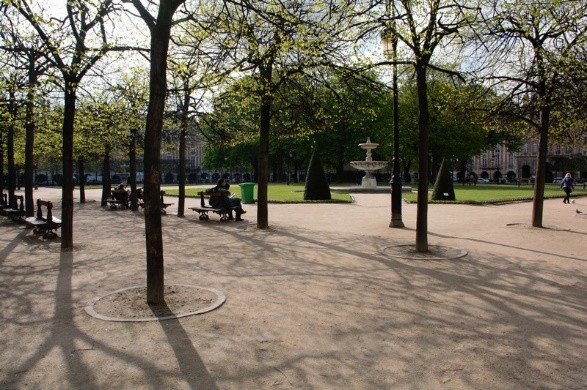
Place des Vosges (Vosges Square) is the oldest square in Paris and was one of the first large modern squares in Western European urban planning. The square, formerly known as Place Royale, was built between 1605 and 1612 under Henry IV. It was completed under Louis XIII, and a statue of this king was erected there. That statue did not survive the French Revolution but was reinstalled afterward, this time in stone. The 140-by-140-meter square is surrounded by 39 identical houses, each built of red brick. On the northern and southern sides stand the larger Pavillon du Roi and the Pavillon de la Reine.
During the French Revolution, the parliament decided to rename the square. From then on, it would bear the name of the first department to pay its taxes to the revolutionary government. The Vosges department was the first to pay and was honored with this square. We will now turn left and walk under the arcades that surround the square, so we will miss the right wing as seen from our vantage point, where lively music is being played right now.
The square has always been a very popular place to live. For instance, at number 21, three centuries apart, two famous people lived here: Cardinal de Richelieu, Prime Minister to Louis XIII from 1615 to 1627, and, from 1924 to 1929, Georges Simenon, the prolific Walloon writer.
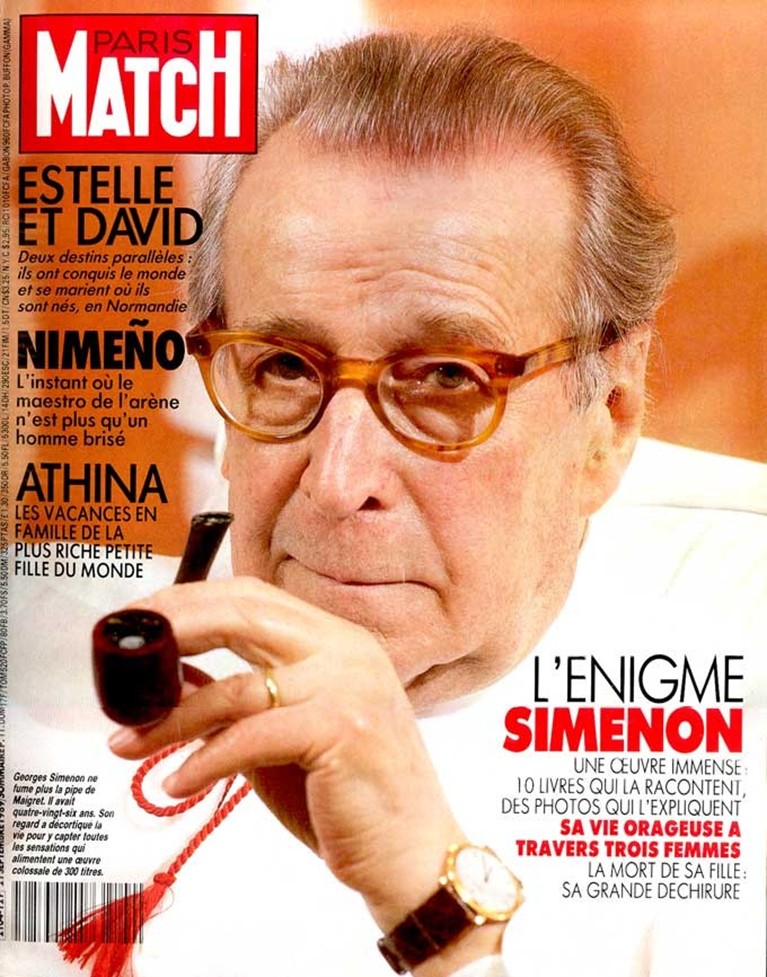
Georges Simenon was born on February 12, 1903, in Liège. His relationship with his mother was very strained, and he revered his father, who, however, died in 1921, when S. was 18. His mother remarried, and S. decided to go to Paris to try to make a living as a journalist and writer. In 1923, he married Regine, whom he called Tigy, and took her to Paris. That same year, his first story was accepted under the pseudonym Georges Sim. Ultimately, 200 stories under this pseudonym would follow.
In 1924, while living on the Place des Vosges, he served as secretary to a marquis. In 1925, the couple hired a housekeeper, Henriette, whom he called Boule. He began an affair with her almost immediately, which only came to light later (in 1944). In 1926, he had a stormy affair with Josephine Baker. In 1929, he took a boat trip through Northern Europe with his wife and housekeeper, and in Delfzijl he conceived the character of Maigret. The first Maigret book would be the first book published under his own name (in 1930). He would eventually publish 192 novels under his own name.
Given his five-year stay on the Place des Vosges, it is no surprise that the Place des Vosges plays a role in one of the Maigret novels.
It was ten o’clock in the evening. The park gates were closed, and the Place des Vosges lay deserted, with the gleaming tire tracks on the asphalt and the monotonous splashing of the fountains. The uniform roofs of the houses surrounding the square stood out against the sky.
In the shopping arcade that encircled the square like a strange belt, lights were on in only a few places. Barely three or four shops. In one of them, Inspector Maigret saw a family sitting at a table, surrounded by funeral wreaths.
He tried to make out the numbers above the doors, but no sooner had he passed the wreath shop than a tiny figure stepped out of the darkness.
“Did I just call you?”
She must have been waiting there for quite some time. Despite the November cold, she was dressed only in her apron, without a coat. Her nose was red and her eyes looked restless.
Less than a hundred meters away, a uniformed officer stood on a street corner.
Didn’t you warn him? Maigret asked unkindly.
No, not because of Mrs. Saint-Marc, who is about to give birth . . . Look, that’s the director’s car; they called him in urgently …
Three cars were parked along the sidewalk with their headlights and red taillights on. Ominous clouds raced across the moonlit sky. It looked as if the first snow was in the air. The concierge was now walking through the building’s entrance gate, which was dimly lit by a heavily dusted lamp.
Let me explain . . . This here is the courtyard . . . You have to go through there to get into the house, unless you need to go into the two shops . . . My lodge is over there on the left … Don’t look in there … I haven’t put the children to bed yet … There were two of them, a girl and a boy, and they were sitting in the cluttered kitchen. But the concierge didn’t go inside. She pointed to a tall, beautiful building standing at the back of the spacious courtyard.
There it is . . . You’ll understand . . . Maigret looked curiously at that strange little woman standing there in front of him, gesturing frantically with her hands.
They’re asking for a commissioner on the phone! That’s what they’d told him a moment earlier at the Quai des Orfèvres. But it didn’t sound very clear over the phone. So he’d had to say a few times:
Speak up a little! . . . I can’t hear you! … – I can’t . . . I’m calling from a store. .. But …
It turned into a faltering conversation.
Someone needs to come right away … 61 Place des Vosges . . . Yes . . . I think a crime has been committed . . . But above all, make sure no one else finds out! … And now the concierge pointed to the large windows on the first floor. Behind the curtains, you could see people walking back and forth.
There it is…
The crime?
No! Madame de Saint-Marc, who is in labor… It’s her first… child… And she’s not very strong… Do you understand? …
In the courtyard, it was even darker than on the Place des Vosges. Only one small lamp was lit, mounted on the wall. Behind a glass door, he could vaguely make out a staircase and a few illuminated windows here and there.
But where was the crime committed, then?
(Georges Simenon: Maigret and the Chinese Shadow)
We’ll run into Maigret again on our walk, but for now we’ll continue our way around the square.
The cardinal and the writer were not the only famous people who lived here. These aren’t just well-known celebrities. At No. 13 (Hôtel Dyel des Hameaux), Dominique Strauss-Kahn lived with his ex-wife Anne Sinclair. We’ll skip him. At No. 8, the poet Théophile Gautier and writer Alphonse Daudet. We’ll come across Gautier shortly, and then we’ll focus on him.
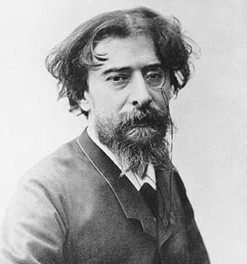
Alphonse Daudet (1840–1897) was a Provençal writer. La Doulou (The Pain) is about the agonies of his tertiary syphilis, which were hellish. The book has been translated into English by Julian Barnes.
What are you doing right now?
I’m in pain.
(….)
For as long as I was taking bromide, I had neglected morphine for a long time. I spent three delightful hours on it. The injection wasn’t too bad and, as always, set off a torrent of words.
(…)
Every evening, vicious, painful spasms in my ribs. I read for a long time, sitting in bed—the only position I can tolerate. I am a poor, old, wounded Don Quixote, sitting on my butt in my armor at the foot of a tree.
Armor is exactly what I feel, a lot of steel that cruelly cracks my lower back. Hot coals, jabs of pain as sharp as needles. Then chloral, the tapping of my spoon against my glass, and finally rest.
This armor has had me in its grip for months; I can’t loosen the straps, I can’t breathe.
(…)
There is no general theory of pain. Each patient discovers their own pain, and the nature of the pain varies just as a singer’s voice varies due to the acoustics of the hall
(…)
Pain has a life of its own. The ingenious attempts a disease makes to survive. People say, “Let nature take its course.” But death is just as much a part of nature as life. The forces of survival and destruction are at war within us and keep each other in balance. I have seen striking examples of how disease sustains itself. The two TB patients who fell in love with each other. You could almost hear the disease saying to itself: well, this is a good buddy! And just imagine the morbidity that can result from this.
(Alphonse Daudet, La Doulou)
Let’s continue with the famous figures. Less well-known, perhaps, is the Duke of Sully, who served as prime minister during the reign of Henry IV (1553–1610) and lived at number 7.
Henry IV was the first Bourbon king of France. Baptized a Catholic, he converted to Protestantism. He renounced that faith upon his accession to the throne in 1589. But with the famous Edict of Nantes in 1598, he ensured religious freedom. He was assassinated in 1610 by a Catholic monk. This assassination attempt succeeded, after several earlier failures. He was very beloved by the people. Louis XIII succeeded him; at the time, he was 8 years old, and his mother, Maria de’ Medici, served as regent.

We have now arrived at the corner of the square diagonally across from where we entered. Here, at number 6, Victor Hugo lived from 1832 to 1848, in what was then the Hotel de Rohan-Guéménée. Today, there is a museum here in memory of Victor Hugo.
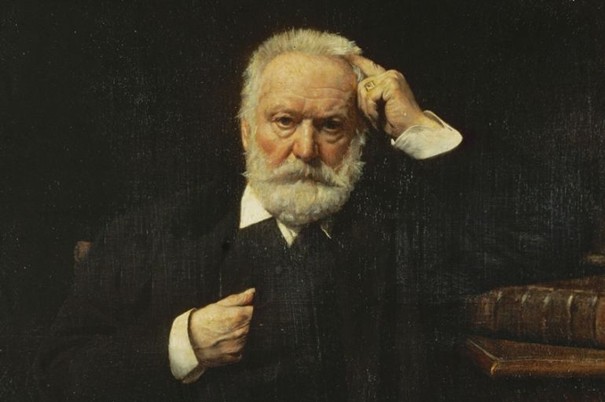
Victor Marie Hugo (Besançon, February 26, 1802 – Paris, May 22, 1885) was a French writer, poet, essayist, and statesman and is considered one of the most important and influential French Romantic authors of the 19th century. He wrote novels, poems, plays, essays, and political speeches, and also left behind an extensive collection of letters. He was the son of a staunchly republican father and a deeply religious mother. That did not last long, and Victor went to live in Paris with his mother. There he married Adèle Foucher, but also had a mistress and secretary, Juliette Drouet. His wife, incidentally, had a relationship with the famous critic Saint-Beuve. In 1831, Notre-Dame de Paris was published, known to us as The Hunchback of Notre-Dame. In 1848, he was elected to parliament. He supported Louis Napoleon, but as the latter seized more and more power, their relationship soured. Hugo was forced to flee, first to Brussels, then to Jersey, and eventually ended up on Guernsey, where he remained until 1870. It was there that he wrote Les Misérables (1862). He died in Paris in 1887.
The museum doesn’t take very long to visit and is definitely worth a quick look. A nice cup of coffee in the courtyard is also not to be missed.
We continue our route along the square. This side of the square is still quite neglected, although improvements are visible. We walk to the next corner. Here, at No. 1 bis, Madame de Sévigné (1626–1696) was born. As mentioned, she became famous for her letters to her absent daughter, who lived in Provence, in which she displays her vivid storytelling skills. Proust frequently refers to her and calls her style “intermittences du coeur”: the alternating absence and return of passion to the rhythm of parting and reunion.

Madame de Sévigné
If we could be a little patient, we would spare ourselves a great deal of sorrow.
We are now at the third corner of the Place des Vosges, and here is a door through which we can leave the square. We enter a courtyard garden of the Hotel de Sully.
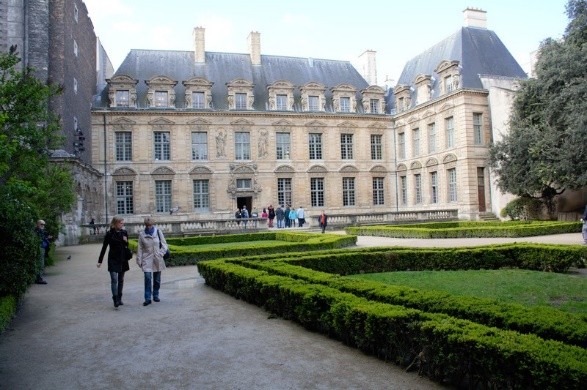
The building adjacent to the garden was constructed between 1624 and 1630. In 1634, the Duke of Sully, who lived at number 7 on the square, purchased the house. His family owned the building until the 18th century. After passing through many hands, it was purchased by the French state in 1944. Following extensive restoration, completed in 1973, the building became the headquarters of the Centre des monuments nationaux. Inside the building is a bookstore with an interesting collection of books on French monuments.
We walk through the building and emerge onto Rue Saint-Antoine, the extension of Rue Rivoli. We cross the street and turn onto Rue de l’Hôtel Saint-Paul. At the end, we turn right onto Rue Neuve Saint-Pierre and then left onto Rue Saint-Paul. Then we turn right onto Rue Charlemagne and subsequently left under the archway, into the village of Saint-Paul.
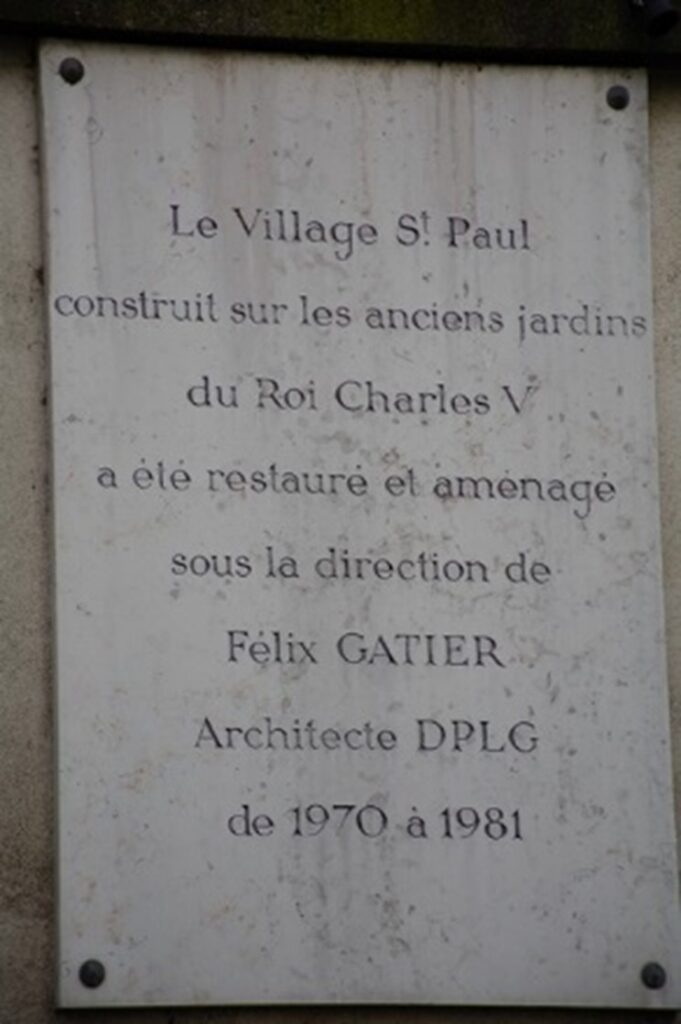
On the site of the former gardens of King Charles V (1338–1380), a kind of kasbah has been created here, featuring boutiques, cafés, and restaurants. In the middle of bustling Paris, it’s a quiet spot to take a break.
We walk south through the Village Saint-Paul and come out onto Rue L’Ave Maria. A short walk to the left brings us to the Quai des Célestines. We cross the Quai, finding ourselves back among the many cars, and head down the stairs to the Seine. Here there are tables with benches where you can sit, and there’s also a café. This branch of the Seine flows to the right. Over there on the right, you can see the Pont Marie.
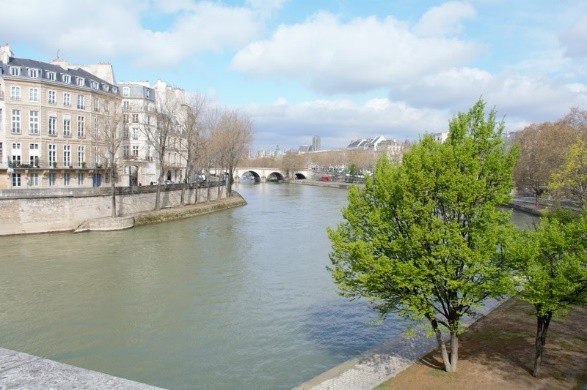
This very spot and the two islands visible across the river are also the setting for a Maigret novel by Simenon: Maigret and the Clochard. A tramp is found seriously injured on the Quai. It turns out that this tramp is a doctor and that, strangely enough, the wealthy woman from whom he ran away to become a doctor in Africa lives 300 meters away on the Île de Saint Louis, which we are now looking out upon.
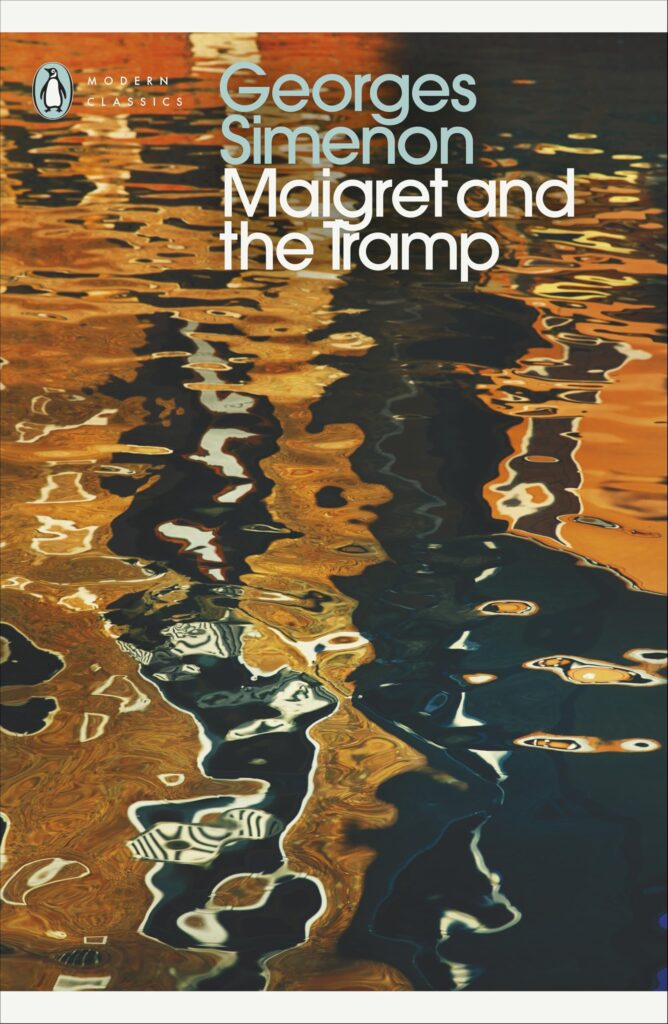
The Seine is still high, noted Lapointe, who had said nothing until now. That was true. For the past month, it had hardly been dry for more than a few hours at a time, and almost every evening the television showed swollen rivers, towns, and villages where water was flowing through the streets. In the Seine, which had a dirty yellow color, all sorts of debris was floating along—old crates, tree branches.
The two men followed the Quai de Bourbon to the Pont Marie, which they crossed at their leisurely pace, and saw a dull-gray barge moored to the right of the bridge, with the white and red triangle painted on its bow, painted by the Compagnie Genbale. It was called ‘Le Poitou’ and was loaded with sand, which was being unloaded by a crane whose groaning and creaking mingled with the jumbled sounds of the city. To the left of the bridge, about fifty meters from ‘Le Poitou,’ lay another ship, which looked much neater. It looked as if it had been scrubbed and polished that very morning. A Belgian flag hung limply at the stern, while next to the white deckhouse a baby lay sleeping in a sort of linen hammock and a very tall man with light blond hair stood looking toward the quay as if he were waiting for something.
The ship’s name was written in gilded letters on the bow: “De Zwarte Zwaan,” a Flemish name that meant nothing to Maigret and Lapointe. It was two or three minutes before ten. The two police officers arrived at the Quai des Célestins, and just as they were about to descend the ramp to the harbor, a car pulled up. Three gentlemen got out, and the door slammed shut.
“Look! We’re right on time.”
They, too, were coming from the Palace of Justice, but from the more distinguished section where the magistrates sat. They were Mr. Parrain, deputy prosecutor; Mr. Dantziger, judge; and an elderly court clerk whose name Maigret could never remember, even though he had met him hundreds of times.
The tramp turns out to be taciturn when he comes to. Maigret finds him likable, even if it means he can’t formally solve the case. We’ll return to Maigret shortly.
Now we turn our gaze to the Île Saint Louis across the river. There, at number 17, stood the Hotel de Lauzun, and before that, the Hotel Pimodan. Today, a department of one of Paris’s many universities is located there, but between 1844 and 1849, this hotel was the meeting place of the Club des Hashischins.
Hashish and opium became increasingly well-known in Europe in the early 19th century. They were used recreationally and out of curiosity. In 1821, Thomas De Quincey’s Confessions of an English Opium-Eater was published. That book was anonymously translated in 1828 by Alfred de Musset, who was a friend of Georges Sand. Who were the “members” of this club? Among others, Théophile Gautier, Eugène Delacroix, Victor Hugo, Alexandre Dumas, Charles Baudelaire, Gérard de Nerval, and Honoré de Balzac. All of them have been featured in previous On the spot articles. Honoré de Balzac, incidentally, did not use the substances himself, but he was certainly interested. In 1838, he wrote Treatise on Modern Stimulants, a purely theoretical work on drugs, as he categorically refused to try any of them.
Théophile Gautier, who lived on the Place des Vosges, wrote about his experiences in 1846 in the Revue des Deux Mondes. Gautier (1811–1872) was a painter, poet, novelist, and critic. At the time, the city was a paradise for bohemians, and as Gautier himself later remarked, “It was fashionable to look pale and haggard; to give the impression that one was succumbing to grief and remorse; to speak gloomily and fantastically of death” . The club met once a month on the top floor of the hotel. Baudelaire also visited the club regularly. In 1860, he wrote Les paradis artificiels (Artificial Paradises), which, alongside De Quincey’s book, stands as the 19th-century work on addiction. Yet Baudelaire was less enthusiastic about hashish; he ultimately preferred alcohol, as the following quote also shows:
Get drunk!
You must always be drunk. That is the point; that is the whole issue. To avoid feeling the terrible burden of Time that breaks your shoulders and bends you to the ground, you must get drunk incessantly.
But with what? With wine, poetry, or virtue—whatever you like. But get drunk.
And if you wake up now and then on the steps of a palace, in the green grass of a ditch, in the melancholy solitude of your room, and notice that the drunkenness has already lessened or vanished, then ask the wind, the wave, the star, the bird, the clock, everything that flees, everything that moans, everything that rolls, everything that sings, everything that speaks, ask what time it is; and the wind, the wave, the star, the bird, the clock will answer you: “It is time to get drunk! Get drunk, get drunk again and again, so that you do not become a slave to Time, which turns us into martyrs! Get drunk on wine, poetry, or virtue—whatever you like.”
(Charles Baudelaire, The Spleen of Paris)
We now walk to the left along the Seine, under the bridge, and then up the stairs. Walking back down the stairs we came up is also an option, by the way. We cross the Pont de Sully to the other side and turn right along the Seine, toward the Hôtel de Lauzun. We are walking in the footsteps of Théophile Gautier.
When, one December evening, I accepted a mysterious invitation, phrased in enigmatic terms that were intelligible to the initiated but incomprehensible to others, I found myself in a secluded neighborhood, a sort of oasis of solitude, in the heart of Paris, which the river embraces with its two arms and which it seems to defend against the encroachment of civilization. For it was in an old house on the Île-Saint-Louis, at the Hôtel Pimodan, that I was to attend for the first time the monthly meeting of the strange club of which I had recently become a member. Although it was barely six o’clock, it was already dark. A mist, denser here than elsewhere due to the proximity of the Seine, shrouded all the surroundings in its embrace, which showed gaps here and there, letting through the reddish glow of the streetlamps and streaks of light escaping from illuminated windows. The pavement, flooded by the rain, glistened under the streetlights like a mirror-like expanse of water reflecting the light of the lanterns; a bitter wind, full of ice particles, lashed my face, and its hoarse howl dominated a symphony in which the churning waves crashing against the bridge piers formed the bass; that evening lacked no element of harsh winter poetry. It was difficult to find the house I was looking for along this deserted quay among the mass of dark buildings; yet my coachman managed, standing upright on the box, to read on a marble plaque the half-worn gilded name of the old house that was the meeting place of the club’s members. I dropped the carved knocker—the use of bells with brass knobs had not yet penetrated these remote neighborhoods—and I heard the door cord creak several times to no avail; finally, it yielded to a stronger tug, the rusted old lock opened, and the door, made of heavy panels, swung on its hinges.
(…)
As far as I could make out in the pale light that falls even from the darkest sky, the courtyard I crossed was surrounded by buildings with old gabled facades. I felt my feet getting damp, as if I had been walking through a meadow, for grass grew everywhere between the paving stones.
I knocked, and was let in with the usual caution. I found myself in a large hall, lit at the far end by a few lamps. Whoever entered here took a step back two centuries. Time, which passes so quickly, seemed to have bypassed this house, and just as with a clock that one has forgotten to wind, and which still shows the same hour, time seemed to stand still here. The walls, which were paneled and painted white, were half-covered with dark linen bearing the mark of its time, and on the enormous fireplace stood a statue that might have been stolen from the back alleys of Versailles. On the domed ceiling, a carelessly painted allegory wound its way, in the style of Lemoine, and perhaps even by his hand. I walked on toward the lit part of the hall where human figures moved about a table, and as soon as the light touched me, making me recognizable, a powerful cheer rang out into the resonant depths of the old building. “It’s him, it’s him,” shouted several voices at once. “Give him his share!” The doctor stood by a buffet table on which sat a tray full of small Japanese porcelain saucers. Using a spatula, he took a piece of pasta or greenish fruit puree—about as thick as my thumb—from a crystal vase and placed it next to a gilded silver spoon on each saucer, The doctor’s face beamed with enthusiasm; his eyes sparkled, his cheeks flushed patchy red, the veins on his temples stood out sharply, and his wide-open nostrils drew the air in forcefully. “This will be deducted from your share in Paradise,” he said to me and handed me the portion that was mine. When everyone had eaten their share, coffee was served in the Arabic manner, that is to say, with the grounds and without sugar. After that, we sat down to eat.
When I came to my senses again, I saw that the room was full of people dressed in black who greeted one another sadly and shook hands with a melancholy warmth, like people mourning a shared sorrow. They said: ‘Time is dead; from this day forward there will be no more years, nor months, nor hours; Time is dead, and we are going to his funeral.’ ‘It’s true that he was very old, but I hadn’t expected this to happen; he looked wonderful for his age,’ said one of the mourners, in whom I recognized one of my friends, a painter.
Indeed, a typical hash experience. We leave this club behind in their haze and walk on along the quay. We turn left onto Rue Poulletier and then right again onto Rue Saint-Louis and Île. Île Saint-Louis is one of the two islands (the other is Île de la Cité) in the Seine in the center of Paris. It is named after King Louis IX, nicknamed the Saint (Fr. Saint Louis). The island once consisted of two islands, which served as pasture for livestock and wood storage. In 1614, Louis XIII ordered that they be merged into a single island. On our left is a church built between 1664 and 1726. It took a while, as funds and/or manpower ran out from time to time. It is a unique church integrated into the row of houses, giving it a rather modest façade. Well worth a visit.
We now turn left onto Rue des Deux Ponts. Before the bridge, turn right onto Quai d’Orléans. Now we return to Maigret, because here, at No. 29bis, lives Mrs. Keller, the wealthy wife of the homeless man who was found seriously injured 300 meters further on—the homeless man who ran away from his life of luxury.
To the Quai des Orfèvres?
No, to the Île Saint-Louis … Quai d’Orléans, …
The house they stopped in front of was old, with a massive carriage gate, but it was maintained like a precious piece of furniture. The brasswork, the banister, the steps, the walls—everything gleamed and shone with cleanliness; not a speck of dust was to be seen; the concierge, in a black dress with a white apron in front, looked like a maid in a well-to-do family.
Do you have an appointment?
No, but Mrs. Keller knows I’m coming …
One moment, please…. The lobby was a small parlor where the smell of floor wax was stronger than the scent of food. The concierge picked up the phone.
What is your name?
(Georges Simenon: Maigret and the Tramp)
Maigret enters a world completely different from that of the tramp, which makes his sympathy for the tramp grow by leaps and bounds. Incidentally, there is another novel by Simenon set on Île Saint Louis: The Old Lady, in which a grandmother and granddaughter have a strained relationship.
We walk along the Seine again and arrive at the Île de la Cité’s Pont St Louis. The fully restored Notre Dame Cathedral gleams before us. A very brief history, taken from Wikipedia:
The first stone was laid in 1163 by Pope Alexander III. By 1177, the choir was completed, and the new high altar was consecrated in 1182. After the death of Bishop Maurice de Sully in 1196, his successor, Eudes de Sully, began construction of the transept and the nave. By the mid-13th century, the west towers were also completed, after which work continued on the interior and the radiating chapels until 1345. During the French Revolution, the cathedral was severely damaged but was eventually restored. The church was one of the first buildings in the world to use flying buttresses. However, the original design did not include these architectural elements. Nevertheless, they were incorporated around the choir and the nave. During the Gothic period, thin walls became very popular. These were also used in Notre-Dame, but during construction, it was discovered that these thin walls could not remain standing without external support; cracks appeared in the walls, and they began to lean outward under their own weight. In response, the architects began building supports around the exterior walls. These supports continued to appear in later churches.
So much for Wikipedia. Notre-Dame made global headlines when the cathedral recently went up in flames. Long before that, it had made global headlines thanks to Victor Hugo and his novel.
To that end, we have attempted to resurrect that admirable church, Notre-Dame of Paris, for the reader. In brief, we have described some of the treasures that were still present in the fifteenth century and are now missing. But we have forgotten the most important one: the view of Paris that one could enjoy from the towers back then. After the long climb up the dim spiral that pierces the thick tower walls vertically, a climb suddenly rewarded by the liberating step onto one of the two platforms flooded with light and air, it must indeed have been a magnificent view that unfolded before one’s eyes in every direction; an incomparable scene that will be easier to imagine for those readers who have previously encountered an intact, fully homogeneous Gothic city, of which a few still exist: Nuremberg in Bavaria, Vittoria in Spain, or even smaller ones that have been preserved intact, such as Vitré in Brittany and Nordhausen in Prussia. The Paris of some three hundred and fifty years ago, the Paris of the fifteenth century, was already a gigantic city. We Parisians usually misjudge the extent to which the city has grown since then. Paris has grown by not much more than a third since Louis XI. And it is certain that it has lost far more in beauty than it has gained in area. Paris, as we know, originated on la Cité, the old island in the Seine shaped like a cradle. The sandy bank of that island was the first rampart, the Seine the first moat. Paris remained in this island state for several centuries, with two bridges—one in the north, the other in the south—and two bridgeheads that served as gates and fortifications: the Grand-Chatelet on the right bank and the Petit-Chatelet on the left bank. With the arrival of the first royal house, the city soon found itself unable to turn or move on the small island, so Paris crossed the water. At that time, the first city walls with towers rose in the fields on both sides of the Seine, beyond the Grand-Chatelet and beyond the Petit-Chatelet. A few remnants of that old city wall still remained in previous centuries; now only the memory remains, and here and there an old name—the Porte Baudets or Baudoyer, once Porta Bagauda. As the mass of houses continued to encroach from the heart of the city, these city walls were gradually overgrown, eroded, hollowed out, and finally swept away. Philip Augustus built a new wall. He enclosed Paris with a circular chain of heavy towers, tall and strong. For more than a century, the buildings, confined within that basin like water in a reservoir, grew ever denser, wider, and taller. The houses grew deeper, adding floor upon floor, climbing over one another, seeking, like any constricted vegetation, a way upward; each sought to stick its head above the others to catch a breath of air. The streets were reduced to deep, narrow caverns; every square was built up. Finally, the houses leaped over the wall of Philip Augustus and spread out merrily across the plain, crisscrossing each other like disorderly refugees. There they spread out, turned the fields into gardens, and made themselves at home. By 1367, the suburbs had expanded so much that a new city wall was needed, especially on the right bank, which was built by Charles V. But a city like Paris grows constantly. Such cities become capitals. They are funnels into which all the geographical, political, moral, and intellectual currents of a country, all the natural inclinations of a people, converge; wells of civilization, so to speak, and also channels in which trade, industry, knowledge, population—everything that gives a nation vitality, life, and soul—is sifted and gathered, ceaselessly, drop by drop, century by century. Thus, the walls built by Charles V met the same fate as those of Philip Augustus. By the end of the fifteenth century, these ramparts too had been overtaken and run over by the encroaching suburbs.
(Victor Hugo: The Hunchback of Notre Dame)
The oldest hospital in Paris is also located on the square in front of Notre Dame. Maigret’s tramp is in this hospital. But we’ll have to be patient for that; we’ll devote separate attention to the many hospitals that have stood in Paris for hundreds of years. We’ll conclude this On the Spot with a very brief overview of what else there is to see on the Île de la Cité.
At the corner of Boulevard du Palais and Quai de l’Horloge stands the Conciergerie. Once the palace of Philip the Fair (early 14th century), it later became a prison. At the start of the French Revolution, people awaiting the guillotine were held here, including Marie Antoinette, wife of King Louis XVI.
Continuing along the Quai de l’Horloge, on the left is the Palace of Justice, famous from the Maigret novels. Turn left onto Rue de Harlay, and then on our right we see the Place Dauphine, also known from the Maigret novels, because this is where they always have sandwiches and beer brought from a restaurant during long interrogations. They keep that in mind at this restaurant, too.
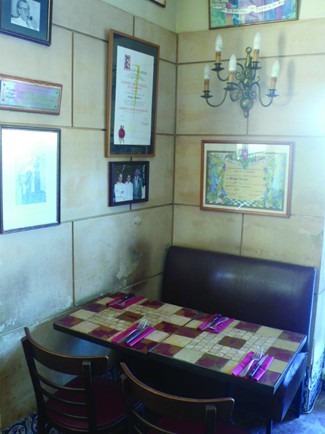
Restaurant Henri IV, Place Dauphine
Ernest Hemingway also walked across the Île de la Cité, to the tip of the island.
I often walked along the quays when I was done with work or wanted to think something over. I found it much easier to think when I was walking or doing something, or watching others do something they knew well. At the start of the Île de la Cité, past the Pont Neuf where the statue of Henri IV stood, the island ended in a point like the sharp bow of a ship, and on the waterfront was a small park with beautiful chestnut trees, huge and sprawling, and in the currents and backwaters that carried the Seine past, there were excellent spots for fishing. You’d walk down a flight of stairs to the park and watch the anglers there and under the big bridge.
The good fishing spots varied with the river’s level, and the fishermen used long, screw-together bamboo rods, but fished with very good guides made of gut line and light tackle and floats, and they were very skilled at baiting the water they were fishing. They always caught some fish, and often they hauled in quite a few of those dace- -like fish, called goujon. They were delicious when fried whole, and I could easily eat a whole plateful. They were plump, and the flesh was sweet, with a flavor even finer than fresh sardines and not at all fishy. We ate them bones and all.
(Ernest Hemingway, An American in Paris.)
We walk back upstream along the quay made world-famous by Simenon: the Quai des Orfèvres, home to the police headquarters.
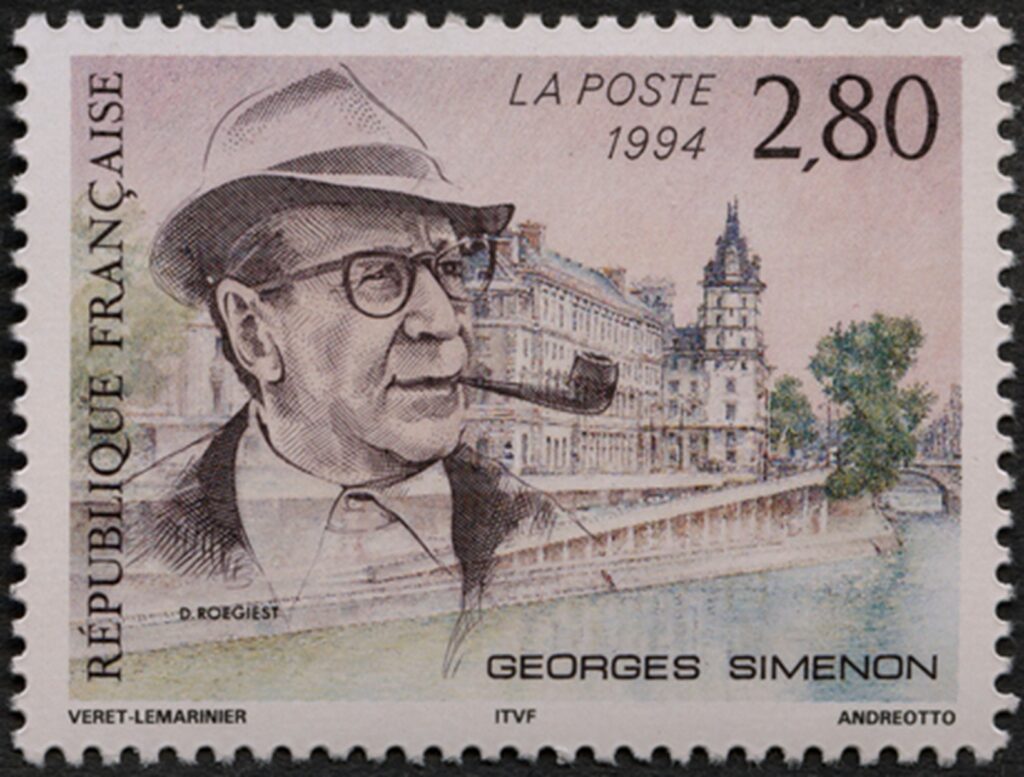
We continue on to the Pont Saint Michel. This spot with the fountain
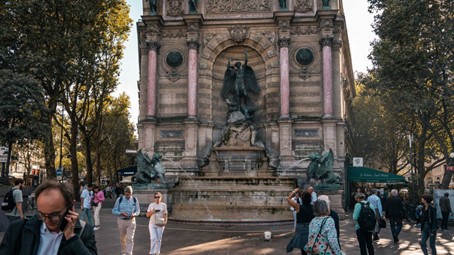
was the heart of the student uprisings in 1968. Here Sartre addressed the crowd. We turn left and continue along the Seine, the Quai Saint Michel, to the Rue du Petit Pont. We cross it to the Rue de la Bûcherie. That is where the modern Shakespeare and Company is located. Where in the world can you still find a bookstore where people line up to get in?
This concludes this installment of “On the Spot.” We’ll continue our series in Paris with the city’s hospitals, starting with the Hôtel-Dieu.