On the Spot – Paris (10) – Hospitals – Hôtel Dieu
Location: Île de la Cité
Metro 4, RER B.
Paris began on the Île de la Cité and the Île Saint-Louis. Cattle and the timber trade. Houses soon followed, and of course a hospital as well, although hospitals as we know them today did not emerge until the 19th century. That hospital was founded in 660. Many versions followed, with a significant milestone in the 12th century, when a new building was constructed. The number of people in the hospital grew gradually. At first to about 900, but by 1709 there were some 9,000 people in this hospital. It was indeed primarily a refuge, which meant that all sorts of industries operated there, such as slaughterhouses and tanneries, which were not exactly conducive to good health. These 9,000 people occupied about 1,000 beds, and everything was in a state of chaos. It was likely the filthiest hospital in Paris. In 1737 there was a major fire, and in 1772 the building burned down almost entirely.

The Fire at the Hôtel Dieu in 1772 Jean-Baptiste-François Génillion
It was not until around 1800 that hospitals specializing in specific diseases began to emerge. In 1815, Baron Guillaume Dupuytren, after whom Dupuytren’s disease is named, became the director of the Hôtel Dieu, and he made the hospital famous. The number of patients at Hôtel Dieu gradually declined from 1,200 to 800 around 1840. By 1840, the injured and sick from all social classes were admitted, except for terminally ill patients, which likely contributed to the hospital’s success. People with chronic illnesses, skin diseases, and syphilis were also not admitted. Pregnant women and children, as well as psychiatric patients, were also turned away, though they could go elsewhere. Another milestone for Hôtel Dieu came when a new building was constructed between 1866 and 1878. In 1754, the Île de la Cité looked like this.
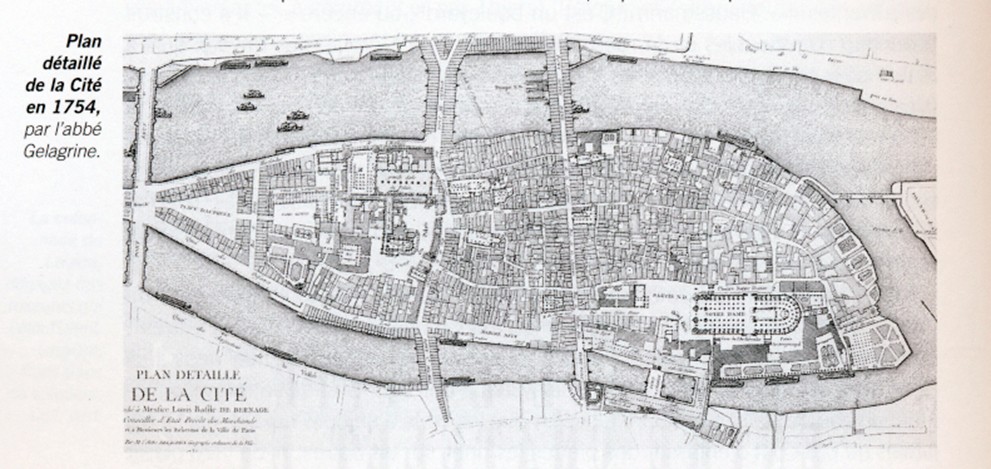
Nothing but narrow streets and houses packed tightly together. If we zoom in a bit on the map—unfortunately, the image isn’t very clear—we can see how cramped everything was back then.

Notre Dame is at the bottom right. This cluttered mess did not sit well with Baron Hausmann, Napoleon III’s city architect. He designed a new Île de la Cité, which looked like this

Much more orderly, then. And, marked in black at the top left of Notre Dame, the new Hôtel Dieu.

Hôtel Dieu in 1875
Marcel Proust’s brother, Adrien, worked here for a while at the beginning of the 20th century.
In theory, Hôtel Dieu is thus the oldest hospital in Paris, because a building that could be called a hospital has stood here since the 7th century. In fact, until 1800 it was more of a refuge than a hospital, and the current building—already the fifth or sixth—dates from the second half of the 19th century, so in terms of the building itself, it is certainly not the oldest hospital in Paris.
The hospital still exists to this day, right in the heart of the Paris metropolis. In fact, it is still undergoing modernization.

It is even the emergency hospital for nine arrondissements, which is not easy given the heavy traffic and the many tourists, who come mainly to see Notre Dame.
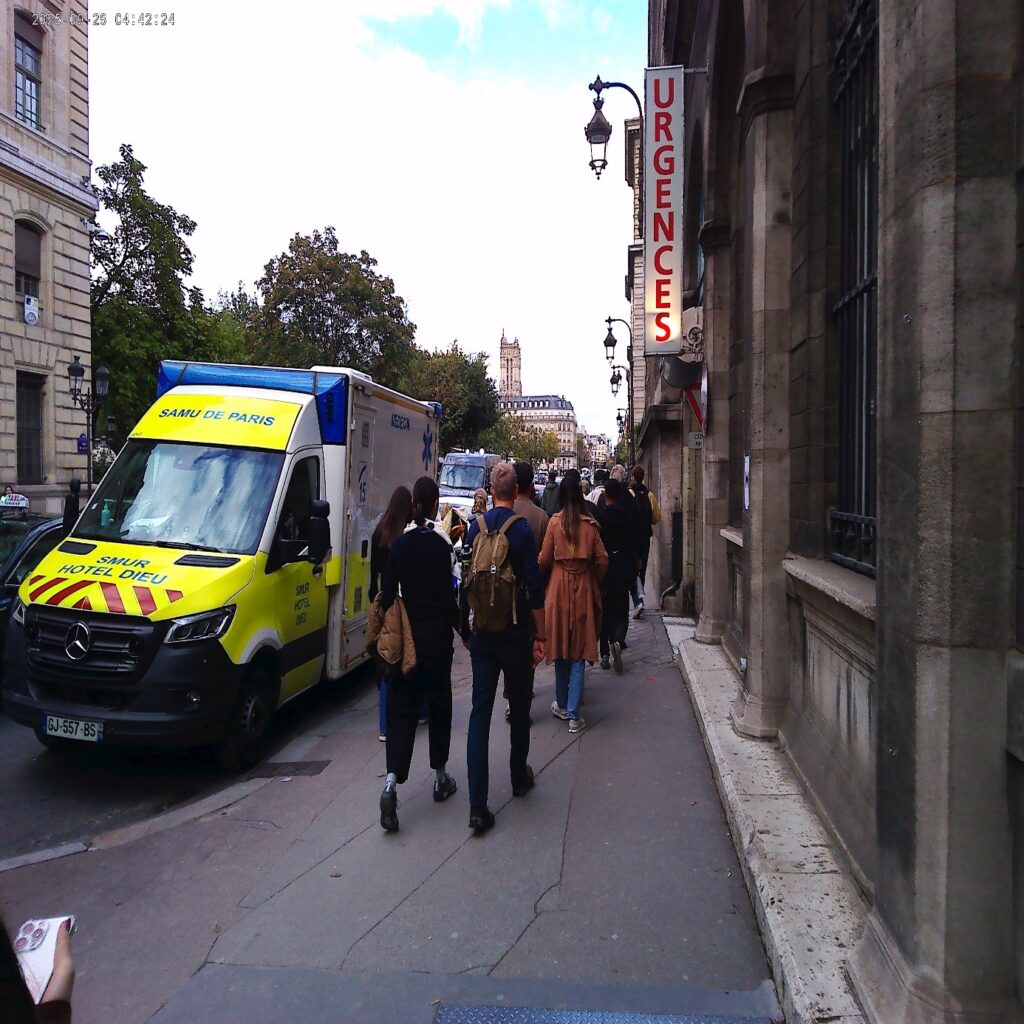
In addition to emergency care, the hospital specializes in diabetes.
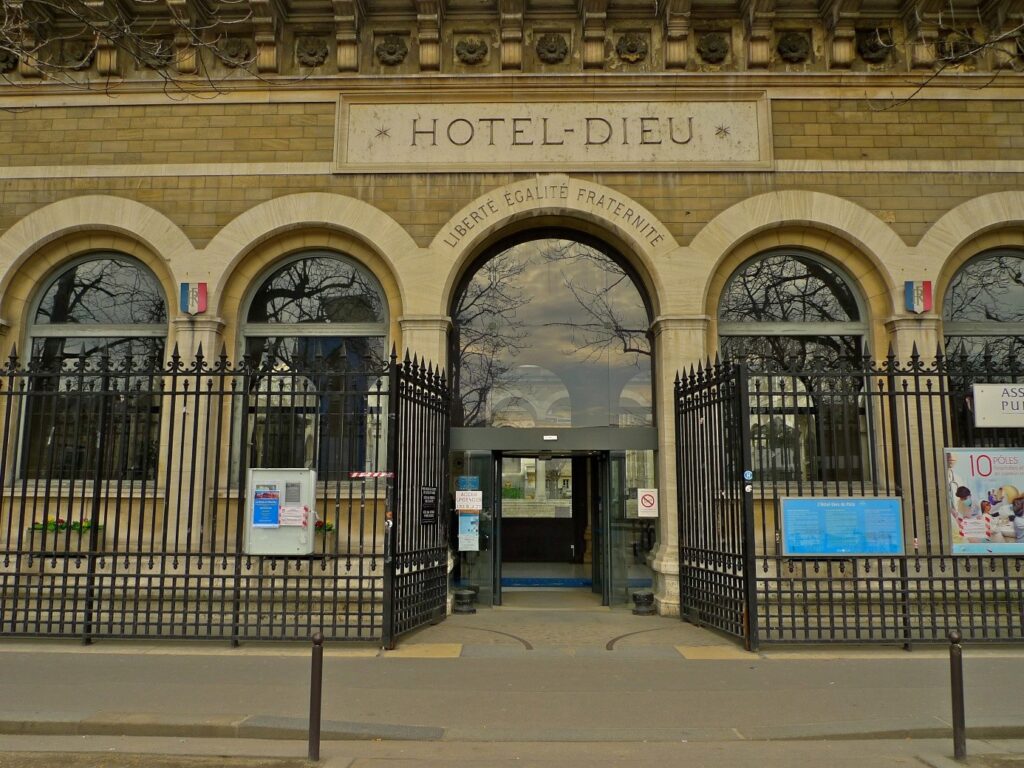
Getting into the hospital is sometimes possible, sometimes not, depending on the attitude of the security guards at the entrance.
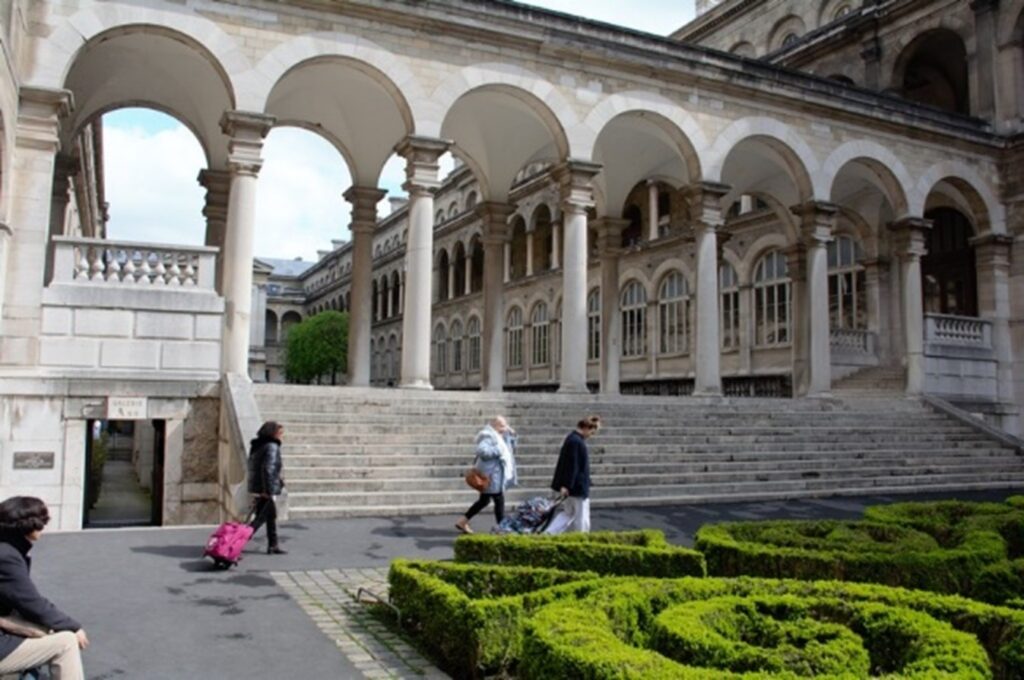
Inside is a garden with benches, where it is pleasant to relax (if you can get in)

In a previous episode of On the spot, No. 9 in the Paris series, we encountered Commissioner Maigret investigating the murder of a homeless man, right here nearby. The homeless man lies seriously injured at Hôtel-Dieu. Maigret also has trouble gaining access to the hospital.
They had a second drink, which the Italian wouldn’t let them pay for. Then they crossed the Pont Marie. A few minutes later, they entered the Hôtel-Dieu. There, they had to negotiate at length with a stern woman sitting behind a counter.
– Don’t you know his name?
– I only know that they call him “the Doctor” on the docks and that he was brought in here last night …
– Last night, I wasn’t there.. Which ward is he in?
– I don’t know… I called earlier, and the assistant I spoke with didn’t mention an operation….
– Do you know the assistant’s name?
– No….
She leafed through a register, looking up two or three names.
– What was your name again?
– Commissioner Maigret …
The woman said nothing and repeated into the receiver: Commissioner Maigret …. Finally, after about ten minutes, she sighed in a tone as if she were granting them a great favor: – Go on up…. Staircase C …. Third floor … You’ll find the head nurse there….
They passed nurses, young doctors, patients in hospital gowns, and through open doors they saw long rows of beds. On the third floor they had to wait quite a while again, because the head nurse was in a heated conversation with two men who were apparently asking for something she didn’t want to grant.
“There’s nothing I can do about it,” she finally said. “Go to the administration office. I don’t make the rules ….
They left, muttering unfriendly words under their breath, and the head nurse turned to Maigret.
– Are you the one here for the tramp?
– Commissioner Maigret…. he repeated.
She searched her memory, but that name didn’t ring a bell either. Here, one found oneself in a different world, a world of numbered rooms, of strictly separated wards, of rows of beds.
(Georges Simenon: Maigret and the Tramp)
The On the Spot series on Paris is taking a summer break and will return on September 5 or 12, 2026, depending in part on the release of Scoop. We will then continue with the old hospitals in Paris.