On the Spot – Paris (8) – The Existentialists (and a (neo)structuralist)
Start of the walk: Rue Férou, Le Bateau Ivre
Cost: none
This walk is a continuation of the walk through the Jardin Luxembourg. We ended that one on Rue Férou, where Rimbaud’s poem Le Bateau Ivre is inscribed on the wall. We now turn onto Rue du Canivet, a short street that ends at Rue Servandoni
No plaque on the wall, but Roland Barthes lived here at number 11. And since I think Roland Barthes deserves a plaque, we’ll pause here for a moment.
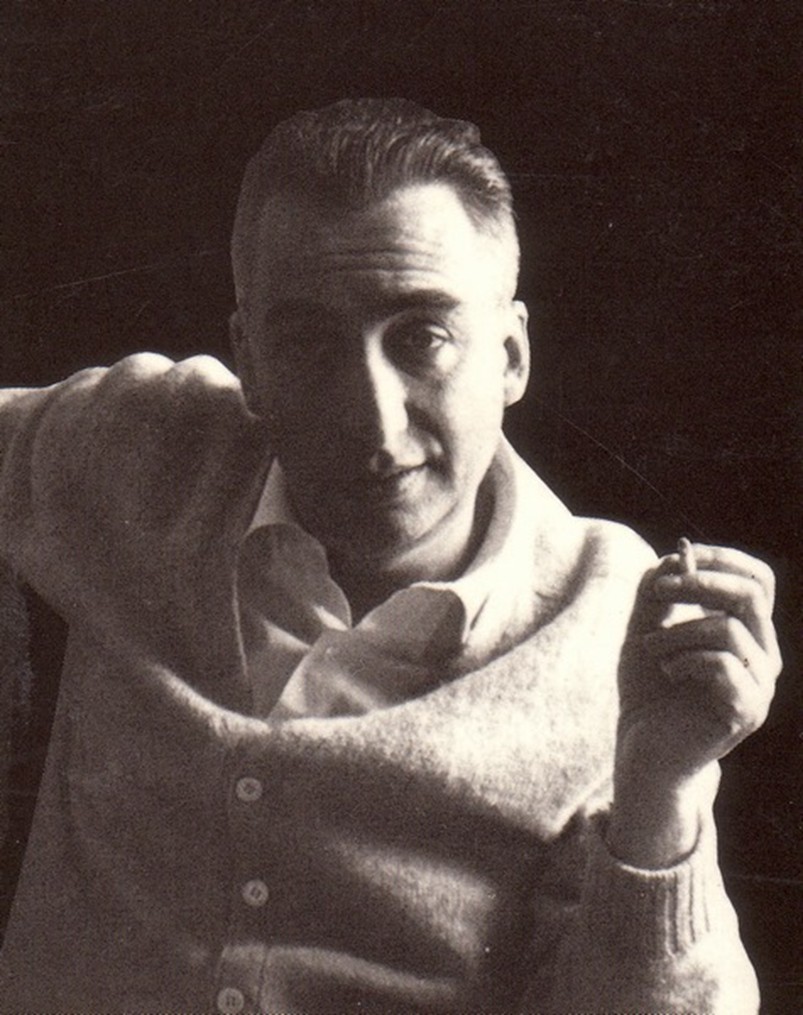
Roland Barthes (1915–1980) was a French literary critic and theorist, semiotician, and philosopher, influenced by semiotics and structuralism.
He was raised by his mother Henriette and his grandparents in the city of Bayonne. His aunt gave him piano lessons. At the age of nine, Barthes moved to Paris with his mother.
Barthes studied classical literature at the Sorbonne from 1935 to 1939. During this period, his health was fragile. He suffered from tuberculosis, among other ailments, and spent part of the war years in sanatoriums. He recounted this in Roland Barthes par (by) Roland Barthes.
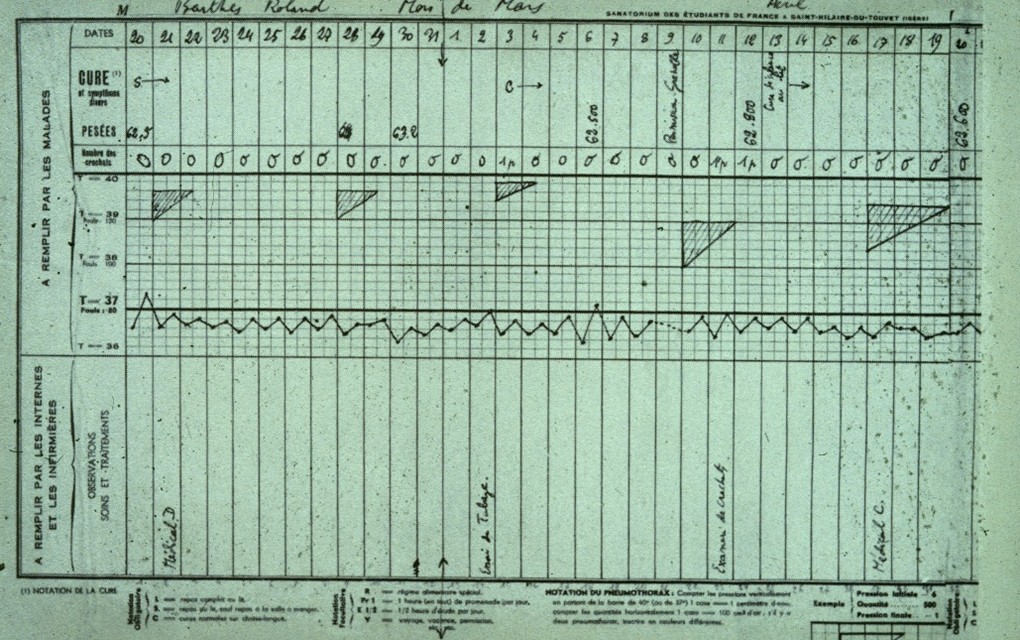
Every month a new sheet was pasted to the end of the old one; eventually there were meters and meters of it: a farcical way of inscribing his body in time. Painless, elusive illness, clean illness, without odors, without “it”; it had no other characteristics than its endless duration, and the social taboo of contagion; beyond that, one was either sick or cured, viewed abstractly, purely and solely on the basis of a doctor’s decision; and while other diseases desocialize, tuberculosis, for its part, cast you into a small ethnographic society that had something of a tribal bond, a monastic community, of a phalanstery: rites, rules, protection.
He conducted research at the Centre National de la Recherche Scientifique (CNRS) and in 1977 was appointed to a senior position at the Collège de France. That same year, his mother, with whom he had lived all that time, passed away. In 1980, his final book, La chambre claire, was published. That year, he was struck by a delivery van. He was seriously injured and died a month later, at the age of 64.
Roland Barthes has many publications to his name, of which here are a few, my favorites:
Mythologies. In 1957, he published the book Mythologies. In it, drawing on Saussure’s linguistics, he analyzes everyday images and products of popular culture (in 1950s France), including wine, Roman hairstyles in Hollywood films, steak and fries, wrestlers, the Citroën DS, and news photography. The book consists of a collection of short essays, followed by a more analytical and theoretical section.
The Death of the Author
In 1968, Barthes published the essay “La mort de l’Auteur,” in which he declares the author dead. By this he means that the author of a text does not impose the meanings that a reader derives from the text, but that the reader himself assigns meanings to the text and even continually finds different meanings.
Fragments d’un discours amoureux (1978) is, in my view, the pinnacle of his oeuvre. In this book, he definitively departs from rigid structuralism by arranging all manner of fragments on love entirely at random according to the alphabet. In this way, a different book emerges in every translation. Rigid structure is replaced by chance.
La chambre claire is one of the most beautiful books on photography.
Journal de Deuil was published long after his death, in 2009. It is based on loose notes about his mother’s death, which were found among his papers. It is one of the most beautiful books on mourning that I know.
‘Mourning’
In a monologue to AC, I explained how chaotic and irregular my mourning is, and in what ways it runs counter to the conventional—and psychoanalytic—view of mourning, which depends on the passage of time, follows a dialectical course, wears away, and is “processed.” The grief hasn’t taken anything away immediately—but on the other hand, it doesn’t fade.
To which AC replies: that is grief. (It then takes the form of the subject of Knowledge, of Reduction) – that hurts me. I cannot bear it when people reduce—generalize—my grief—Kierkegaard: “it is as if they were robbing me of my grief.”
(……)
Why can’t I stand traveling anymore? Why do I always want, like a lost little boy, to “go back home”—where Mom isn’t anymore?
Staying “in conversation” with Mom (the shared conversation was the presence) does not take place as an internal conversation (I was never “in conversation” with her), but as a way of life: I try to continue living every day according to her values: to recapture a bit of the food she used to prepare by making it myself, to maintain her domestic order, the fusion of ethics and aesthetics that was the incomparable way she lived, the way she did her daily work.
But that “personality” of the domestic and empirical is not possible while traveling—it is only possible when I am at home. Traveling is separating myself from her—even more so now that she is no longer here—she is now merely the most intimate aspect of daily life.
The spot in the room where she was ill, where she died, and where I now live—the wall where the headboard of her bed stood—there I have placed an icon—not out of faith—and I always put flowers on a table there. I’ve reached the point where I no longer want to travel, so that I can be there, so that there are never wilted flowers.
(Roland Barthes: Mourning Diary)
One last observation from Barthes:
August 24, 1979
(Last night.) At Le Flore, where I’m reading a copy of Le Monde with no major news, two young men sitting next to me (I recognize one by sight and we even exchange greetings; his regular features give him a certain beauty, but he has coarse nails) are talking at length about the wake-up service: the phone rings twice, but that’s all, even if you’re not awake yet; it’s all done by computer now, etc. In the metro, where I thought I saw quite a few young foreigners (perhaps from the Gare du Nord and the Gare de l’Est), a folk guitarist was begging in one of the cars; I carefully chose the car next to it, but at the Odeon station he himself changed cars and got into mine (he must go down the entire train that way); when I saw that, I slipped out and got into the car he had just left (that begging always bothers me as a form of hysteria or extortion, also because of its presumptuousness, as if it goes without saying that I’m in the mood for that music—or just for music—at any given moment). I got off at Strasbourg–Saint-Denis; a solo saxophone echoed through the entire station; in the bend of one of the corridors I saw a slender young Black man playing the sax and producing that deafening, ‘ reckless’ noise. The dilapidated character of the neighborhood. I located the rue d’Aboukir and thought of Charlus, who mentions it; I didn’t know it came out so close to the Boulevards.
(Roland Barthes: Parisian Evenings (published posthumously)
We leave Roland Barthes behind in his musings on life in Paris and turn left onto Rue Servandoni. It’s just a few steps, and we’re standing in front of the side entrance to Saint-Sulpice Church. This 17th-century church is located in the Parisian neighborhood of the same name. The church is dedicated to Saint Sulpicius the Pious.
The church is 118 meters long and 57 meters wide. This is not much shorter than Notre-Dame de Paris, making it the second-largest church in Paris. Beneath the church lie several crypts, which together cover nearly the same area as the church itself. Saint-Sulpice is known for its large organ (1862) by Aristide Cavaillé-Coll, which is still in its original condition.
We turn left into the church, and at the very end on your left is the Saint-Anges Chapel, decorated by Eugène Delacroix.

Eugène Delacroix (1798–1863) is regarded as the most important French painter of the Romantic era, alongside Théodore Géricault. He is also sometimes called a “literary painter” (by Baudelaire, among others) because he often drew his themes from writers.
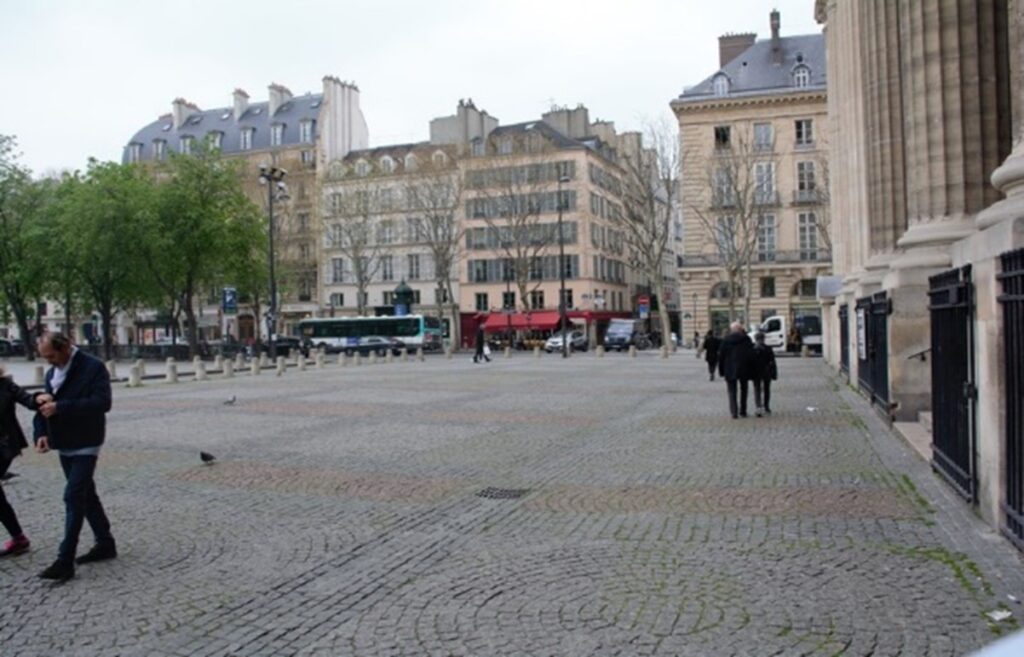
We exit the Saint-Sulpice Church through the front and arrive at Place Saint-Sulpice. Look to the right. There you’ll see the Café de la Mairie, pictured with the red awnings, made famous by Georges Perec, even though the café had a different name back then.
Georges Perec (1936–1982) was a French author. He became known for his 1969 book La Disparition, a literary thriller centered on the disappearance of the letter “e.” In the story, which spans over 300 pages, that letter does not appear even once.
In 1978, he published his magnum opus La Vie mode d’emploi, a collection of novels. ‘Novels’ in the plural, because it consists of hundreds of stories linked together by a building with nine residential floors and a basement level at 11 Rue Simon-Crubelliers in Paris. Hundreds of stories, hundreds of styles, from kitsch to luxury, from shopping lists to philosophical reflections, from nonsense to chess problems. This book was awarded the ‘Prix Médicis’.
But we are now standing on Place Saint-Sulpice, where he wrote Tentative d’épuisement d’un lieu parisien (1974), translated into English as An Attempt of an Exhaustive Description of a Place in Paris. Perec sat behind a window in the café for days on end and described what he saw.
There are many things on Place Saint-Sulpice, for example: a town hall, a tax office, a police station, three cafés—one of which sells tobacco products—a movie theater, a church built by Le Vau, Gittard, Oppenord, Servandoni, and Chalgrin, and which is dedicated to a chaplain of Chlotharius II, who was archbishop of Bourges between 624 and 644 and is commemorated on January 17, a publishing house, a funeral home, a travel agency, a bus stop, a tailor, a hotel, a fountain featuring statues of the four great Christian preachers (Bossuet, Fenelon, Hechler, and Massillon), a newsstand, a vendor of religious items, a parking lot, a beauty salon, and many other things.
A large part, if not the majority, of these things has been described, listed, photographed, recounted, or cataloged. My intention on the following pages was primarily to describe everything else: that which you usually don’t notice, that which doesn’t matter: what happens when nothing happens, except for time, people, cars, and clouds.
Date: October 18, 1974
Time: 10:30 a.m.
Location: Bar-tabac Saint-Sulpice
Weather: Dry cold. Gray sky. Occasional clearings.
An inventory of some of the immediately visible things:
- Letters of the alphabet, words: ‘KLM’ (on a hiker’s jacket pocket), a capital ‘P’ for ‘parking lot’; ‘Hotel Recarnler’, ‘St. Raphael’, ‘Savings adrift’, ‘Taxi stand beginning’, ‘Rue du Vieux-Colombier’, ‘Brasserie-bar La Fontaine de Saint-Sulpice’, ‘p ELF’, ‘Parc Saint-Sulpice’.
- Everyday symbols: arrows beneath the P’s of parking lots, one pointing slightly toward the ground, the other toward Rue Bonaparte (toward Jardin du Luxembourg), at least four one-way traffic signs (a fifth reflected in a café window).
- Numbers: 86 (on a bus from line 86, above the destination: Saint-Germain-des-Prés), 1 (sign for house number 1 on Rue du Vieux-Colombier), 6 (at the location indicating that we are in the sixth arrondissement of Paris).
- Fleeting slogans: ‘From the bus, I see all of Paris’
- Ground: piled-up gravel and sand.
- Stone: curbs, a fountain, a church, houses…
- Asphalt
- Trees (in leaf, mostly yellowing)
- A fairly large patch of sky (perhaps 1/6 of my field of vision)
- A flock of pigeons suddenly settling on the square, between the church and the fountain
- Vehicles (still to be inventoried)
- People
- A kind of basset hound
- A loaf of bread (baguette)
- A head of (curly?) lettuce sticking partly out of a shopping basket
Routes:
The 96 goes to Gare Montparnasse
The 84 goes to Porte de Champerret
The 70 goes to Place du Dr-Hayem, Maison de l’o.R.T.F.
The 86 goes to Saint-Germain-des-Prés
Ask for Roquefort Soclete, the real one in the green oval. No water is coming out of the fountain. Pigeons are perched on the edge of one of the basins. On the raised platform are benches, double benches with backrests. From where I’m sitting, I can see six of them. Four are empty. Three homeless people performing their rituals (drinking red wine straight from the bottle) on the sixth bench.
The 63 goes to Porte de la Muette
The 86 goes to Saint-Germain-des-Prés
Cleaning up is good, not making a mess is better
A bus from Germany
A Brinks van
The 87 goes to the Champ-de-Mars
The 84 goes to Porte Champerret
All well and good, this is of course a very funny description, but it’s also a kind of anti-literature. We walk into Rue des Canettes with the café on our left. At the end, we turn left onto Rue du Four and immediately right onto Rue Bonaparte. We arrive at the intersection with Boulevard St Germain, the creation of Baron Hausmann. On the right, we see the Église Saint Germain des Prés. On the left, on the corner, we see Les deux Magots, the famous café, and a little further to the left we see Café Flore, at least as well-known.
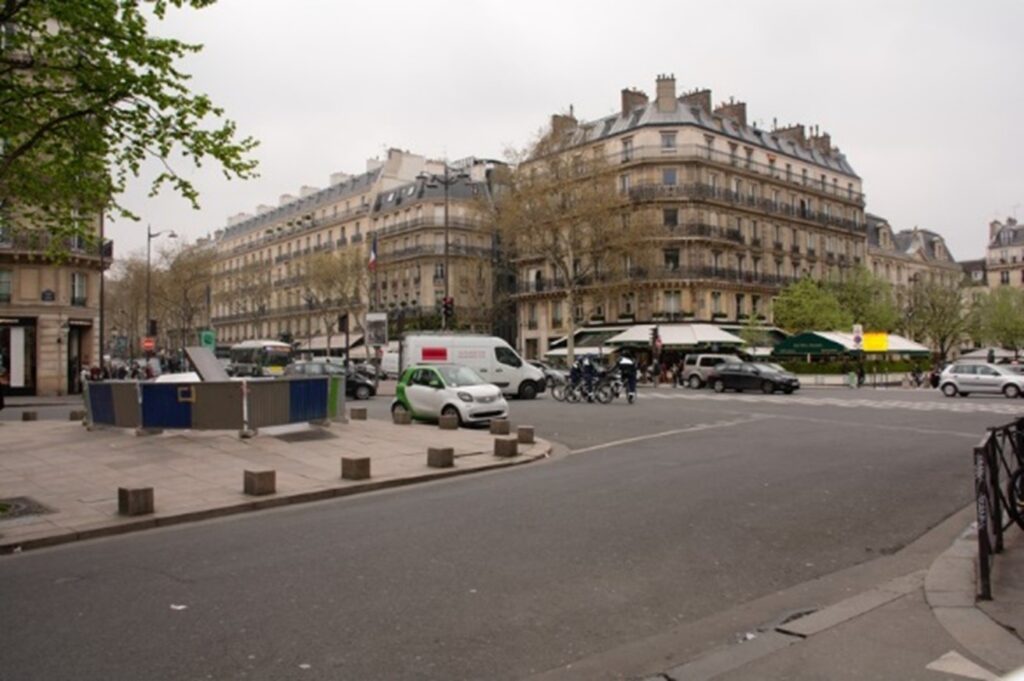
That fame stems mainly from the fact that it was a gathering place for the existentialists, the most famous of whom are Jean-Paul Sartre and Simone de Beauvoir (not to mention Albert Camus, of course).
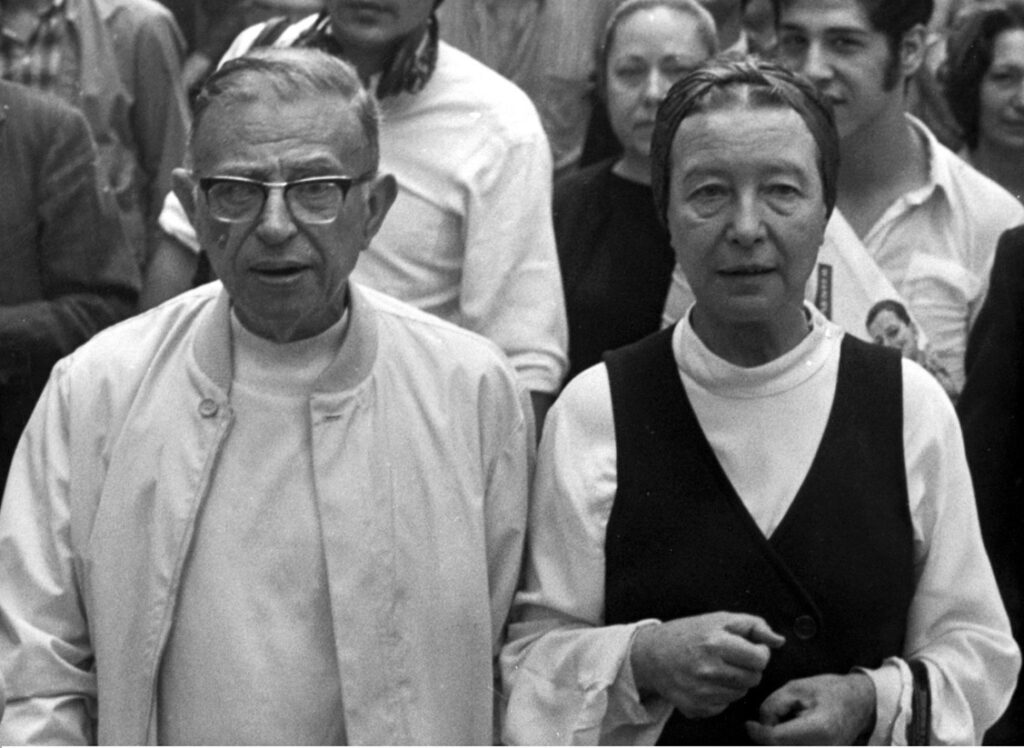
Jean-Paul Sartre (1905–1980) was a philosopher, writer, and activist. It was particularly in that last capacity that he was at risk. His apartment, located nearby, was the target of two bomb attacks by the OAS, and the French government considered arresting him. President Charles de Gaulle, however, rejected this. “You don’t arrest a Voltaire,” he said.
Sartre was involved with the literary and political quarterly Les Temps Modernes. Think of it as The New Yorker or The New York Review of Books, but much more influential.
Sartre made his literary debut in 1938 with the novel *La Nausée’, Nausea.
This is what I thought: to turn the most mundane event into an adventure, one need only tell it to someone else. This is how people are deceived: every human being is a storyteller. He lives surrounded by his own stories and the stories of others; he sees everything he experiences in the light of those stories, and he tries to live his life as if he were retelling them. But you have to choose: live or tell stories.
(…)
When you live, nothing happens. The scenery changes, people come and go—that is all. There is never a clear beginning. The days line up one after another without any discernible pattern, an endless, monotonous succession.
(…)
That is life. But when you tell your life story, everything changes. Only no one notices that change. The proof of this is that you speak of true stories. But true stories do not exist at all: the events take place in a certain order, and we tell them in exactly the opposite order. It seems as though you’re starting at the beginning. “It happened in 1922, on a beautiful autumn evening. I was a clerk at a notary’s office in Marommes.” But actually, you started at the end. The end is already invisibly present; because of the end, those few words take on the weight and value of a beginning. “I had gone for a walk; without realizing it, I had left the village behind me; I was thinking about my financial worries.” If you examine that sentence closely, it says that the first-person narrator was in a gloomy mood and was brooding. The thought of an adventure was far from his mind. He was, in fact, in the kind of mood where things happen around you without you paying them any attention. But the ending, which casts everything in a different light, is already there. To us, that man is immediately the hero of the story.
(J. P. Sartre: Nausea, La Nausée)
Sartre became famous for his plays, such as La Putain respectueuse and Huis Clos, No Exit. Three people end up in hell, only hell is not quite what they had imagined:
GARCIN The statue… (He caresses it.) Now the moment has come. Here is the bronze statue; I look at it and I understand that I am in hell. I tell you that everything was foreseen. They had foreseen that I would stand before this mantelpiece, that I would press my hand against this statue, with all those eyes fixed on me. All those eyes devouring me… (Turning abruptly) Ha! Are there only two of you? It seemed to me there were many more. (Laughs.) So this is hell, then. I would never have believed it. Do you remember: sulfur, the pyre, the roasting grid… Ha! What a joke! A roasting grid isn’t necessary: hell is the Others.
ESTELLE My love!
GARCIN (pushing her away) Leave me alone. She’s standing between us. I can’t love you if she sees me.
ESTELLE Ha! Well then, she won’t see us anymore. (She takes the folding table leg from the table, lunges at Ines, and stabs her several times.)
INES (deflecting her and laughing) What are you doing, what are you doing, have you gone mad? You know I’m dead, don’t you?
ESTELLE Dead? (She drops the knife; pause; Ines picks up the knife and stabs herself with it like a madwoman.)
INES Dead! Dead! Dead! No knife, no poison, no noose. That’s already happened, do you understand? And we’ll stay together forever. (She laughs.)
Simone de Beauvoir, 1908–1986, was a novelist and Sartre’s life partner. I consider her finest novels to be All Men Are Mortal and her autobiographical A Gentle Death, but this is a medically inspired choice.
She smiled at Fosca.
“Do you know what you should do?” she said. “Write your memoirs. That would be a very special book.”
(…)
“I’ve been writing for twenty years. And one day I realized it was always the same book.”
“But now you’re a different person,” she said. “Now you have to start a new book, too.” ’
‘A different person?’
‘You’re now a man who loves me and lives in this era. Try writing again.’
He looked at her and his face brightened. ‘I’ll do it because you want it so badly,’ he said fervently.
He kept looking at her and she thought: he loves me. I am loved by someone who is immortal. She smiled, but she didn’t feel like smiling. She was afraid. Her gaze slid along the walls. She could no longer expect any support from the world around her; she was stepping into a strange universe, where she would be completely alone with this stranger. What is going to happen? she thought.
(Simone de Beauvoir, All Men Are Mortal)
But Simone also became famous for her influential feminist book The Second Sex, published in 1949 (very ahead of its time). Sartre and De Beauvoir are buried together at Montparnasse, but that is too far off our route in this case.

Sartre died first. De Beauvoir recorded the conversations she had with Sartre shortly before his death and later published them in The Farewell (La cérémonie des adieux). I’m including an excerpt here, if only for the whiskey, the cigarettes, his failure to take his medication, and his alarmingly low (!) blood pressure of 140, combined with his frail health.
But when he arrived at Arlette’s that evening, he was in bad shape; and in the morning he had gotten up in the condition in which I now saw him: it was clear that he had suffered a minor stroke during the night. I had long feared such an incident and had resolved to keep a cool head. I cited the example of friends who had gone through a similar ordeal and had suffered no lasting harmful effects from it.
Besides, Sartre was going to see his family doctor the next morning; that reassured me somewhat, but no more than that. I had to make a special effort not to let my panic show. Sartre insisted on drinking his usual amount of whiskey, so that by midnight not a single intelligible word came out of his mouth and it took him great effort to drag himself to bed. I fought my anxiety all night long. The next morning, Liliane took him to Dr. Zaidmann. He assured me that everything was fine: his blood pressure was 180, which was normal for him, and serious treatment would begin immediately. Liliane, who called me shortly afterward, was less optimistic. According to Zaidmann, the crisis had been more severe this time than in October, and what worried him was that the symptoms had returned so quickly. One of the causes was likely that Sartre had stopped taking his medication since March; it had also been very bad for him to walk up to the tenth floor from time to time. The most important factor, however, was a serious circulatory disorder in a specific area of the brain, on the left side. In the afternoon I went to see Sartre, and I found him neither better nor worse. Zaidmann had strictly forbidden him to walk. Fortunately, his elevator was working again. In the evening, Sylvie drove us to my house and stayed with us for a while. Sartre drank only fruit juice. Sylvie was shocked by how he looked. I suppose the stroke—perhaps without him realizing it—had been a very painful shock for him; he seemed very dejected. His cigarette kept falling out of his mouth. Sylvie would pick it up, hand it to Sartre, who would take the cigarette and then let it slip from his fingers again. Over the course of that gloomy evening, that whole scene repeated itself I don’t know how many times. Since conversation was completely impossible, I put on some records, including Verdi’s Requiem, which Sartre loved dearly and which we often listened to. “Very fitting,” he muttered, a remark that chilled Sylvie and me to the bone. Shortly after that, Sylvie left, and soon Sartre went to bed. When he woke up, he felt he could barely move his right arm; it was so heavy and stiff. When Liliane came to get him for breakfast, she whispered to me: “I think he’s not doing as well as yesterday.” As soon as they left, I called Professor Lebeau at the hospital. He couldn’t come himself, but he would send another specialist. I went to see Sartre, who was at home, and at 11:30 a.m. Dr. Mahoudeau arrived. He examined Sartre for an hour and reassured me. His sensitivity was unaffected, his head was fine, and the slight slurring was due to his crooked mouth. His right hand was weak: Sartre still had trouble holding a cigarette. His blood pressure was 140: that was an alarming drop, caused by the many medications he had to take. Mahoudeau wrote a new prescription and urged us to be extremely careful over the next forty-eight hours. Sartre had to rest a lot and must not be left alone for a moment. If that advice was followed, he would be fully recovered within ten to twenty days. –
Anyway, we’re still standing on the corner of Boulevard St Germain. On our side of the boulevard, across from Flore, is the Lipp brasserie, where Hemingway often went.
At Lipp, that’s where you go to eat and have a drink or two. It was a quick walk to Lipp, and every sight I passed—which my
stomach noticed just as quickly as my eyes and nose—made this walk a heightened pleasure. There were few people in the brasserie, and when I sat down on the bench along the wall with the mirror behind me and a small table in front of me, and the waiter asked if I wanted beer, I ordered a “distinguée”—the large glass mug that held a liter—and a potato salad. The beer was very cold and delicious to drink. The pommes a l’huile were firm and marinated, and the olive oil was delicious. I sprinkled finely ground black pepper on the potatoes and dipped the bread in the olive oil. After the first big gulp of beer, I drank and ate very slowly. When the pommes a l’huile were gone, I ordered another serving and a cervelas. It was a sausage like a thick, wide hot dog split in two and topped with a special mustard sauce. I used the bread to mop up all the oil and sauce and slowly drank my beer until it wasn’t so cold anymore, and then I finished it off and ordered a demi and watched as it was poured. It seemed even colder than the distingue, and I drank half of it.
(Ernest Hemingway, A Moveable Feast)
Finally, we cross Boulevard St. Germain and walk to the church entrance.
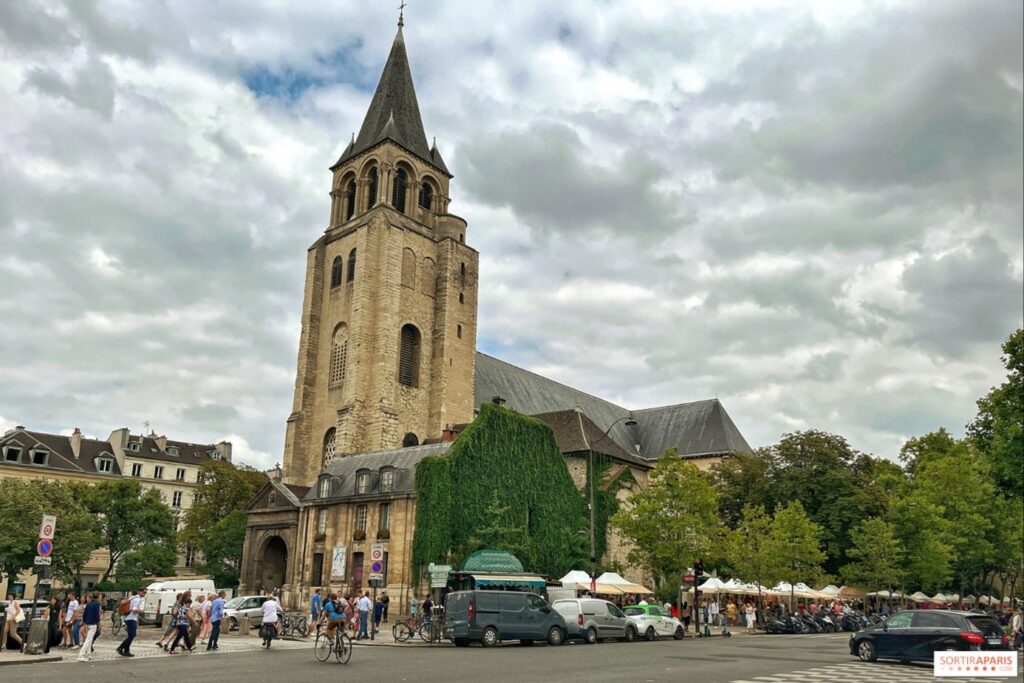
Saint-Germain-des-Prés is the oldest church in Paris and a rare example of Romanesque architecture in the city. The current church was built in the 11th–12th centuries. Earlier churches bearing this name were destroyed four times by the Normans. The church was rebuilt each time according to the original plans. Over the years, sections were gradually added, such as the portal in 1607. Fortunately, Haussmann spared the church.
A number of famous people are buried in this church, including the French philosopher René Descartes (in the right section), the philosopher Comte, and the Polish King Jan Casimir (in the left section).

Descartes’s grave
René Descartes (1596–1650) was a French philosopher and mathematician. His approach to the problem of knowledge and the nature of the human mind played an important role in the development of philosophy.
He was forced to leave France and moved to the Netherlands, where he worked for 20 years. He made contributions to mathematics, physics, and physiology. Back then, that was still possible. He became famous primarily for his Discourse on the Method (1637) and the famous doubt experiment. How could he be certain of our knowledge? He doubted everything, but ultimately not the fact that he could doubt, and he was able to doubt because he could think. Hence Cogito ergo sum, I think, therefore I am. Descartes is always accused of dualism between body and mind.
Another philosopher is buried here: August Comte, the nineteenth-century philosopher considered the founder of positivism.
August Comte’s grave

We’re leaving the church—a beautiful and colorful church, by the way—and now turning right onto Rue Bonaparte. Jean-Paul Sartre and Simone de Beauvoir lived at No. 42 from 1945 to 1962. As you can see, it’s just a few steps away from Flore. Auguste Comte lived at No. 36 between 1817 and 1822. Romy Schneider, the actress (Sissy!), lived at No. 34 in the 1970s, and Georges Wolinski lived there from 1974 to 2009. Wolinski was a cartoonist for Charlie Hebdo who was killed in the terrorist attack on the magazine in 2015.

At No. 30 is Café Le Pré aux Clercs, one of Ernest Hemingway’s favorite restaurants.

We continue down Rue Bonaparte and cross Rue Jacob. At No. 24 Rue Bonaparte, Henry Miller (1891–1980) lived between 1928 and 1930. This is where he began his relationship with Anaïs Nin. Miller wrote, among other works, Sexus, Nexus, and Quiet Days in Clichy. The 1934 novel Tropic of Cancer caused a sensation because of its explicit depictions of sex. For that reason, his novels were banned in the U.S. for a long time (and are likely disappearing there from many libraries again right now).
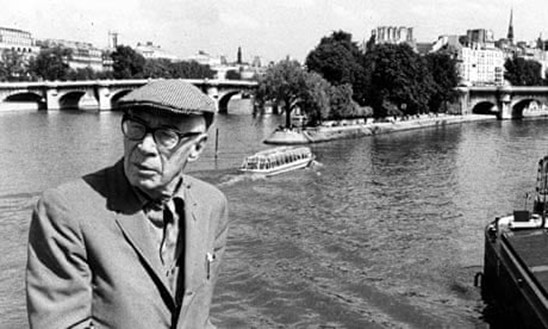
We cling to memories in order to maintain an identity that, however, can never be lost. When we realize this and arrive at the true memory, we forget everything else. “Even God,” wrote De Nerval, “cannot erase everything through death.” It began last night when I was lying on my stomach on the floor next to Minerva, pointing out to her on the map of Paris the neighborhoods where I used to live. It was a large subway map, and when I started naming the stations, I was immediately filled with delight. Then I traced my index finger from one neighborhood to the next, occasionally pausing at a street I had actually forgotten, such as the rue de Cotentin. I couldn’t find the street where I had last lived; it was a dead-end alley between the rue de l’Aude and the rue St. Yves. But I found Place Dupleix and Place Lucien Herr and Rue Mouffetard (blessed name!) and Quai de Jemmapes. There I crossed the canal via one of the wooden bridges and lost my way in the throng around the Gare de l’Est. When I came to my senses again, I found myself on Rue St. Maur. From there I walked northeast, toward Belleville and Menilmontant. At the Porte des Lilas, I got a lump in my throat.
(Henry Miller: France. Land of Memory)
Then we turn right onto Rue Visconti. This rather unassuming little street is truly brimming with (French) literature and painting. At number 26 or 28—I wasn’t entirely sure—lived Jean Racine (1639–1699) . Racine was one of the three great playwrights of seventeenth-century France (along with Molière and Corneille). Racine wrote mainly tragedies, but also one comedy (Les Plaideurs). He is considered the most important French tragedian.
At No. 19 was one of Eugène Delacroix’s studios; we had already seen one of his murals in the Saint-Sulpice Church. In the Delacroix Museum, which we won’t be visiting during this walk, another of his studios can be admired. Address: 6 Rue de Furstemberg
At No. 17, Honoré de Balzac had a printing press. Balzac was a printer between 1826 and 1828. It did not make him very happy. In 1827, he referred to himself as a “man of leaden letters.”
The business was not financially viable, and this failure led Balzac to return to literature. Illusions Perdues is his novel about the Book in all its forms, from the choice of paper and typefaces to the collection of poems, via literary critics, booksellers, journalists, and critics, without ever forgetting the material conditions of production and the costs of each edition. It is therefore no coincidence that the novel’s opening scene takes place in a printing house. Balzac also has his own museum: the house where he lived. It is too far off the route for this walk. Address: 47 Rue Raynouard.
Between numbers 8 and 12 is a small garden. In Perfume, Patrick Süskind sets the “rue des Marais” here, where the first murder is committed by Jean-Baptiste Grenouille, the man without scent in the stinking world of 18th-century Paris. Grenouille comes from the Rue du Seine, which lies ahead of us.
No hurried human scent disturbed him, no acrid gunpowder smoke. The street smelled of the usual scents of water, shit, rats, and vegetable scraps. But rising above it all, clear and distinct, was the trail that guided Grenouille. After a few steps, the faint nightlight from the sky was swallowed up by the tall houses, and Grenouille walked on through the darkness. He didn’t need to see anything. The scent guided him infallibly. After fifty meters, he turned right into the Rue de Marais, an alley that was, if possible, even darker, barely an arm’s length wide. Strangely enough, the scent didn’t grow much stronger. It merely became purer, and because of that—because of its ever-increasing purity—it also exerted an ever-greater pull on him. Grenouille walked on, as if in a trance. At one point, the scent suddenly pulled him to the right, seemingly right up against the wall of a house. A low passageway loomed ahead, leading to a courtyard. As if in a dream, Grenouille walked through this passageway, crossed the courtyard, turned a corner, and found himself in a second, smaller courtyard, and here at last there was light: the space was only a few paces square. A wooden canopy jutted diagonally forward from the wall. On a table beneath it stood a candle. A girl sat at this table, cleaning mirabelle plums. She took the fruits from a basket to her left, cut off the stems with a knife, removed the pits, and dropped them into a bucket. She was perhaps thirteen or fourteen years old. Grenouille stopped in his tracks. He knew immediately what the source of the scent was that he had smelled from more than half a mile away on the other side of the river: not this grimy courtyard, not the mirabelle plums. The source was the girl. For a moment he was so bewildered that he truly believed he had never seen anything as beautiful as this girl in his life. Besides, he could only see her silhouette from behind against the candle. Of course, he meant that he had never smelled anything as beautiful. But since he knew human scents in abundance—thousands of them—
from men, women, and children, he simply could not understand how such an exquisite scent could emanate from a human being. Usually, people smelled bland or wretched. Children smelled faint, men of urine, of sharp sweat and cheese, women of rancid fat and rotting fish. People smelled utterly uninteresting and repulsive. .. And so it came to pass that, for the first time in his life, Grenouille did not trust his nose and had to rely on his eyes to believe what he smelled.
(Patrick Süskind: Perfume)

We continue on to the T-junction with Rue du Seine. This street is home to many art galleries, and many famous people have lived here, such as Marcello Mastroianni and the aristocratic Marquis Armand de Montriveau from Honoré de Balzac’s novel La Duchesse de Langeais. On your left on Rue du Seine, at number 25, lived D’Artagnan, of the Musketeers, whose remains were rediscovered in Maastricht at the end of March 2026. He died in the Franco-Dutch War. Baudelaire lived at number 27 (he also lived at number 57, by the way). His most famous work is Les Fleurs du mal (The Flowers of Evil, 1857)

The Wine of the Ragpickers
Often, by the red glow of a gas lantern,
While the wind tugs at the flame and the glass,
Deep in an old neighborhood, a muddy labyrinth,
Where teeming humanity finds wild fermentation,
One sees a rag-picker go, head shaking,
Who stumbles like a poet, bumping into walls,
And, caring not for silent policemen whom he can
Manipulate, loses himself in a lofty plan.
He swears a solemn oath and sublimely enacts the law,
He brings down the villain, ensures that wrong is righted;
Under a starry sky like a canopy
He revels in his own virtues.
Yes, that sort of man, bent by domestic cares,
Broken by work, tormented by old age,
Worn out under the weight of all his ragged burden,
The motley refuse that Paris has produced,
Returns as he spreads the scent of casks and barrels,
With comrades who have grown gray in battle,
Whose mustaches hang like old flags.
The banners, triumphal arches, and floral splendor
Rise before them, a solemn magic!
And in the thunderous, radiant orgy
Of brass music and sun, shouts and drumbeats
Let them honor the people who drank themselves into a stupor of love!
Among frivolous humanity, the wine will circulate
Like gold, a Pactolus that will never run dry;
It sings of feats of arms thanks to man’s thirst
And reigns through its talents, like a true monarch.
(Charles Baudelaire: The Flowers of Evil)
We now turn right onto Rue du Seine. On the first corner on the left is a café (La Palette) where we can take a short break. Then we continue along Rue du Seine. Amantine-Lucile-Aurore Dupin, better known as George Sand, lived at No. 52. Her statue stands in the Jardin Luxembourg (see that walk).
At number 60 is the Hotel La Louisiane. It was built in 1823. This hotel has hosted many famous people. For example, Jean-Paul Sartre in room 10 and Simone de Beauvoir in room 68. They lived here during World War II starting in 1943. On the roof, you could sunbathe and read quietly in the evenings.
Other people who stayed here included, in no particular order, Ernest Hemingway, Quentin Tarantino, Brigitte Bardot, Charlie Parker, Miles Davis, and the Rolling Stones.
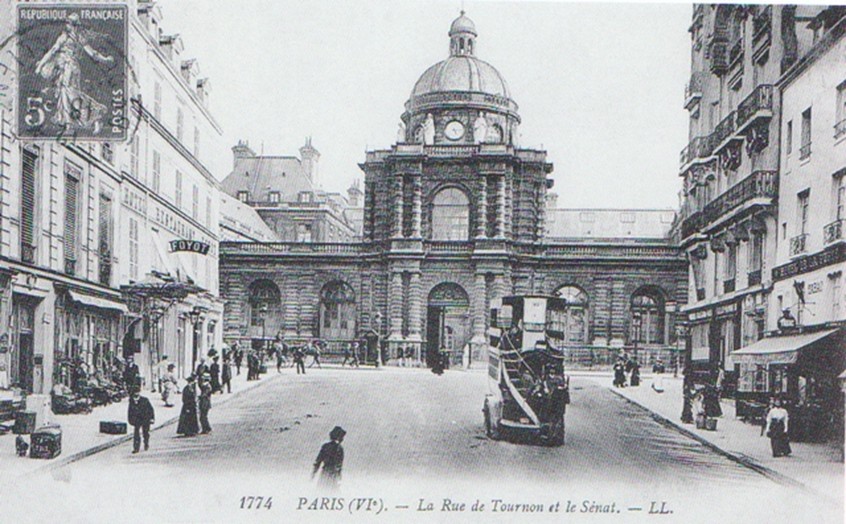
We continue walking and have now arrived back at Boulevard Saint-Germain. We cross the street. The extension of Rue du Seine is Rue de Tournon. Joseph Roth always stayed here in a hotel that no longer exists. Joseph Roth (1894–1939) was originally a journalist, but also wrote novels. In a letter to his friend Stefan Zweig dated November 2, 1937, he wrote about the hotel where he was staying.
Dear friend, This is not a letter, merely a note to inform you that I have a new address. Hotel Foyot is being demolished by order of the magistrate, and I left there yesterday as the very last guest. The symbolism has become all too cheap. I therefore very much fear that what you sent me has been lost. I kindly ask you to reply as soon as possible.
Your old friend Joseph Roth
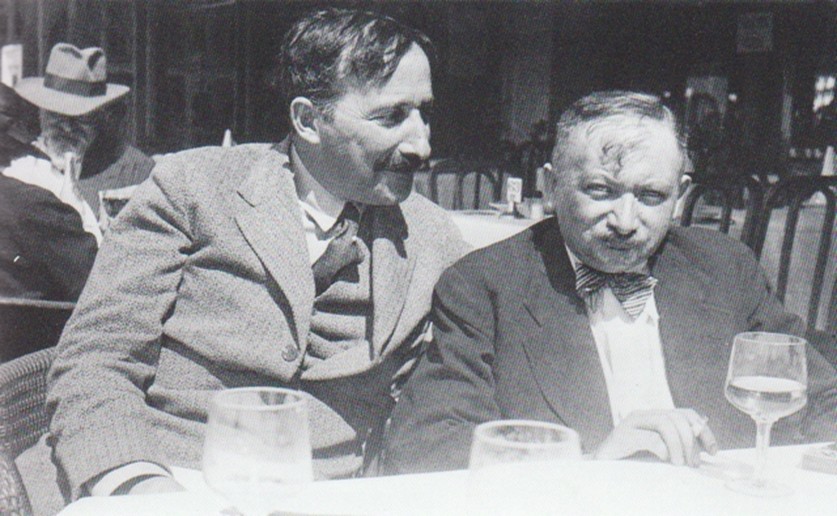
Stephan Zweig and Joseph Roth in Ostend
Peace in the Face of Destruction
Across from the bistro where I sit all day, an old house is currently being demolished—a hotel where, apart from my travels, I lived for sixteen years. The night before last, one wall was still standing, the back wall, waiting out its final night. The other three walls had already been torn down, turned to rubble, on the partially cordoned-off site. How remarkably small this place seemed to me today compared to the grand hotel that once stood there! It is as if an empty space is smaller than one that is built up. But perhaps these sixteen years, now that they are over, seem so precious to me, so full of treasures, that I cannot comprehend that they unfolded in such a humble place. And because the hotel is now as shattered as the years I spent there have passed, it also seems much larger in my memory than it may have been.
On the last wall I still recognized the wallpaper from my room, a sky-blue, softly gold-marbled wallpaper. Yesterday they had already erected a scaffold; two workers were standing on it. With a pickaxe and sledgehammer they struck at the wallpaper, on my wall; and when it had become brittle and crumbly, the men tied ropes to it —the wall on the scaffold. The men came down and the scaffold was dismantled. On either side of the wall, the ends of the ropes hung down. The men each pulled on an end. And with a roar, the wall collapsed. A white, dense cloud of lime mortar shrouded the event. Then the two men emerged from that cloud, white with dust, like two mighty millers grinding stones. They came straight toward me, just as they do every day, several times a day. They’ve known me since I’ve been here. The younger one pointed his thumb over his shoulder and said, “Now it’s gone, your wallpaper!”—I invited them to have a drink with me, as if they had built a wall for me. We joked about the wallpaper, about the walls, about my precious years. The workers were demolition men: tearing things down was their trade; they weren’t cut out for building. “And that’s just as well,” they said. “To each his own trade, and credit where credit is due! This is the king of the demolition men,” said the youngest. The oldest started laughing. They were in good spirits, the demolition men, and so was I. Now I sit facing the empty space and hear the hours slip by. That’s how you lose one homeland after another, I tell myself. Here I sit with my walking stick. My feet are worn out, my heart is weary, my eyes are dry. Misery sits down beside me, growing ever softer and deeper; the pain remains standing, becoming strong and benevolent; fear pounds away at it and can no longer instill fear. And that is precisely what is so desolate.
(From: Joseph Roth: Hotelman)
At the intersection with Rue des Quatre Vents, we turn left onto Rue des Quatre Vents. The narrator of Confession of a Murderer, told in a single night, by Joseph Roth, lives on this street.
A few years ago, I lived on Rue des Quatre Vents. Across from my windows was the Russian restaurant Tari-Bari. I often went there to eat. You could get beetroot soup, fried fish, and boiled beef there at any hour of the day. I sometimes got up late. The French restaurants, where people strictly adhered to the usual lunch hours, were already making preparations for dinner. But in the Russian restaurant, time played no role. A tin clock hung on the wall. Sometimes it stood still, sometimes it ran unevenly. It seemed not to want to tell the time, but to mock it. No one looked at the clock. Most of the guests in that restaurant were Russian émigrés. And even those among them who might have had a sense of punctuality and precision in their homeland had lost it in a foreign land, or were ashamed to show it.
It was as if the emigrants were deliberately protesting against the calculating, all-calculating, and oh-so-calculated mentality of the European West, as if they were doing their best not only to remain true Russians, but also to pass as “true Russians” and live up to the image the European West had formed of Russians. The clock in Tari-Bari, running slow or standing still, was thus more than a mere prop: it was a symbolic prop. The laws of time seemed to have been suspended.
(Joseph Roth: Confession of a Murderer. Told in One Night)
We continue walking and arrive at the Carrefour de l’Odeon, where we turn right onto Rue de l’Odeon. This street was once home to two famous bookstores. At number 7, Adrienne Monnier opened her bookstore La Maison des amis des livres in 1915, and at number 12, Sylvia Beach established her bookstore Shakespeare and Company after initially being located at 8 Rue Dupuytren. In 1922, she published James Joyce’s Ulysses. That was a daring act, and the beginning of Joyce’s career. During World War II, the shop closed in 1941 and did not reopen after the war, despite the fact that Ernest Hemingway personally helped liberate it.
At that time, there was no money to buy books. I got my books from the lending library, Shakespeare and Company, which was Sylvia Beach’s library and bookstore at 12 Rue de l’Odeon. Located on a cold, windy street, this was a warm, cozy spot with a large stove in the winter, tables and bookshelves, new books in the window, and photos on the wall of both deceased and living famous authors. The photos were all just snapshots, and even the dead writers looked as if they had truly lived. Sylvia had a lively, sharply defined face, brown eyes as alert as those of a small animal and as cheerful as those of a young girl, and wavy brown hair combed back from her finely chiseled forehead and cut short below her ears, even with the collar of the brown velvet suit she was wearing. She had shapely legs and was friendly, cheerful, and interested in others, and she loved jokes and small talk. No one I have ever known has been kinder to me. I was very shy when I first walked into the bookstore, and I didn’t even have enough money in my pocket to join the lending library. She told me I could pay the membership fee when I had it, issued a card for me, and said I could take as many books as I wanted.
(There was absolutely no reason for her to trust me. She didn’t know me, and the address I’d given her—rue Cardinal Lemoine—couldn’t have been more shabby. But she was pleasant and charming and hospitable, and behind her, all the way up to the ceiling and into the back room overlooking the building’s courtyard, were shelves upon shelves filled with the riches of her library. I started with Turgenev and took the two volumes of A Sportsman’s Sketches and one of D.H. Lawrence’s early books, Sons and Lovers, I believe, and Sylvia told me to take more books if I wanted. I chose the Constance Gamett edition of War and Peace and The Gambler and Other Stories by Dostoevsky. “If you read all that, you won’t be coming back anytime soon,” said Sylvia. “I’ll come back to pay,” I said. “I still have some money at home.” “That’s not what I meant,” she said. “Just pay whenever it’s convenient for you.” “When does Joyce come here?” I asked. “When he comes, it’s usually late in the afternoon,” she said. “Haven’t you ever seen him?” “We saw him eating with his family at Michaud’s,” I said. “But it’s not polite to stare at people while they’re eating, and Michaud’s is expensive.”
And, following up on an earlier quote about hunger:
There was a fountain with lions, and the pigeons walked in the middle of the street and perched on the statues of bishops. There was the church and the shops selling religious articles and ornaments on the north side of the square. ,,, From this square, you couldn’t go any further toward the river without passing shops selling fruit, vegetables, and wine, or bakeries and pastry shops. But if you chose your path carefully, you could turn right around the gray-white stone church and reach the rue de l’Odeon, then turn right toward Sylvia Beach’s bookstore, and along the way you wouldn’t encounter too many places selling food. Rue de l’Odeon had no places to eat until you reached the square where there were three restaurants. By the time you reached 12 Rue de l’Odeon, your hunger had subsided, but your powers of observation were all the sharper. The photos looked different, and you saw books you had never seen before. “You’re too skinny, Hemingway,” Sylvia always said. “Are you eating enough?”
(Ernest Hemingway, A Moveable Feast)
Shakespeare and Company is back in Paris now, but on the Seine. We’ll end our next walk there.
At No. 21 on Rue d’Odeon lived the Romanian philosopher Emil Cioran, known for works such as *The trouble with being born’.
We forget the body, but the body does not forget us. Cursed memory of the organs!
At the end of the street is the Place de l’Odeon with the Odeon Theater. This is one of France’s six national theaters. Built between 1779 and 1782. Originally intended for the Comédie Française, but they preferred to stay at the Palais Royal. The theater burned down, like so many theaters, in 1818. It reopened in 1819 and has since been a famous theater where many chansonniers have performed.
We are almost at the end of this walk. We turn left onto Rue Casimir Delavigne, and then left again onto Rue Monsieur le Prince. Then right onto Rue Dupuytren, named after the physician Baron Guillaume Dupuytren (1777–1835). He was a French surgeon, best known as the discoverer of Dupuytren’s contracture. He worked at the Hôtel-Dieu Hospital in Paris and became deputy head of the clinic in 1808. Under his leadership, the Hôtel-Dieu Hospital became one of the most prestigious hospitals in Europe. In 1831, he described a condition of the hand characterized by the formation of hard lumps in the palm; the contracture.
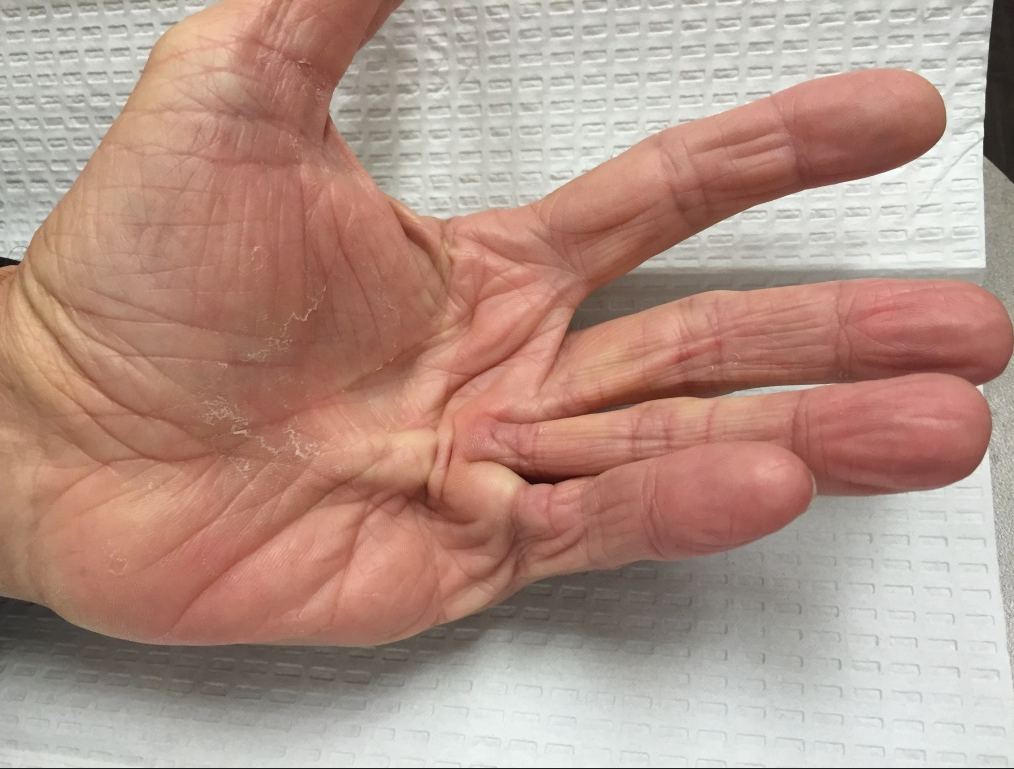
At No. 8 Rue Dupuytren was the first store of Shakespeare and Company, before they moved to Rue d’Odeon. We now turn right onto Rue de l’École de Médecine. There is the Descartes University, home to the Museum of the History of Medicine and the painting depicting Jean Martin Charcot’s clinical lecture. See On the spot nr 1 in Paris, about Jean Martin Charcot.