How to get there (public transport): RER H Gard du Nord to Pontoise, change at Saint-Ouen-l’Aumône
Costs
Musée Dr. Gachet: 5 euros
Château of Auvers: 12 euros
Musée du Absinth : 6 euros
Auberge Ravoux: 10 euros
Tree roots : 6 euros
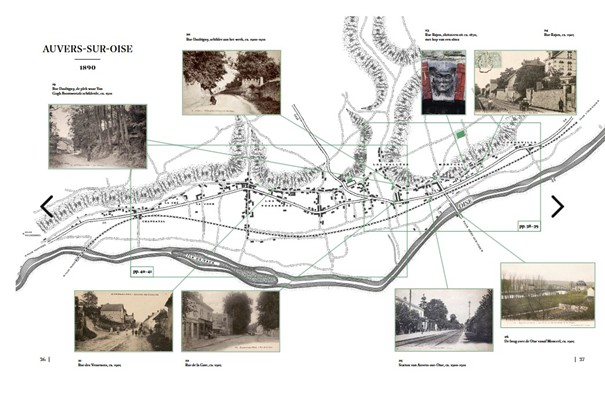
After his stay in St Rémy de Provence, Vincent van Gogh left for the north again. That took some doing, as evidenced by his letter of May 4, 1890, to his brother Theo:
Thank you for your kind letter and for the portrait of Jo, which is very nice and very successful in terms of pose. I will be very simple and as practical as possible in my reply. First of all, I categorically reject what you say, that I must be accompanied throughout the journey. Once I am on the train, nothing can happen; I am not dangerous—even if I have an attack, aren’t there other passengers in the carriage, and don’t they know what to do in such a case at every station? You are worrying about this so much that it is weighing heavily on me and I am in danger of losing heart.
I just said the same thing to Mr. Peyron and pointed out to him that seizures like the one I just had were always followed by three or four months of complete calm. I want to use that period to move—I want to move in any case, my desire to leave here is now absolutely certain.
I do not feel able to judge the way in which they treat the sick here, I do not feel the need to go into details.
He decided to go, via Paris, to Auvers sur Oise, an (artists’) village northwest of Paris. In Paris, he meets Jo, his brother’s wife, for the first time. He could not have imagined how important she would become in his growing fame. The same applies to Theo and Jo’s young son. He writes to Theo and Jo from Auvers on May 20, 1890:
Now that I have met Jo, it will be difficult for me to write to Theo alone in the future, but Jo will hopefully allow me to write in French, because really, after two years in the South, I think I can better express what I have to say that way. Auvers is very beautiful—among other things, there are many old thatched roofs, something that is becoming rare.
So I hope that by making a few serious paintings of it, I will be able to recoup my accommodation costs—because it really is very beautiful, it is completely rural, characteristic, and picturesque.
Even then, in 1890, you could get to Auvers by train, as recorded by Van Gogh.
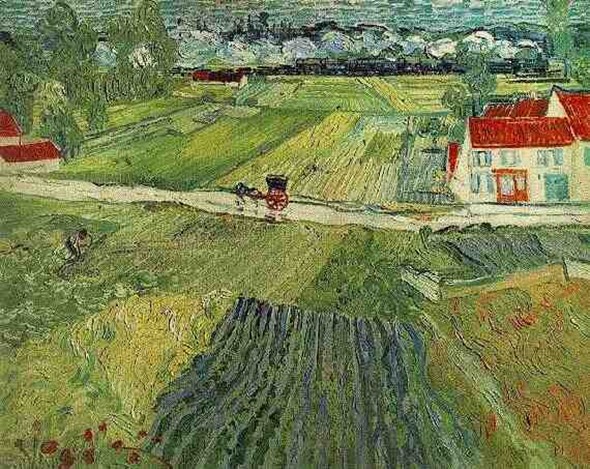
Oil on canvas. 72.0 x 90.0 cm. Auvers-sur-Oise: June, 1890. Moscow: Pushkin Museum
Now you take the RER H from Paris Nord towards Pontoise and then change at Saint-Ouen-l’Aumône for the train to Auvers-sur-Oise. There are also other routes, including via Valdomois and then the bus or train. Or take the train to Méry-sur-Oise, and then enjoy a beautiful walk to Auvers with stunning views of the village along the way.
Van Gogh had two reasons for going to Auvers: a concrete reason: Dr. Paul Gachet, and an idealistic reason: Charles-François Daubigny. Let’s start with the latter.
Charles-François Daubigny was one of the painters he admired, and Daubigny had lived and worked in Auvers.
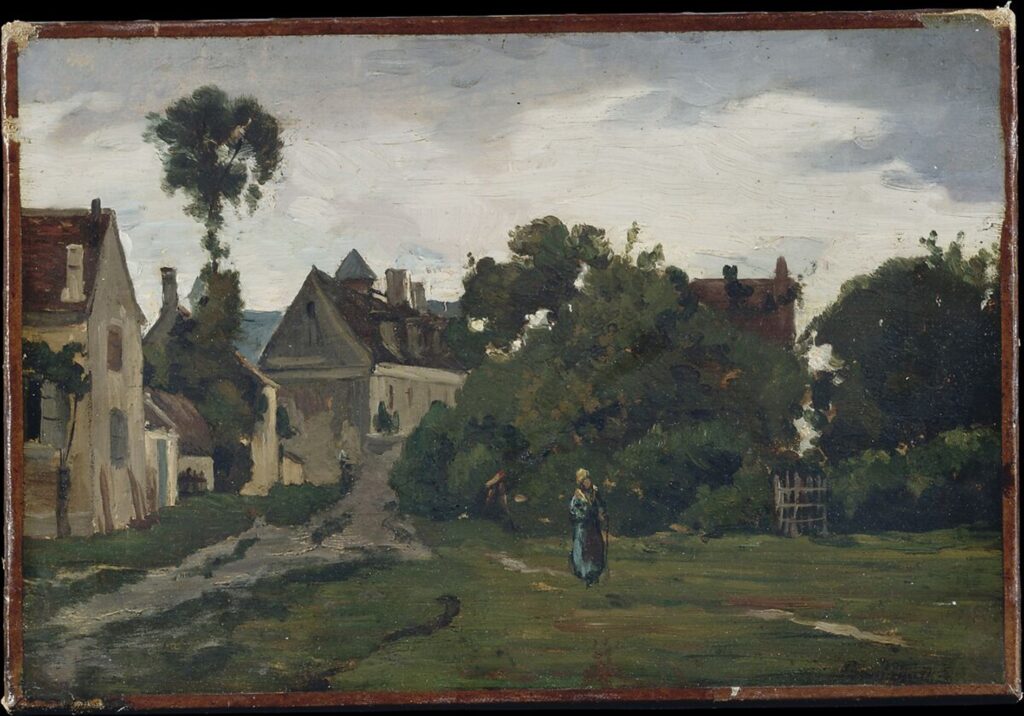
Charles-François Daubigny – View of Auvers-sur-Oise – The Metropolitan Museum of Art, New York
Daubigny had died in 1878 (his grave is in Père Lachaise in Paris), but his wife was still living in Auvers when van Gogh arrived there. Van Gogh sought her out and painted the garden of Daubigny’s house several times. We will pass it on our walk.
The other reason was, as mentioned, a concrete and much more important one. Dr. Paul Gachet worked in Paris during the week, but had been living in Auvers with his two children and housekeeper since 1873. Vincent was still not fully recovered and could use his (medical) help. From the letter of May 20:
I have seen Dr. Gachet, who struck me as rather eccentric, but his experience as a doctor will probably keep him balanced in his struggle against the mental illness from which I believe he suffers as much as I do.
(….)
You will probably see Dr. Gachet this week—he has a very beautiful Pissarro, Winter Landscape with Red House in the Snow.
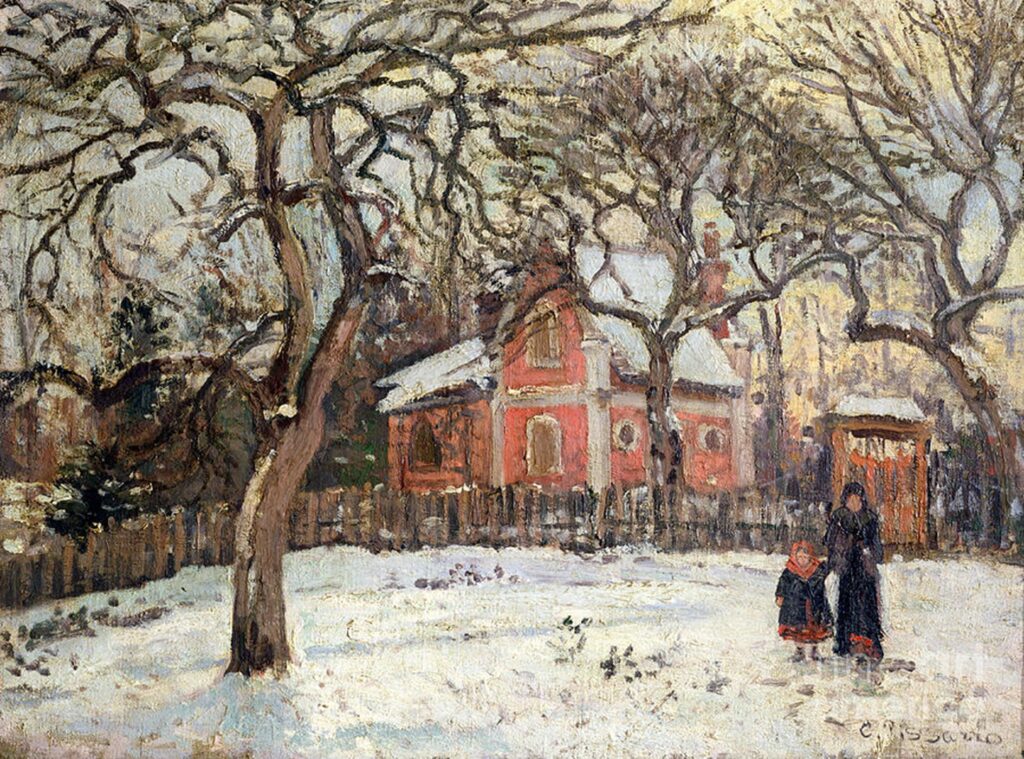
Camille Pissarro Chestnut Tree in Louveciennes 1872
And two beautiful bouquets by Cézanne. And another Cézanne of the village. For my part, I would very much like to do something with the brush here.
(…)
His house is full of very dark old junk, with the exception of a few sketches by the aforementioned Impressionists. Although he is a strange fellow, he does not make an unfavorable impression on me. When he talks about Belgium and the time of the painters of yesteryear, a smile returns to his grief-stricken face, and I think I will remain friends with him and that I will paint a portrait of him. He also tells me that I must work hard and steadily and not think at all about what I have had.
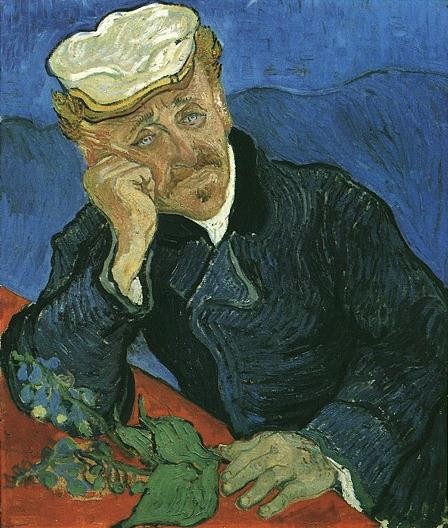
Oil on canvas. 68.0 x 57.0 cm. Auvers-sur-Oise: June, 1890 Musée d’Orsay, Paris, (May 25, 1890)
Thank you for your letter, which I received this morning, and for the fifty francs it contained.
Today I saw Dr. Gachet again and I am going to paint at his house on Tuesday morning, then I will have lunch with him and afterwards he will come and look at my paintings. He seems very sensible to me, but he is just as discouraged in his profession as a country doctor as I am in my painting. So I told him that I would like to swap professions with him. Anyway, I am confident that we will eventually become friends. He told me that if my melancholy or whatever becomes unbearable, he could do something to alleviate it and that I could be completely honest with him. Well, that moment when I will need him may of course come, but so far things are going well. And they could get even better; I still believe that what I have contracted is mainly a disease of the South and that my return here will make it all disappear.
(….)
But you will see, his house is like an antique shop, crammed full of things that are not always worthwhile; it is even terrible. But the good thing about it is that there is always something to arrange flowers or still lifes. I made those studies for him to show him that we will always reward him for what he does for us, even if we do not pay him in money.
Dr. Gachet’s house is still standing and is now a museum. We’ll go there in a moment, but first some more information about Auvers. There are van Gogh stones here too.

According to Wikipedia, Auvers has 6,820 inhabitants. So Auvers is not very big. It is located on the Oise, a medium-sized river that rises in Belgium and flows into the Seine at Conflans-Sainte-Honorine after 351 km.
Once at the station, there are roughly two options for visiting Auvers. You can turn left immediately into Auvers, or you can first take a walk west along the river (on the rive droite) and then return to Auvers from the south. Those who walk along the river can take a circular route through Auvers, passing all the important places. Those who walk into Auvers first will also encounter all these places, but will almost inevitably have to walk back and forth to Dr. Gachet’s house.
We therefore walk along the river first, a river that, curiously enough, hardly attracted Van Gogh. He made only one painting and one watercolor of it. That is not much, considering that he made 74 paintings in Auvers in 70 days. And that’s not even counting the drawings.

The Bank of the Oise at Auvers. Oil on canvas, 73.3 x 93.7 cm. Auvers-sur-Oise: July, 1890. Detroit: The Detroit Institute of Arts
We start our walk. First, we cross the railroad tracks (via the tunnel) and then walk down the parking lot to Rue Montmauer. Turn right and then left again onto Rue du Bac. At the river, turn right onto the footpath. It is a beautiful walk along the river. Rue du Belle Rive further along the river, at the end turn right and then left again, Rue des Gords and then right onto Rue Rémy until Rue du Dr. Gachet. Just before that, at the end of a small alley on the right, the first one after the intersection of Rue Rémy and Rue François Villon/Parmenier, is the small house where Cézanne stayed in 1873.
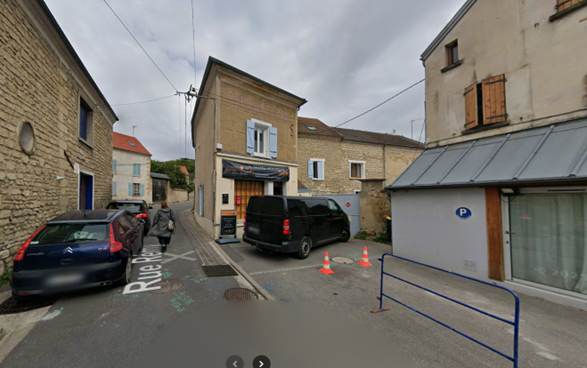
You will soon see Dr. Gachet’s house. Admission is €5, and for that you get an impression of how Dr. Gachet lived. It’s a nice museum, but nothing more. Vincent’s description still applies.
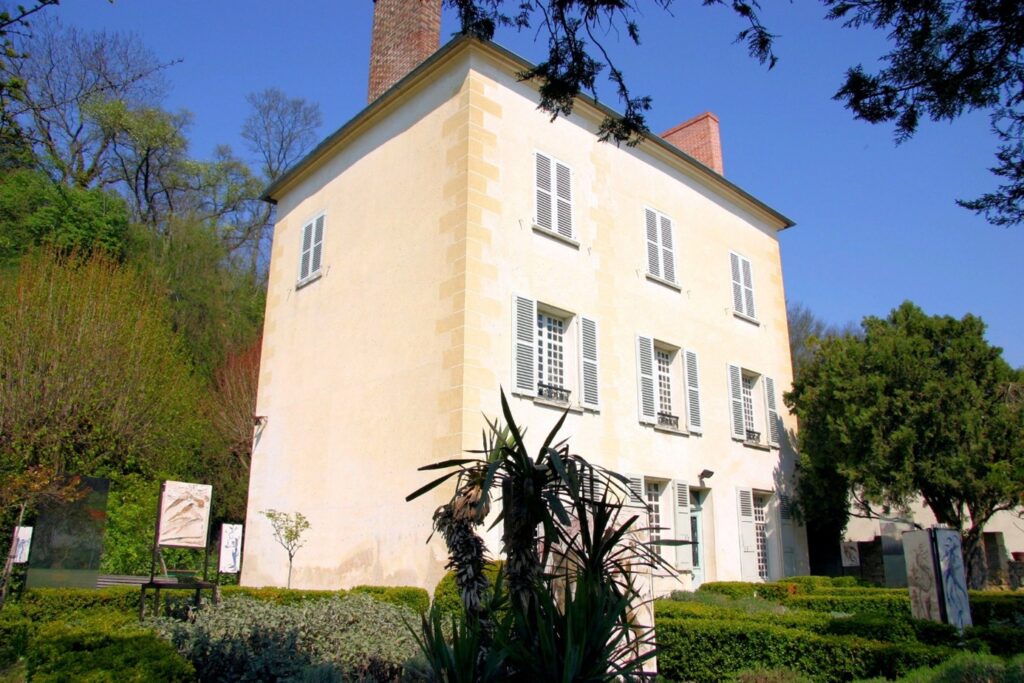
After the visit, continue north on Rue du Dr. Gachet (turn left when you leave the house). After a while, this road becomes Rue Victor Hugo and at one point crosses a provincial road (entirely in style the Rue de Zundert). Across the street on the left is the castle of Auvers. You can visit it; when I was there in September 2025, there was a Van Gogh exhibition. For €12, you get a tour of posters (!) of Van Gogh paintings and yet another biography. The castle has been so extensively renovated that the interior has almost completely disappeared. And at the end, yet another Van Gogh shop…
We continue on the same road, now called Rue Léry, passing under the arch. Turn right onto Rue Alphonse Calle, and on that road, on the left-hand corner, is a delightful museum, the absinthe museum.
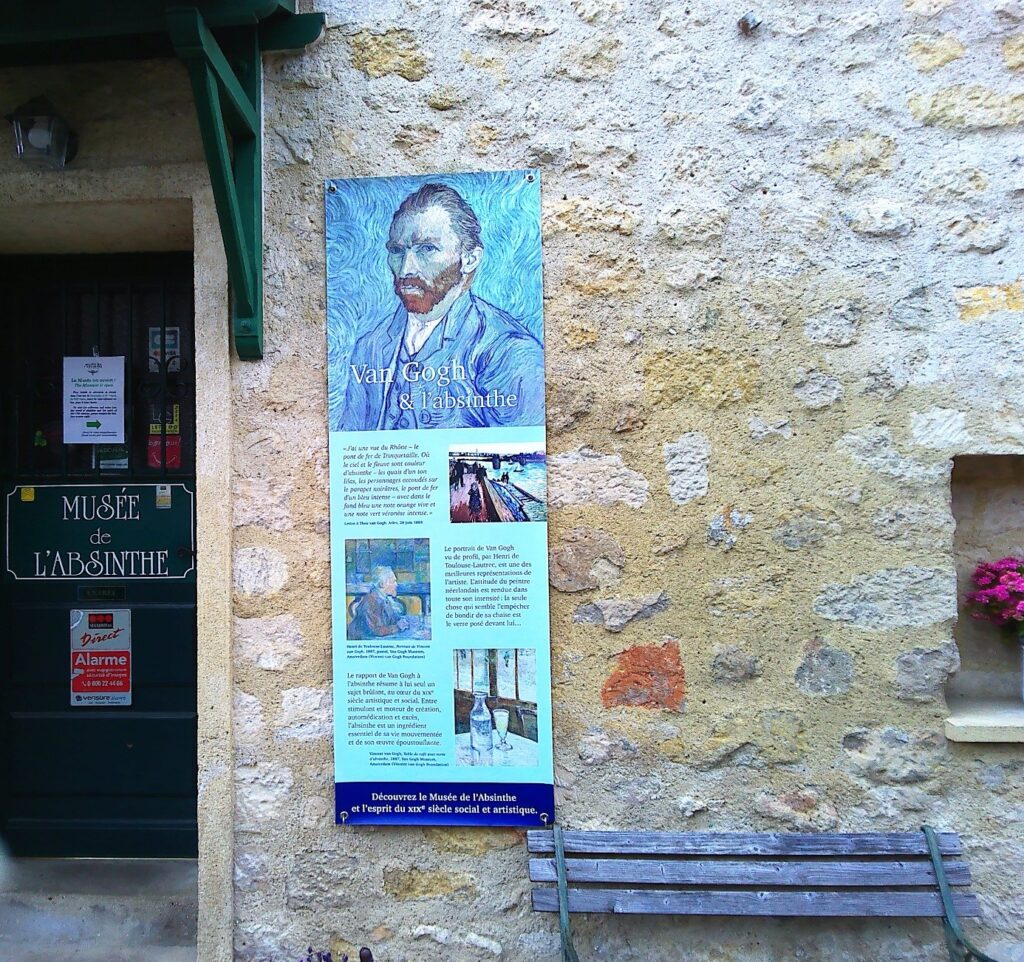
First, we are led through the garden, where many of the herbs used in absinthe are grown. Then the museum door is unlocked, the lights are turned on, and I am allowed to wander solo through the museum’s three rooms. Absinthe is both healthy and delicious as well as dangerous and deadly, it turns out.
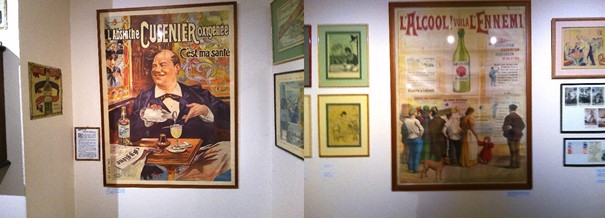
A staircase leads down to a café-like space where absinthe can be consumed. I declined, so I don’t know if that is included in the €6 price.
Back to Rue Léry, continue down the road to Rue Daubigny. Turn right towards the center of Auvers, insofar as there is a center, and walk past the Daubigny museum. Turn left and walk past Daubigny’s maison/atelier, a beautiful little museum that (when open) is well worth a visit. It is still run by Daubigny’s family. We continue on our way to the site of one of Van Gogh’s most famous paintings. We turn right onto Sante du Montier (on the corner is a magnificent house, Villa Corot, where the American artist Robert Wickenden once lived, who also met Van Gogh in Auvers). It’s a bit of a steep climb. On the left are the kind of roots we know from the last painting (although that location is somewhere else). At the top, there is an open plain. For the real experience, you should come here in mid-June, when the grain is tall, two weeks before it is harvested.

Because that is the image that belongs with this painting. Fortunately, the sign is there for clarity. Strictly speaking, we do not know whether this is really the place where Van Gogh painted this work: there are more three-way intersections in the fields around Auvers, but it could well be. Daubigny also painted in this area.
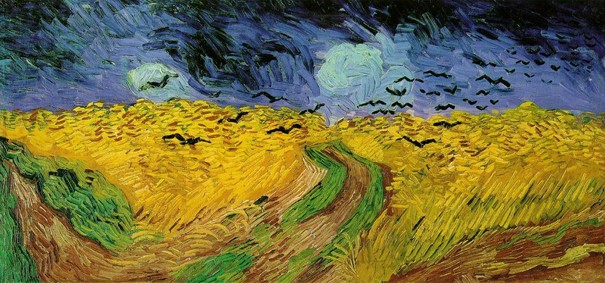
After a visit to Paris, Van Gogh wrote about this on July 10
Back here again, I still felt very depressed and felt the storm that threatens you continue to weigh on me. What to do—look, I usually try to be fairly good-humored, but my life has also been affected at its roots, and I too am no longer standing firmly on my feet. I was afraid—not terribly, but a little—that I was a threat to you because I live at your expense—but Jo’s letter is living proof to me that you realize very well that I work just as hard and toil just as much as you do.
So—back here, I have returned to work—although the brush almost falls out of my hand and—because I knew exactly what I wanted, I have since painted three more large canvases. They are immense, sprawling cornfields under stormy skies, and I have deliberately tried to express sadness and extreme loneliness in them. You will see them soon, I hope — because I hope to bring them to Paris for you as soon as possible, as I am almost certain that these canvases will tell you what I cannot express in words: how healthy and heartening I find the countryside.
There is indeed much to say about this painting, and that has been done. I will stick to the view that the crows are just crows, and not harbingers of his death, and that the corn is about to be harvested before the storm breaks.
We continue along the unpaved country road, straight ahead until we reach the cemetery. Vincent and Theo are buried there. Theo died a few months after Vincent in the Netherlands and was also buried there, but in 1914 he was reburied next to his brother in Auvers.

However, Vincent is not the only painter buried here. The Dutch painter Corneille was also buried here fairly recently. Corneille lived in Auvers.
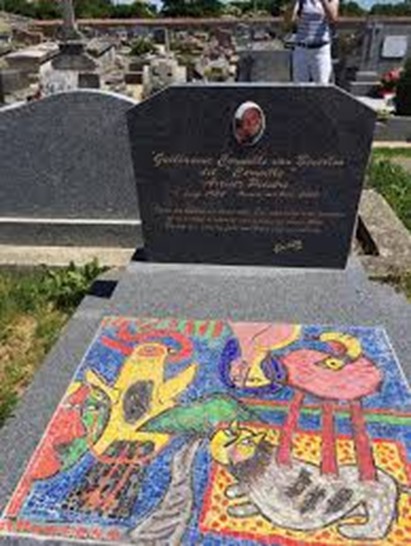
Via the Ave. de Cimetière, we walk back down to Auvers and then straight to the church of Auvers, also immortalized by Van Gogh.
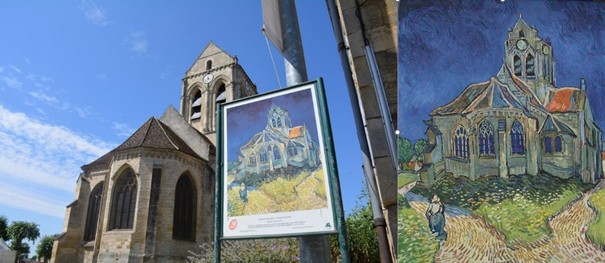
Oil on canvas, 94.0 x 74.0 cm. Auvers-sur-Oise: June, 1890. Paris: Musée d’Orsay
Whereas in Arles we came across bridges and cafés that were partly built by looking closely at the painting, I’m exaggerating a little, this church is still Van Gogh’s church.
We have now almost completed our walk through Auvers. We walk to the Rue du Général de Gaulle and see the station again on our left. Now we continue on our way to three more sights. First, on the right-hand side, is the Parc van Gogh. There is the Auvers tourist office, with, unsurprisingly, a Van Gogh shop. But, interestingly, there is a statue of Van Gogh in the park, made by Zadkine.
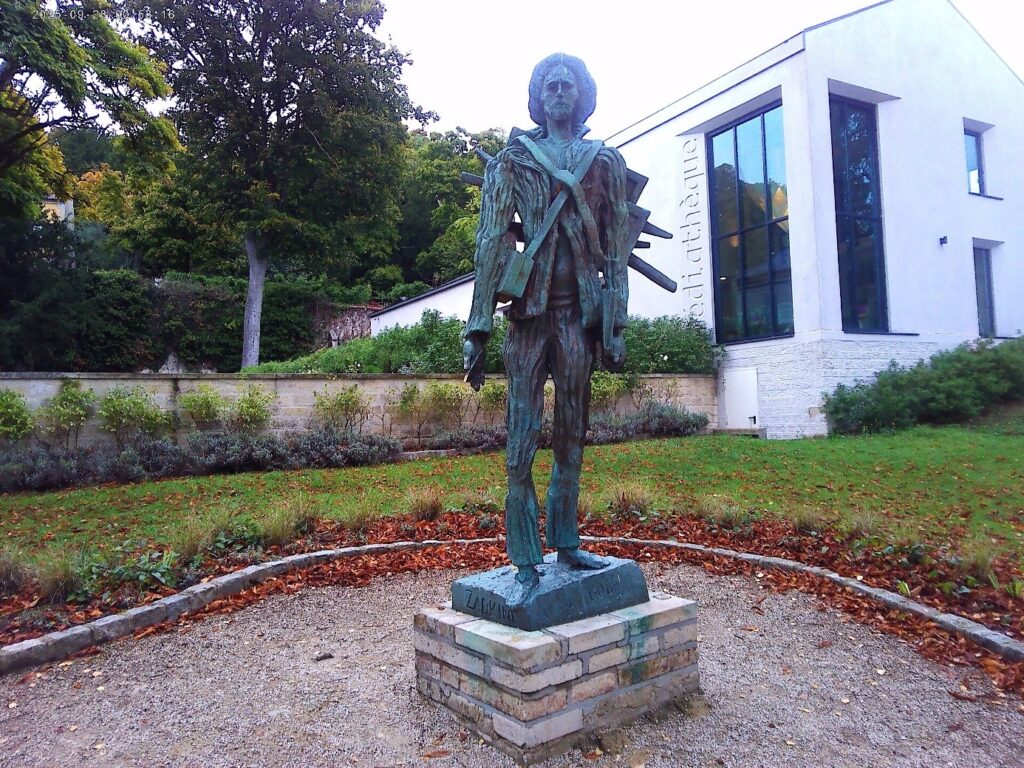
We continue on our way, passing signs with paintings by Van Gogh, just like in Arles and St Rémy. Then, on the right-hand side, we see the Auberge Ravoux. But first, let’s take a look to the left, because the town hall of Auvers also closely resembles the painting by Van Gogh, made on July 14, 1890.
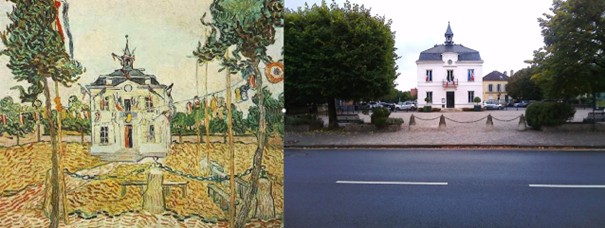
Oil on canvas. 72.0 x 93.0 cm. Auvers-sur-Oise: July, 1890. Spain: Private collection
Van Gogh stayed at the auberge. He wrote about it:
He (Dr. Gachet) took me to an inn where they charged 6 francs a day. For my part, I found one where I will pay 3.50 francs per day. And I think I should stay there until further notice.
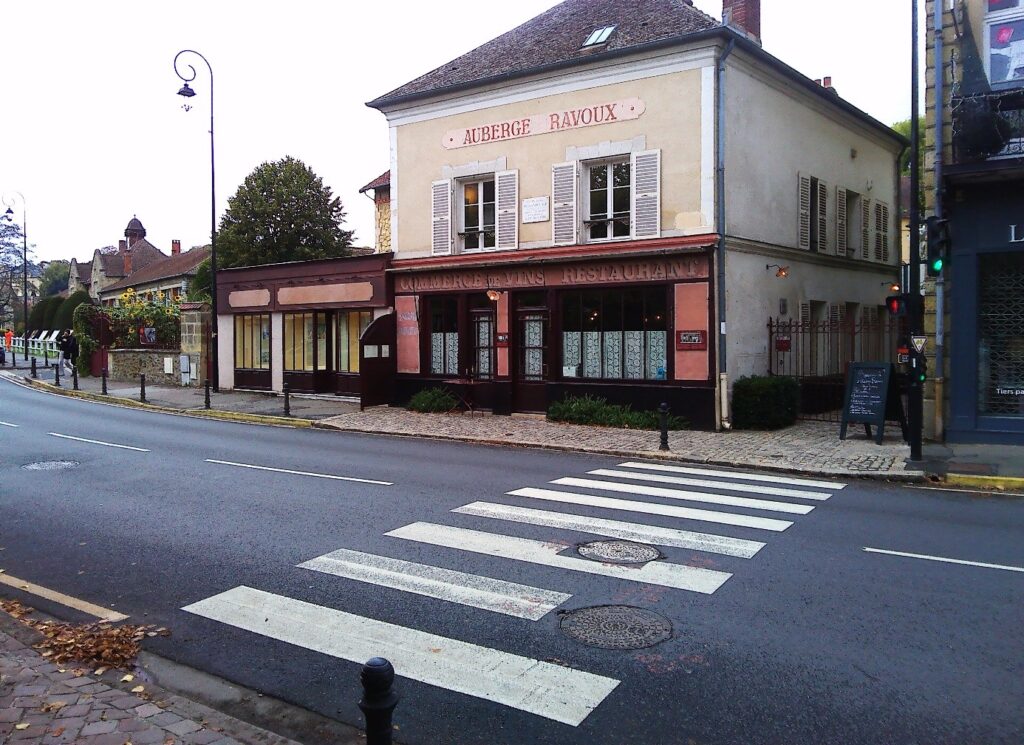
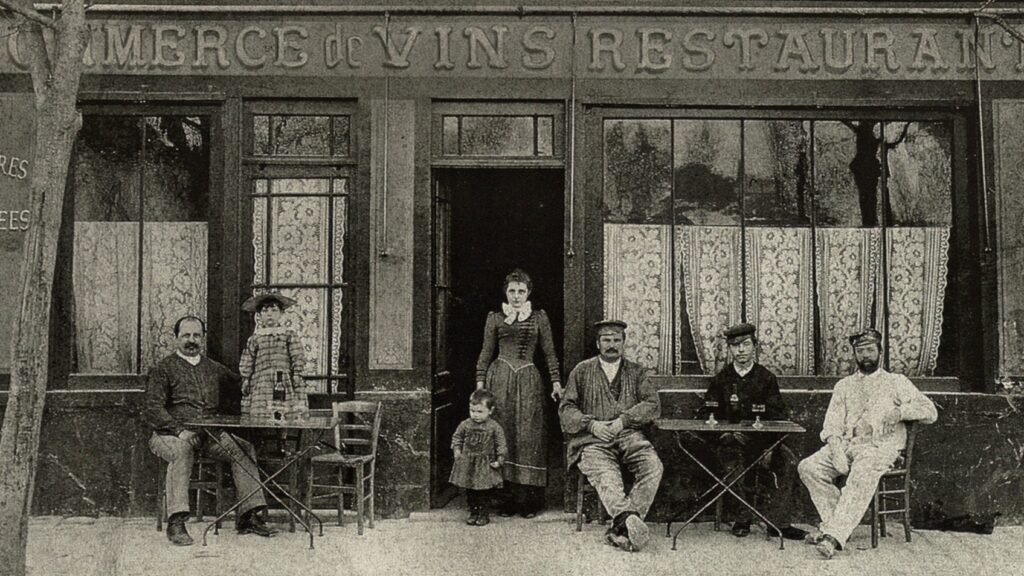
You can visit the room where he died. Walk down the street after the inn to the right, where you will find the entrance. For 10 euros, you can watch a beautiful video about his life—but it is yet another well-known biography—but first you have to climb a narrow staircase to his bare room.
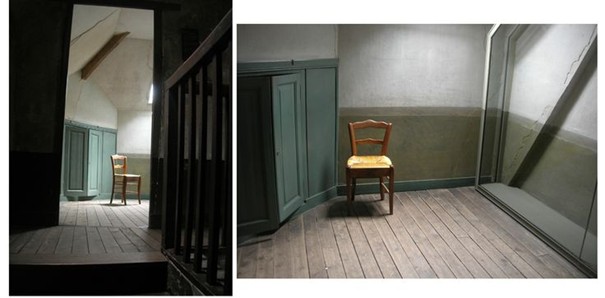
This is where he slept for 3.50 francs a day (including food, mind you).
After the video, you will, unsurprisingly, find yourself in the Van Gogh shop. You can enjoy a delicious lunch in the restaurant, but reservations are recommended. Dinner is no longer available since Covid, except for very special occasions.
We leave the auberge again and enter the side street, turning right and arriving—once again—at Rue Daubigny. On the left is the Daubigny Museum. As mentioned, Van Gogh painted the garden of his house near the station several times.
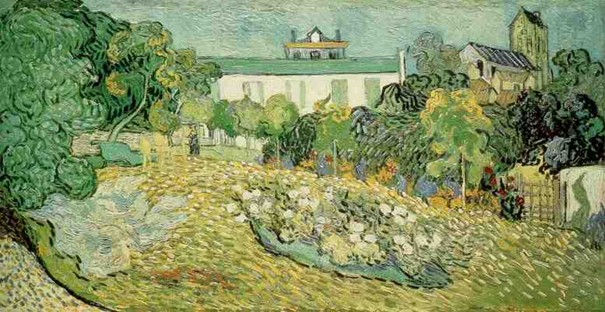
Oil on canvas. 53.0 x 103.0 cm. Auvers-sur-Oise: July, 1890. Hiroshima: Hiroshima Museum of Art
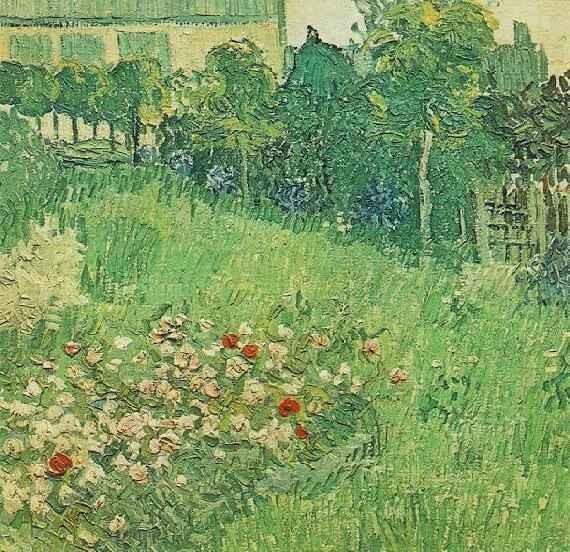
Oil on canvas. 50.7 x 50.7 cm. Auvers-sur-Oise: mid-June, 1890 Amsterdam, Van Gogh Museum
We walk past the museum, now closed for renovation, and come to a large sign by some tree roots on the right. These are the roots that appear in Van Gogh’s last painting.
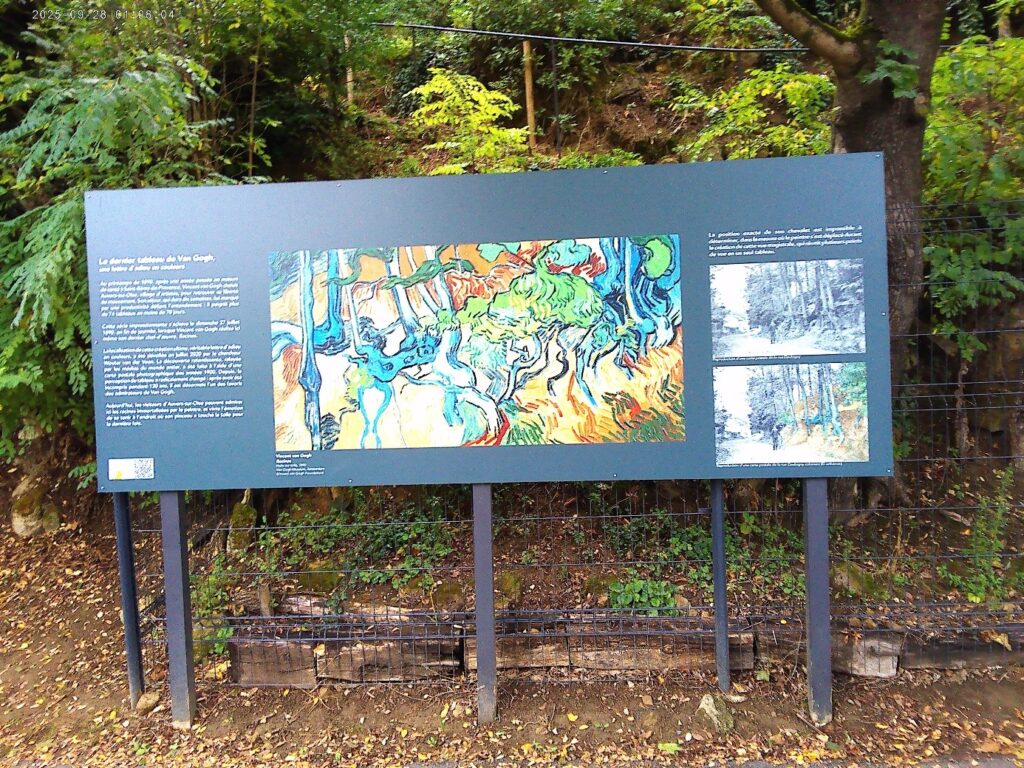

This spot was ‘discovered’ in 2020. The roots are on private property, which did not sit well with the mayor of Auvers. Her position is that the roots are public property. In protest, the mayor put up a (closed) fence with a small peep hole in front of it, then they nailed the peep hole shut, and later, when the owner’s right of ownership was proven, he put a (open) fence around it at night.
The judge has twice rejected the mayor’s claim that the roots belong to her. She has appealed to the Supreme Court. The owners of the roots offer a guided walk on their property. Not for the roots, because they can be seen from the street. What this walk – Le sentier du dernier tableau – is for is a bit of a mystery. We climb up and when we reach the top, we see the cornfields again, but this walk is not necessary for that either. The walk is actually a path through the garden of the owners of the tree roots. It seems to have little to do with those roots or the cornfields. Six euros lighter, we walk back down.

Oil on canvas. 50.0 x 100.0 cm. Auvers-sur-Oise: July, 1890. Amsterdam: Van Gogh Museum
We have reached the end of our Vincent van Gogh exploration. Five or six biographies and van Gogh shops later, we conclude that commemorating Vincent van Gogh is a mixture of authentic moments and authentic kitsch. Nevertheless, it is pleasant to walk around Auvers itself, which has remained quite authentic as a village. It was the interior of St Rémy that made the biggest impression, in the full knowledge that the rooms we saw there were the women’s quarters and were probably never entered by van Gogh. But the interior as such is still in its original condition. There are also original places to be found in Auvers, such as the auberge, Dr. Gachet’s house, the church, the town hall, and the cornfield, as well as many old farms, but you have to walk a little further to Chaponval in the west or Cordeville in the east.
Since his death, van Gogh has undergone a true metamorphosis. Not only has he become a great artist, but he also makes us all healthier nowadays. On November 5, 2025, a message appeared in the Dutch newspaper Trouw. Unreadable for non-Dutchman, but it states that researchers of Kings College in London have found out that looking at original paintings makes you feel much better, compared with a group of people who saw posters of paintings in a test environment. They knew this because they measured certain biomarkers.
If I may be the peer of this research that has not yet been found yet, I would first say that it is a mistake to equate lab values, biomarkers, with clinical relevance. On that basis alone, this research can be consigned to the cylindrical archive (the trash can). And, if you show two groups in completely different environments, it could also be sated that the museum environment is more important than the paintings. Finally, there is no explanation for the differences, which makes it completely dubious. Who knows, it could be a coincidental statistical correlation. So beware of this kind of nonsense research!
For now, we conclude this exploration of Van Gogh. We will continue our series in Paris, where we will be staying for a long time.
Arko Oderwald
With many thanks to Teio Meedendorp
Sources
Nienke Bakker et al. Van Gogh in Auvers-sur-Oise. Ghent: Uitgeverij Tijdsbeeld, 2023.
Leo Jansen, Hans Luijten, and Nienke Bakker. Vincent van Gogh. The Art of the Word. His Most Beautiful Letters. Amsterdam: Carrera Publishers, 2014.
Paintings by Van Gogh
https://vggallery.com/international/dutch/paintings/main_az.htm