Scoop 19 January 17th, 2026
In this episode, a powerful novel (The Heaven & Earth Grocery Store) about—among many other things—a corrupt doctor in the racist and ethnically divided America of the 1920s and 1930s, a film (Vie privée) about a psychiatrist, an ophthalmologist, and a patient of the former who committed suicide, and finally the film Signs of Life: about how life can literally leave you speechless.
Final editing/correction: Cathri van de Haar
Comments, questions, tips, criticism, and/or praise can be sent to: scoop0329@gmail.com
Novel
The Heaven & Earth Grocery Store, James McBride.

How a racist society is reflected
Doc Earl Roberts, a general practitioner in Pottstown, Pennsylvania, is a small-minded man who initially dreamed of a glittering career but did not have the courage to realize that ambition. Because – this is the 1930s – the big city frightened him with its strangers, its black population, and all those white families who, unlike him, had been swimming in money for generations. It was safer to return to his hometown after completing his studies and heal the sick there. But that too has now become a city of immigrants and blacks. The picturesque horse-drawn carriages of his childhood have been replaced by trucks with trailers carrying steel, the countless dairy farms by large-scale industry belching smoke, and Main Street is full of cars on Saturdays. Roberts is good friends with the white dignitaries and, despite the fact that there is a shiny Chevrolet in the driveway of his ivy-covered house, he still travels by horse and carriage.
Difficult feet
In the Ku Klux Klan, the doctor finds allies, men like him who want to “save” America and prevent the pure heritage of white Anglo-Saxon Protestants from being mixed with that of the Greeks, Italians, the Jews, and the black population, “whose men dreamed of raping white women and whose lustful black women posed a threat to every decent, God-fearing white man.” And although the men hide under a sheet and a pointed cap during parades, the local doctor repeatedly betrays himself with his limp, the result of polio affecting his left foot. Problems with difficult feet are a recurring theme in James McBride’s (1959) The Heaven & Earth Store, which, in addition to portraying a colorful working-class neighborhood in a fictional city, is also a funny book at times. Doc Roberts, for example, becomes the terror of the black children, the center of their nightmares, if only because he serves as an easy bogeyman: “If you don’t close your eyes now, I’ll take you to Doc Roberts.”
Skeleton
The story begins in 1972, with the discovery of a skeleton in a well. Identity unknown. There are indications that the person was of Jewish descent. The authorities question the only remaining Jewish man from the formerly vibrant Jewish community of Pottstown, but the investigation comes to a halt when a storm erases all traces. We then flash back to the 1920s and 1930s, to Chicken Hill, the neighborhood in Pottstown where Jewish, Black, and Latin American immigrants settled. Initially, the focus is on Moshe Ludlow, a Romanian Jew who owns the local theater and dance hall, and his wife Chona, who runs the grocery store after which the book is named. The store costs them more money than it brings in, because Chona gives credit to many of the Black and European immigrants—credit that is rarely repaid.
The plot thickens when Chona and Moshe hide a black, deaf orphan named Dodo, because the authorities want to lock him up in the horrific Pennhurst asylum, where mentally and physically disabled people lead a miserable existence. When the state officials manage to catch him anyway, the local community organises a rescue mission.
Web of storylines
Chona, Moshe, Doc Roberts, and Dodo are just four of the long parade of characters that pass through the web of storylines that McBride spins, storylines that ultimately all come together “neatly”: we find out who the corpse is and how Dodo ultimately fares. These two main storylines sometimes remain out of sight for long periods of time, because other story elements also receive the necessary attention: they are merely the driving force, but not the essence of this narrative. And narrative is the right word, because McBride proves himself to be a magnificent and almost classic, omniscient storyteller. In the best tradition of the Dickensian novel, or perhaps even better, the Great American Novel, he paints a fresco of the social, racial, and ethnic relationships and tensions in the first decades of the twentieth century, which still leave their mark on America today. A country in which people are defined by the past they left behind in the old world (read: Europe) or in the southern states of the US, and who, at the same time, want to shake off that past in all their optimism and make a new start. And in doing so, when the need arises, they manage to muster great solidarity among themselves, across all those differences.
And those differences exist, even within the black population, for example: there are those who live in the Chicken Hill neighborhood, who, according to the blacks who live further away, are stuck up. They try too hard to get on the good side of the white residents. They—they call themselves the Lowgods—think this is too much of a burden on the body. Because look: that is precisely why some of the black people who are now admitted to Pennhurst – ‘the best, the most honest’ – have gone mad.
Inhumane place
McBride did not make up Pennhurst, where Dodo is forcibly admitted, out of thin air. It is a grim, inhumane place where patients are treated like cattle: ‘It’s not the filth, or the naked people running around and banging their heads against the wall, or even the smell that stays in your nose for the rest of your life. A chained dog in a yard has a better life than someone in Pennhurst. You have no idea what suffering is until you’ve seen forty adults hanging around in the living room all day, year after year, just to catch a glimpse of the outside world. Or a grown, highly educated man who pees against a radiator while pretending to be a radio announcer because he’s too afraid to ask a caregiver if he can go to the toilet. Or a teenage girl who begs an adult male caregiver for a cigarette and shows him her private parts. It is not clear what exactly the doctors who work there do: they come and go, “and then another doctor arrives who doesn’t know what the first one did.” “There are mules that have a better life.”
Progressive disease
Chona is, in a sense, the central figure in the novel: she has read extensively about politics, socialism, progressive Jews, union founders, and pacifists, people who all pushed aside the restrictions imposed on them and demanded the same fullness of American life that others, more affluent, receive. Her grocery store embodies the multicultural character of the neighborhood, as she is one of the few white shopkeepers who also welcomes black customers. She suffers from a strange, progressive disease, with sudden fainting spells and epileptic seizures. But she refuses to be treated by Doc Roberts. He has more than a crush on her, but also finds her mean and arrogant, a combination that ultimately leads to a dramatic turning point in the novel.
McBride shows how the state of healthcare—the professional outlook and attitude of the family doctor, the fate of Dodo, Chona’s illness, and the conditions in Pennhurst—is an accurate reflection of the flawed social fabric of which his numerous protagonists are a part. And that the opposites Chona and Doc Roberts are exemplary of two fundamentally different visions of what the American dream entails. McBride makes no bones about the fact that these visions continue to have an impact to this day in the final pages of his beautiful novel.
Jazz
Two final remarks: McBride frequently uses the ‘n-word’, because that was common in the 1920s and 1930s, and jazz fans will be delighted, because Moshe has just about all the greats from the Swing era perform in his dance hall: Count Basie, Lionel Hampton, Louis Jordan, Chick Webb and so on. A nice playlist can be foundhere.
Henk Maassen
Film
Vie privée, now in theaters
Here you can find the trailer.
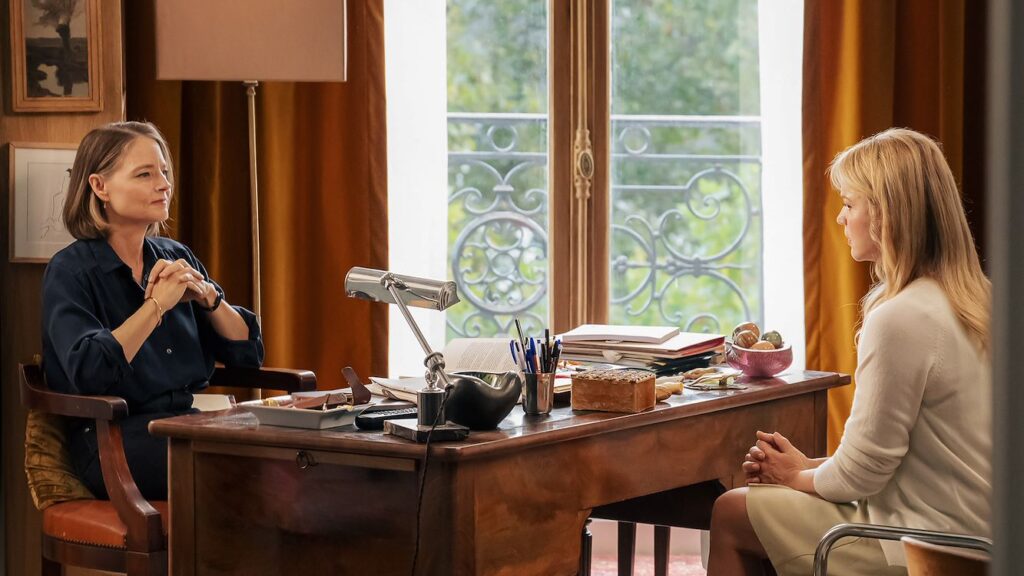
Psychiatrist and ophthalmologist solve a puzzle
Anyone who combines the efforts of a psychiatrist with those of an ophthalmologist in a whodunnit in the search for the perpetrator, thus alluding to emotion and intuition (psychiatrist!) versus rationality and objective judgment (ophthalmologist!), will undoubtedly be accused of venturing down the slippery slope of hackneyed clichés and risky stereotypes. Yet that is what the film Vie privée does, but not in the way you might expect. If only because the psychiatrist turns out to be a cold-blooded, cerebral woman and the ophthalmologist a gentle, empathetic man.
Doctor with issues
In flawless French, Jodie Foster plays the American psychiatrist Lilian Steiner in this film. She is a doctor with issues, but what those issues are is never entirely clear. At least, this viewer couldn’t quite put her finger on it, but perhaps Lilian herself couldn’t either. Lilian is deeply shaken when she learns that a beloved patient with whom she had a long-term therapeutic relationship has unexpectedly committed suicide. Convinced that she was murdered, she begins a private investigation. Her ex-husband, ophthalmologist Gabriel (a fine role played by Daniel Auteuil), agrees to help her. Being a control freak, Lilian does not immediately realize that she is upset. She attributes her tears, undoubtedly the result of suppressed grief over the loss, to a problem with her eyes, which is why she consults her ex.
Doubt
Ultimately, this film revolves around the question of whether Lilian is really on the trail of a murder, or whether she is at a loss with the knowledge that she did not see her patient’s suicide coming – a patient she thought she knew so well. Professional doubt creeps up on her: is she actually listening carefully to what her patients confide in her? Is that why she records all those conversations? How well does Lilian actually know her patients? And the question behind all these questions: what does a psychiatrist, especially one like Lilian with a psychoanalytical orientation, actually do other than interpret signs in an attempt to turn them into a sometimes false but coherent (life) story?
Hypnotist
Rebecca Zlotowski’s film received a standing ovation at the Cannes Film Festival last May, but I didn’t quite get it at first—it seems as if the filmmaker couldn’t choose between seriousness and mild humor, between a full-blooded thriller, a black comedy, or a more or less philosophical treatise on the limits of the profession of psychiatrist, and even about the role that esoteric ‘realities’ can play in human existence. See how Lilian, against all her rationality, consults a hypnotist and thus ends up in a hallucinatory dream state, in which she and her deceased patient were lovers in a previous life. There are also recurring references to Jewishness, to the dybbuk, for example: in Jewish folklore, the soul of a deceased person who takes over a living body to complete unfinished business.
Jigsaw puzzle
But the fact that this film does not adhere to ‘genre hygiene’ turns out to be a strong point in retrospect. Vie privée is thus much more than a fairly trivial drama about a thawing ice queen. Take, for example, the cameo appearance of the famous documentary filmmaker Frederick Wiseman – himself a genius ‘observer’, as the man who has captured human interactions in institutions such as the army and healthcare in lengthy films with his ‘objective’ recording camera. In an extremely short but ambiguous casting, he plays an old, wise colleague of Lilian’s who advises her to delve into her past, more specifically into the role her mother played in it. But will that lead to a conclusive story in which her inner demons will be revealed?
No, the jigsaw puzzle of life is not that easy to put together. Of course, you know that, but it’s not often that you get to see it presented in such an entertaining way as in Vie privée.
Henk Maassen
Film
Signs of Life, now in theaters
You can find the trailerhere.

Stunned into silence
A woman with a stern face and sunglasses arrives alone at a hotel on the Canary Island of Lanzarote. She doesn’t speak, but she can apparently hear. Is she unable to speak, or does she not want to? She doesn’t last long at the hotel, feeling harassed by the noise of loud, intrusive, even hostile young people. Homeless, she roams the island at night. She meets a talkative man, a good-natured type, who has rented a luxurious villa for himself and his children, but they did not come with him because his ex forbade them to. Now he is alone. He offers her shelter. The woman accepts his invitation, albeit with some hesitation, and moves in with him. Meanwhile, she continues to wrap herself in silence. She is apparently literally struck dumb, because she is in deep mourning: the love of her life has died.
Intimate drama
Signs of Life is the sympathetic directorial debut of British actor Joseph Millson: an intimate, simple drama that relies on two excellent actors who, as opposites, find support in each other. She in her depressive speechlessness, he in his sad anger. The gloomy landscape in which they move does not help to lift the mood, nor does the irritating music. And yet you will leave the cinema in good spirits.
Henk Maassen