In this section we will describe all kinds of interesting medical-literary places in Europe. The section has started on June 21, 2025 and will appear every two weeks, alternately with Scoop. Older posts can be found below. Comments, questions, tips, criticism, and praise can be sent to Arko Oderwald: website@litmed.nl
On location – Paris (4) – The passages
Address: Rue de Richelieu/exit passage de Beaujolais
Cost: €13 for the Bibliothèque National
We start this On the spot at the place where On the spot number 3 ended. We have just walked through the short passage de Beaujolais and are now in the R. de Richelieu. We turn right and then left again, into the Rue des petits champs. We cross Rue Sainte-Anne and after Rue des Moulins on your left, you will find the Choiseul passage across the street. This passage is one of the few remaining passages that were built in the 19th century. Thérèse Raquin, Zola’s novel, is largely set in such a passage.
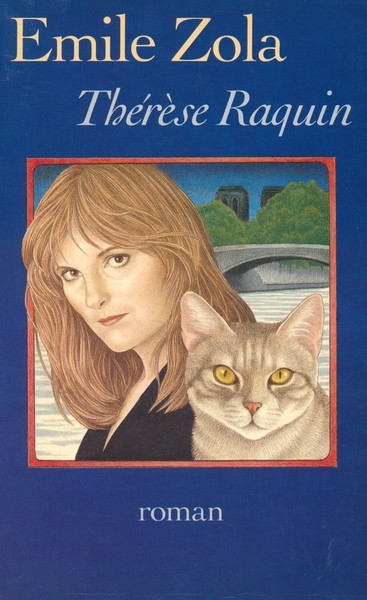
Coming from the quays, at the end of Rue Guénégaud, you will find a narrow and gloomy passageway connecting Rue Mazarin with Rue de Seine, called Passage du Pont-Neuf. This passage is at most thirty paces long and two paces wide; it is paved with yellowish, worn tiles, which have come loose in places and, due to their dampness, give off a sour smell; the rectangular glass roof that covers these passages is black with dirt.
On beautiful summer days, when the sun scorches the streets, a meager glimmer falls through this grimy glass roof onto the pavement. In the misty morning hours of sunless winter days, a grimy twilight reigns in this covered alley. On the left are dark, low, dilapidated shops that exude a cold basement air. There are bookshops, toy shops, and bookbinders whose shop windows are buried under a thick layer of dust. The merchandise looks strangely distorted and twisted behind the greenish windows, which consist of small panes. Behind them, the shop looks like a dark hole where strange shapes move.
This is how the novel begins, and the tone is set immediately. Indeed, it does not end well.
We are about to embark on a journey of discovery through the passages that still exist, but first a brief history of the passages. The passage is an architectural form that originated in the early 19th century. The industrial revolution led to an expansion of the urban landscape, increased prosperity and, consequently, a rise in demand for luxury goods. The concept of the shop changed: previously, people went to a craftsman and had goods made to measure, but now shops selling ready-made products to take away were emerging.
However, the city was dirty and unsafe and therefore not an ideal place for the wealthy ‘high society’. Moreover, the streets were very narrow and muddy. There were no sidewalks. When a carriage passed by, you risked getting covered in mud.
The shopping arcade was the answer to this problem. This new architectural form was made possible by the use of glass and metal. The glass roof gave visitors the feeling of being outside, without being at the mercy of the weather. In addition, this new industrial development also led to the emergence of shop windows, allowing visitors to stroll around at their leisure while observing the latest trends and products. These arcades were originally only accessible to the wealthy. There were guards at the entrances and sometimes you even had to pay an entrance fee.
In Paris, around 130 passages were built in the 19th century. Of course, not all of them were equally luxurious, but we cannot speak of truly architecturally austere shopping arcades either. Every 19th-century shopping arcade has a beautifully carved entrance full of frills and decorations. The name is usually found among these decorations, unless it is displayed in mosaic on the floor. The exit—or entrance via a less busy street—is usually architecturally simpler.
The luxury of shopping arcades captured the imagination in the 19th and 20th centuries and was therefore a great source of inspiration for many philosophers and writers. It was in this context that the flâneur was born.
For the German philosopher Walter Benjamin, the flâneur is a person whose ‘way of life conceals the desolation of the future inhabitants of our metropolises behind a beneficial illusion’. Benjamin sees the passages as an attempt to seduce the walking and strolling human being into the consumer goods industry.
Pedestrian culture is transformed into an economically exploitable phenomenon.
The passages form the basis of our consumer behavior. Walter Benjamin says about this:
The goods that tempt us from the shop windows are a kind of ideal, a dream image of a happy life.
Baudelaire already spoke of the visitor to the passages, the flâneur. But his flâneur is a specialist in doing nothing. This is also where he derives his personality. Walter Benjamin’s flâneur is based on this, but his flâneur, closer to the end of the 19th century, must be situated in a more advanced phase of ever-expanding industrialization. Benjamin’s flâneur wants to be seen less than Baudelaire’s flâneur, as in the following poem from Les Fleurs du mal, The Flowers of Evil, from 1857.
Apologies for the maybe wrongful translation)
For a passerby
The street surrounded me with its thunderous noise and
Long, slender, in deep mourning, a woman passed me by,
Sublime in her sorrow; with a graceful hand she let
The hem of her robe rise and fall,
On swift legs and with statuesque grandeur.
And from her eyes, leaden air where storms arise,
I drank, tense, transfixed like a stranger,
Sweetness that fascinates, pleasure that leads to death.
A flash of lightning… and then the night! – Fleeting beauty
Whose gaze rewarded me with vitality for a moment,
Will I only see you again in eternal life?
Elsewhere, far away from here! Too late! Or perhaps never!
I don’t know where you are fleeing, you don’t know where I will go,
Woman I had loved, woman who understood that
Just as our shopping centers become impoverished over time, so too did the passages. Beggars and homeless people also find the passage the ideal place to spend the night. This was the case in the 19th century and is still the case today. Steel gates try to keep unwanted visitors out at night. During the day, however, they are wide open. A sleeping homeless person, a woman in a too-short skirt spinning on a single tile, arguments between prostitutes and pimps… you encounter them all in the passage.
The dark side of the passage stands in stark contrast to the ideal image in which it was created.
Our first passage is that of Choiseul. The sign is clearly visible across the street.

And this passage has a clear medical-literary relevance, because this is where the young Louis-Ferdinand Destouches, better known by his pen name Louis-Ferdinand Céline, lived.
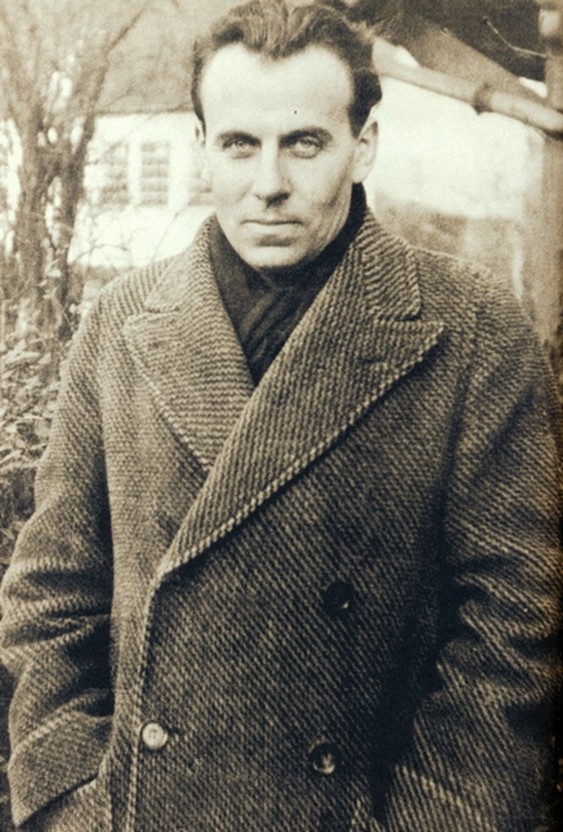
Céline was a doctor and writer. He was certainly committed to his mostly poor patients.
There was no shortage of sick people, but not many of them could or wanted to pay. Nothing is as thankless as the medical profession. When you ask rich patients for money, you feel like a lackey; with poor patients, you just feel like a thief. ‘Fee’? What a word! They don’t even have enough money to eat and go to the movies, and then you have to take money from them to get your ‘fee’? Especially when they’re on their deathbed. That’s not easy. You let it slide. You become friendly. And then you’re lost.
(Journey to the End of the Night)

Drawing: Tardi
But he didn’t idealize his patients.
In my field, I didn’t perform any miracles in the few months that I was involved in this special practice. Yet miracles were sorely needed here. But my patients weren’t fond of miracles from me; on the contrary, they counted on their tuberculosis to turn their total misery, which had always destroyed them, into bearable misery thanks to a tiny state pension. Since the war, they had been dragging their more or less positive phlegm from one examination to another. They were emaciated from the fever that would not subside, because they ate too little, vomited too much, drank an enormous amount of wine, and also because, to be honest, they still worked one of the three days.
(Journey to the End of the Night)
Céline was born in 1894 and lived in the Passage Choiseul during his youth. His mother had a shop here.
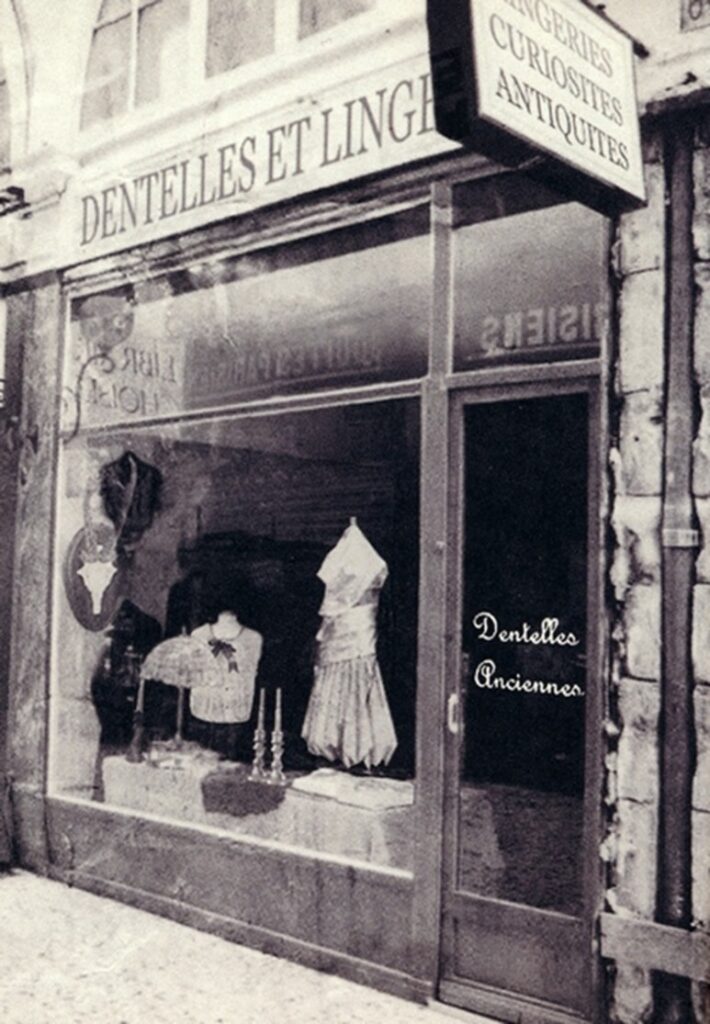
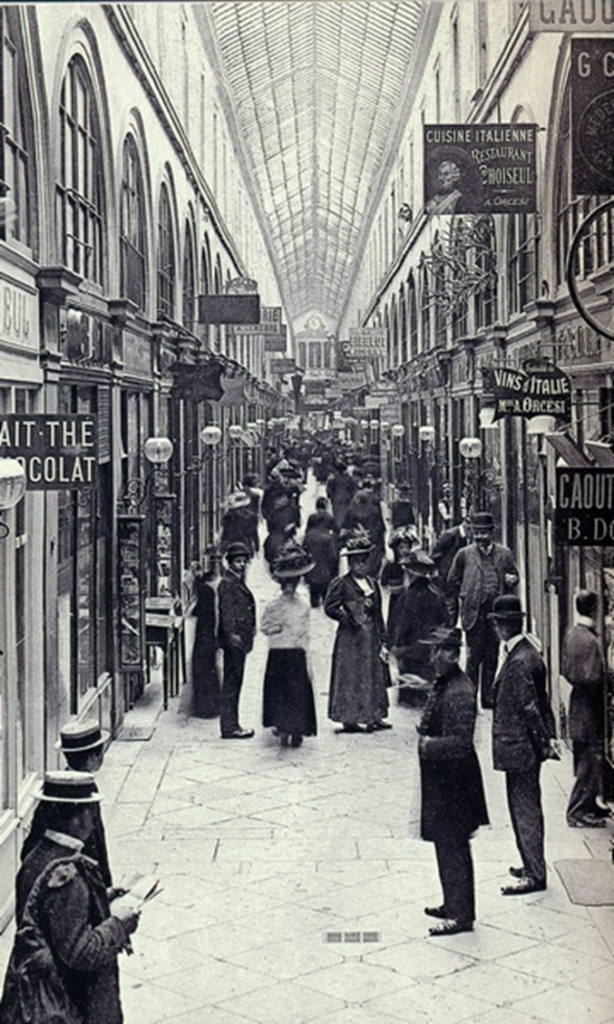
The Passage Choiseul was therefore a passage from Benjamin’s time, when it had already fallen into disrepair. As with Zola, his description is not particularly flattering.
A little further down the passage lived a bookbinder with his family. The children were never allowed to go out. Their mother was a baroness. Her name was de Caravals. She was terrified that her children would learn bad language. They played together all year round, neatly indoors, behind their windows, trying to stick their noses and both their hands in each other’s mouths at the same time. They were as pale as asparagus. Once a year, Mrs. de Caravals went on vacation by herself to visit her cousins in the Perigord. She told anyone who would listen that her family picked her up at the station in a “brik” with four “superbe renpaarden” (superb racehorses). They then drove through their endless fields… In the avenue in front of the castle, the farmers rushed over and knelt as they passed by… That’s how she talked. Once she took her two little boys with her. She came back alone, it was already winter, much later than usual. She was in deep mourning. You couldn’t see her face anymore, she wore so many veils. She didn’t say anything to anyone. When she got home, she went straight to bed. She never spoke to anyone again. For those children who were never allowed outside, the transition was too great. The outside air had been too much for them! … That disaster made the whole neighborhood think. From Rue Therese to Place Gaillon, people talked about nothing but oxygen … For a month …
(Death on credit)
The entire passage was deeply moved by the sad story of the Caravals, so much so that something had to be done. Suddenly, everyone turned out to be a ‘paleface’. Good advice went from shop to shop. They were all talking about microbes and the horrific risk of infection. The children knew all about their parents’ concerns. They were stuffed with cod liver oil, concentrated cod liver oil, double portions, whole bottles, barrels at a time. To be honest, it didn’t do them much good. It made them burp. And it made them even greener, they couldn’t stand on their legs anymore, the oil took away all their appetite. It was indeed unbelievable how polluted the air was in the passage. Everything contributed to making you die, slowly but surely, the dog piss, the shit, the spit, the gas leaks. It was filthier than a dungeon. Under the glass roof, the sun was so miserably pale that a candle gave off more light. Everyone suffered from shortness of breath. The passage became aware of its own suffocating stench! … Everyone talked about leaving the city, about fields and valleys, the beauties of nature, castles in the air …
(Death on credit)
We had only one thing in common in our home in the passageway, and that was the fear of hunger. It was deeply ingrained in us. From my first breath, I felt it… It was instilled in me from an early age… We were obsessed with it at home, all of us. A soul, that was pure fear for us. The fear of poverty … it dripped from the walls … in every room … That’s why we always wolfed down our food at the table, why we rushed through every meal, why we ordered so quickly, why we scurried around Paris like fleas, from Place Maubert to the Etoile, afraid of the bailiff, of the rent, of the gas man, terrified of the taxman…
I never had time to wipe my ass, everything had to be done so quickly.
(Death on Credit)
We know that Céline exaggerated his impoverished childhood somewhat, so it is uncertain whether this is a true picture. What we do know is that Marcel Proust also came to this passage around this time for a meeting of a magazine, of which he was an editor. That is actually very difficult to reconcile with the above description.
We walk through the Choiseul passage, now filled with all kinds of upscale shops. Halfway through, there is another exit to the left and right, but we continue to the end. We arrive at Rue Saint Augustin, turn right and then right again onto Rue Saint Anne. Then we turn left onto Rue Rameau. We walk past the Fontaine Louvois. To the right of the fountain was Celine’s school when he was 6 years old (1900).
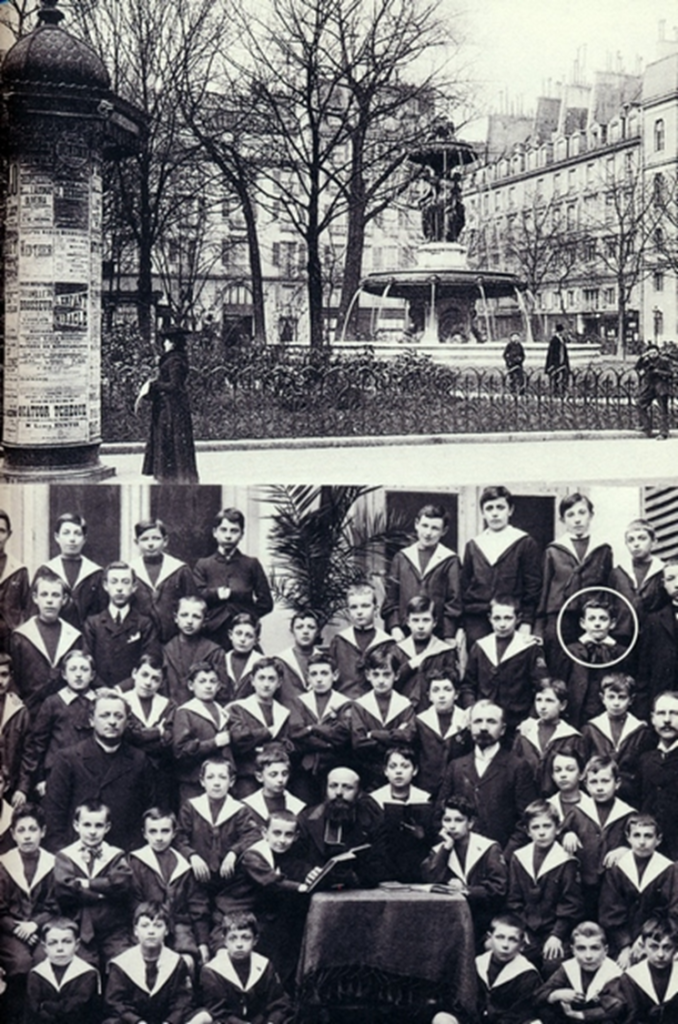
We turn right into Rue de Richelieu. On our left is the Richelieu Library, named after Cardinal de Richelieu. We walk down Rue Richelieu, turn left onto Rue des petits Champs (we walked here earlier) and then left again onto Rue Vivienne. On our left is the entrance to the Richelieu Library, the national library of France.
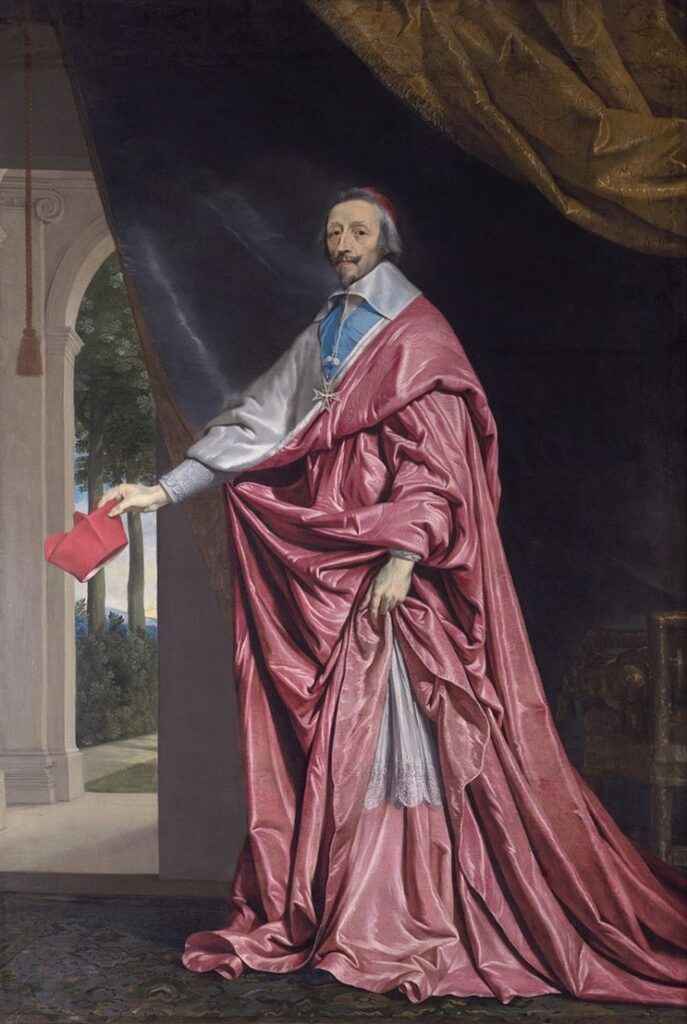
Cardinal Richelieu was a nobleman, church leader, and statesman. He was ordained bishop in 1608 and later entered politics, becoming secretary of state in 1616. Richelieu rose rapidly in prominence, both in the Catholic Church and in the French government, becoming a cardinal in 1622 and Prime Minister to King Louis XIII in 1624.
Cardinal de Richelieu became known as the king’s “first minister.” As a result, he is considered the world’s first prime minister in the modern sense of the word. He wanted to strengthen royal power and destroy domestic factions. By curbing the power of the nobility, he transformed France into a strong, centralized state. His main foreign policy goals were to curb the power of the Austrian-Spanish House of Habsburg and to promote French security interests in the Thirty Years’ War. Although he was a cardinal, he did not hesitate to form alliances with Protestant rulers to achieve his goals.
Richelieu also became famous for his patronage of the arts, particularly for founding the Académie française, a scientific society dedicated to the French language.
He is one of the main characters in Alexandre Dumas père’s novel The Three Musketeers. He is portrayed as a powerful ruler, even more powerful than the king, but events such as the Journée des dupes in 1830, the day on which the king almost withdrew his confidence in him, show that his power was in fact highly dependent on the king’s trust in him.
The current Richelieu Library is well worth a visit. After a very long restoration, the building has been both modernized and restored to its former glory. A beautiful exhibition space and a magnificent library can be admired there.
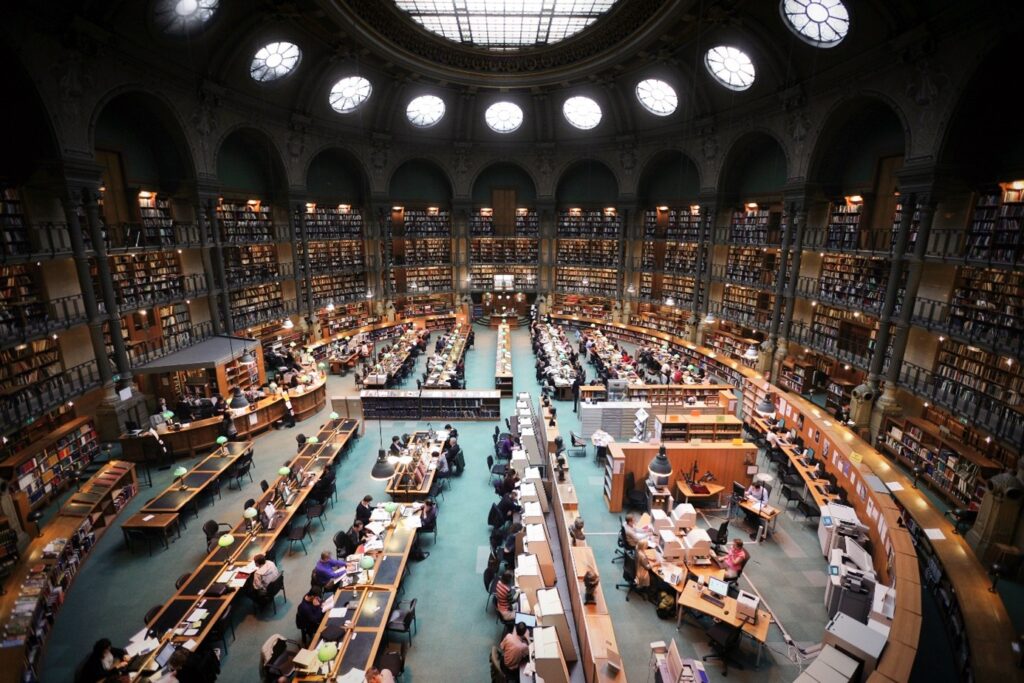
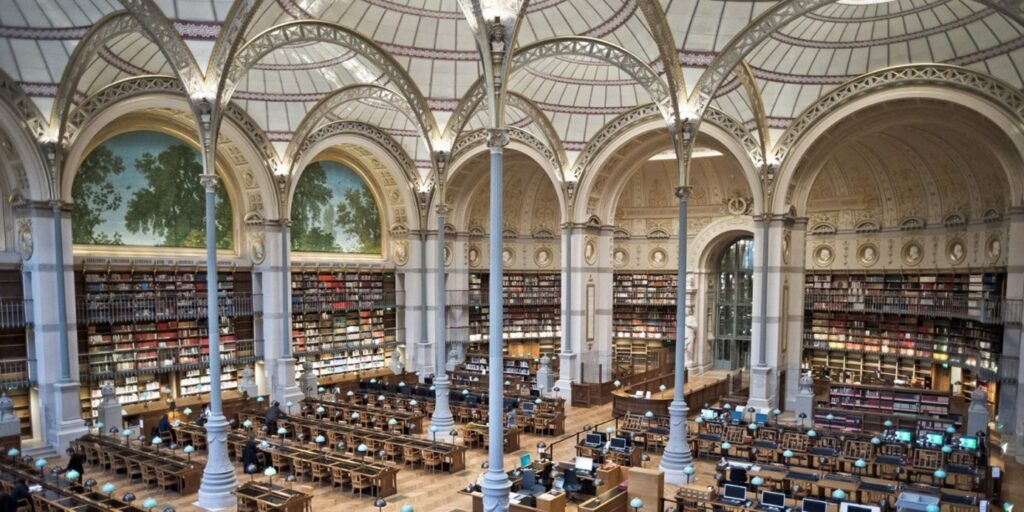
When we leave the library, we see the entrance to the second passage we are visiting, the Passage Colbert, across the Rue Vivienne. Just like in the old days, there is a security guard at this passage who wants to take a look in your backpack. To be honest, it’s not very convincing.
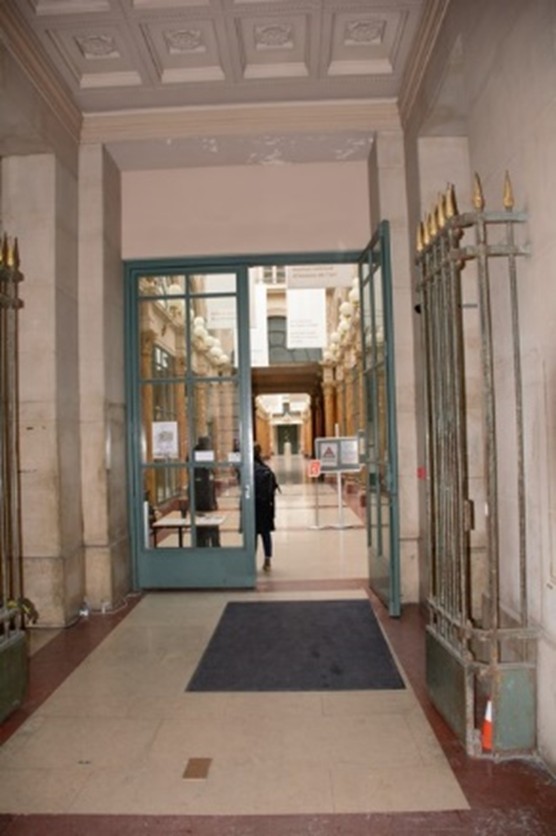
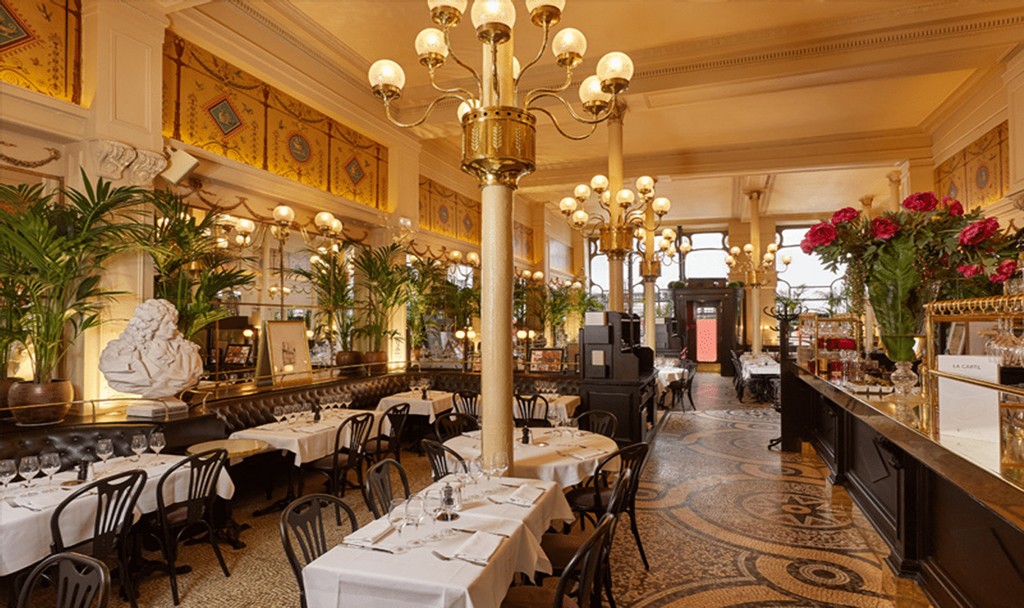
The Passage Colbert was built in 1823. It is located close to its great rival, the Passage Vivienne. The Passage Colbert is owned by the National Library and, unlike other passages in Paris, does not have a single shop. It focuses on culture and houses the French National Institute of Art History and the National Institute of Heritage. It is open to the public, who are invited to discover the beautiful rotunda, crowned by a glass dome. The brasserie Le Grand Colbert, a historic Art Nouveau monument often used for filming, is located in the passage, with its entrance on Rue Vivienne.
At the exit, we turn left and then immediately left again, into the Passage Vivienne. This was recently under reconstruction.
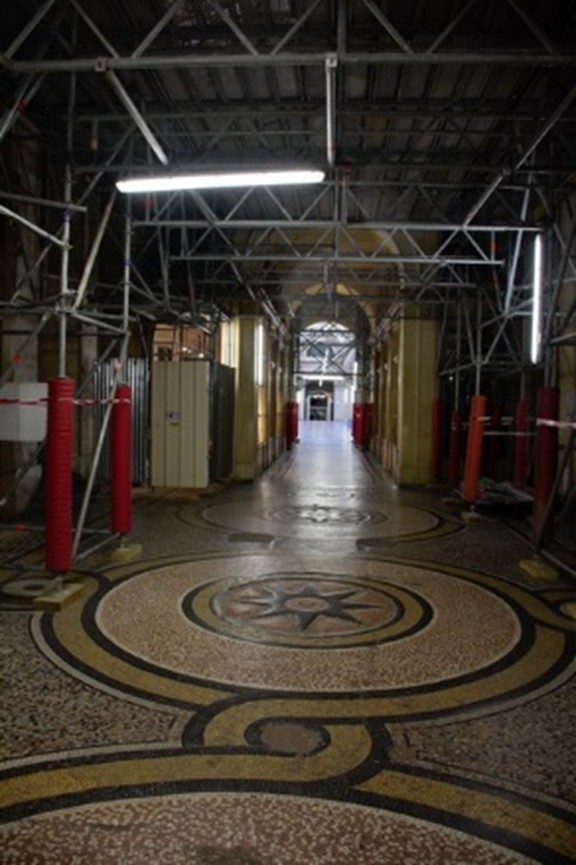
This passage also dates from 1823. The covered shopping street has managed to preserve the atmosphere of bygone times, while the world around it has begun to change. Over the years, the Vivienne passage slowly began to fall into disrepair. A large-scale restoration in the 1960s has ensured that the Vivienne passage will hopefully be preserved for a long time to come.
The Vivienne passage is richly decorated and mainly furnished in a neoclassical style. The mosaics on the floor, interwoven in colorful patterns, are by the famous mosaic maker Facchina. Ideally located between the Palais-Royal and the Bourse, the Vivienne passage, with 70 shops, has been a resounding success since its restoration.
In the 20th century, the Vivienne passage was given a new lease of life after the 1960s, like most covered passages. Fashion boutiques—Jean Paul Gaultier, Yuki Torii—have contributed greatly to its revival.
At the heart of this beautiful passage, the Jousseaume bookshop has been in existence since 1826. Literature lovers are invariably seduced by this charming bookshop, which was once frequented by Colette and Aragon. Old books, new or used, the choice is enormous.
After a 90-degree turn, we come out of the Vivienne passage back onto Rue Vivienne. Across the street is the Richelieu National Library again. We turn right and walk a few hundred meters to the Place de la Bourse. Depending on the day, there is a market on the square in front of the stock exchange. The stock exchange building itself houses the Paris Stock Exchange, known as Euronext Paris since 2000.
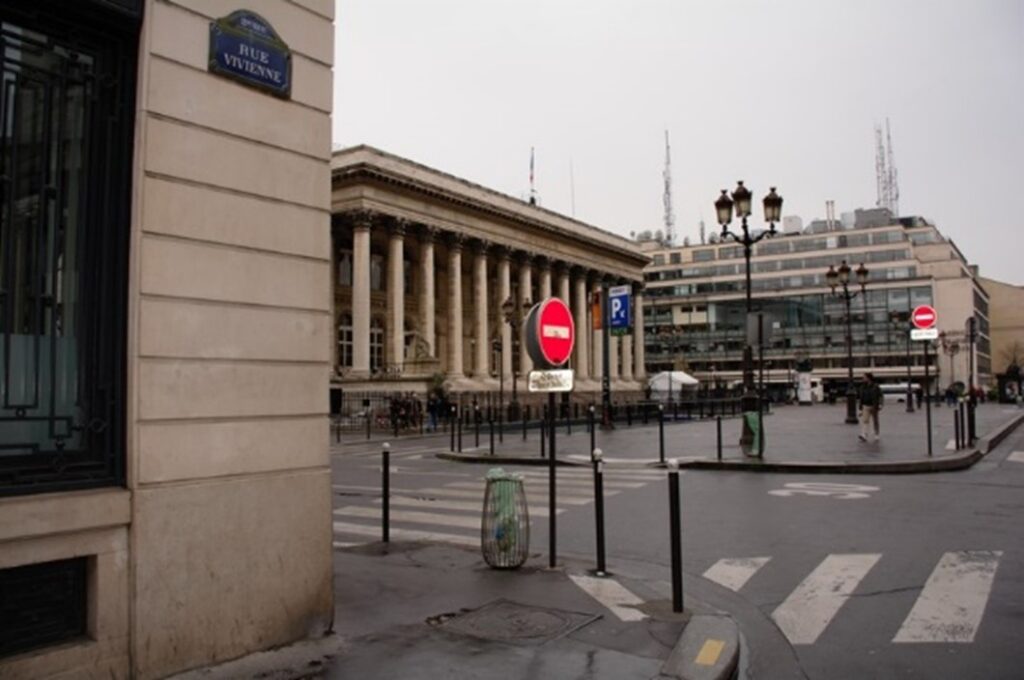
The building, known as the Palais Brongniart, was designed by architect Alexandre-Théodore Brongniart and built between 1808 and 1813, then completed by Éloi Labarre between 1813 and 1826.
Brongniart spontaneously submitted his project, which was a rectangular neoclassical Roman temple with a gigantic Corinthian colonnade. Napoleon admired the design, but it was later criticized for its perceived academic dullness. The authorities had demanded that Brongniart modify his designs, and after Brongniart’s death in 1813, Labarre changed them even further, greatly weakening Brongniart’s original intentions. From 1901 to 1905, Jean-Baptiste-Frederic Cavel designed the addition of two side wings, resulting in a cruciform plan with many columns. According to architectural historian Andrew Ayers, these modifications “did nothing to improve the reputation of this uninspired monument.”
L’Argent, a novel by Emile Zola published in 1891, is set largely here. L’Argent meticulously describes the intense activity of the Place de la Bourse shortly before its heyday: arriving from the four corners, a carriage and carriage balloon criss-crossed a large square covered with chestnut trees and benches, where it buzzed with rumors and negotiations in the shops, banks, cafes, and restaurants around it.
We continue our passage tour in the Rue Vivienne and turn right into the Rue Feydeau. Then we turn left into the Rue des Panoramas, cross the street and, a little to the right, we see the entrance to the Passage des Panoramas.
The Passage des Panoramas is the oldest covered passage in Paris; it is one of the earliest locations of the Parisian philatelic trade and was one of the first covered commercial passages in Europe. Bazaars and souks in the East had covered commercial passageways centuries earlier, but the Passage de Panoramas innovated in the use of glass roofing and later, in 1817, gas lighting.
The passage was opened in 1800 on the site of the city residence of the Maréchal de Montmorency, Duke of Luxembourg, which had been built in 1704. The doorway of the modern building, which opened onto the rue Saint-Marc, opposite the rue des Panoramas, was the gate of the original mansion. The name came from an attraction built on the site: two large rotundas displaying panoramic paintings of Paris, Toulon, Rome, Jerusalem, and other famous cities. They were a business venture of the American inventor Robert Fulton, who had come to Paris to offer his latest inventions, the steamboat, submarine, and torpedo, to Napoleon. While awaiting a response, Fulton earned money with his exhibition. Napoleon, who had little interest in the navy, ultimately rejected Fulton’s projects. Fulton left his Panoramas behind and went to London to offer his inventions to the British.
In the 1830s, architect Jean-Louis Victor Grisart renovated the passage and created three additional passages in the block: the Saint-Marc passage parallel to the passage des panoramas, the passage des Variétés giving access to the artists’ entrance of the Théâtre des Variétés, and the Feydeau and Montmartre passage. The part of the passage close to the Boulevard Montmartre is richly decorated, while the part where we enter is more modest. The passage, as it was in 1867, is described in chapter VII of Émile Zola’s novel Nana.
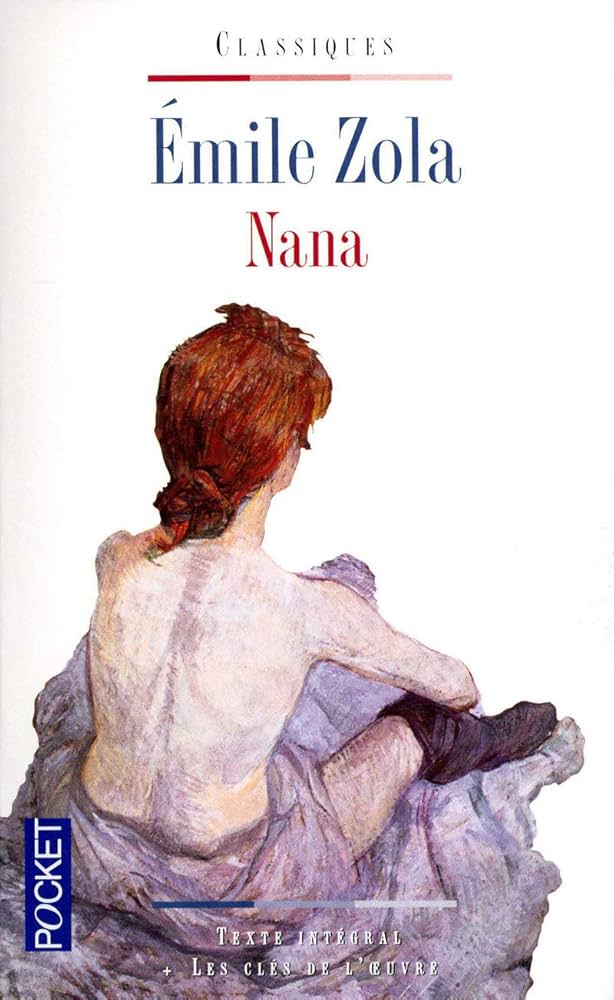
Nana tells the story of Nana Coupeau’s rise to high-class prostitution during the last three years of the Second French Empire. The character Nana first appeared at the end of Zola’s earlier novel in the Rougon-Macquart series, L’Assommoir (1877), where she is the daughter of a drunkard. At the end of that novel, she is living on the streets and just beginning a life of prostitution.
Three months later, Count Muffat was walking through the Passage des Panoramas on a December evening. The evening was very mild, and a downpour had just filled the passage with a wave of people. It was crowded there, with people packed together between the shops, walking slowly and with difficulty. Under the glass roof, which had become opaque due to the reflection, it was brightly lit, with bright spots everywhere, white balls, red lanterns, blue lanterns, gas lanterns, giant clocks, and fans through which flames flickered. And the colorful mixture of shop windows, the gold of the jewelers, the crystal of the confectioners, the light-colored silk of the milliners blazed in the bright light of the surfaces that reflected the light behind the transparency of the windows. Among the colorful mix of signs, in the distance, a huge purple glove appeared on a bloody hand that had been cut off and attached to a yellow cuff.
Count Muffat had slowly walked to the boulevard. He glanced across the road, then slowly walked back along the shops. A damp and heated atmosphere cast a glowing mist in the narrow passageway. Footsteps sounded incessantly on the tiles, which had become soaked by the water rolling off the umbrellas; no sound of voices could be heard.
Passers-by who bumped into him at every corner looked at him inquiringly with silent faces that had been made pale by the gaslight. To escape these curious glances, the count then stood in front of a stationery shop, where he looked very attentively at a display of presse-papiers and glass balls in which landscapes and flowers floated.
He saw nothing; he thought of Nana. Why had she lied again? That morning she had written to him that he did not need to come that evening, on the pretext that Louiset was ill and that she would spend the night at her aunt’s house to watch over her. But he had become suspicious, and when he went to her house, he heard from the concierge that Madame had just left for the theater. That surprised him, because she wasn’t performing in the new play. So why the lie, and what could she be doing at the Variete theater tonight?
The Passage des Panoramas ends at Boulevard Montmartre.

We cross the street to the next passage, the Passage Jouffroy.
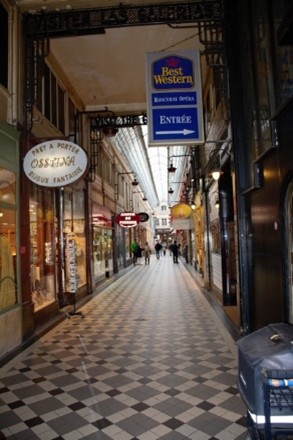
The Passage Jouffroy was built in 1845 along the line of the Passage des Panoramas to capitalize on the popularity of the latter. A private company was set up to manage it, headed by Count Félix de Jouffroy-Gonsans, who gave his name to the passage, and Verdeau, who gave his name to the passage that was built as a further extension, the Passage Verdeau. The Passage Jouffroy represents an important stage in the technological evolution of the 19th century and the mastery of iron structures. It is the first Parisian passageway to be built entirely of metal and glass. Only the decorative elements are made of wood. In the early 1880s, Arthur Meyer, founder of the newspaper Le Gaulois, consulted with cartoonist Alfred Grévin to create a gallery of wax figures on a site next to the passage. It was inaugurated on January 10, 1882, and has since taken the name of the Musée Grévin. The museum’s exit, decorated with an assemblage of various characters, is located in the passage and contributes greatly to its success. The museum includes a hall of mirrors that was originally designed for the 1900 World’s Fair. In 1974, the passage was registered as a monument historique. The passage was completely renovated in 1987. The original paving was then restored.
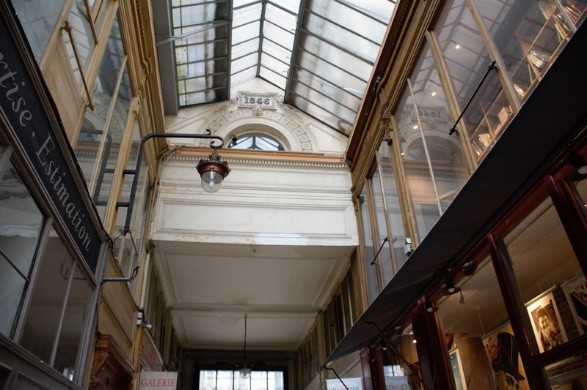
This passage ends at Rue La Grange Batelière. Cross the street and you can enter the Verdaud Passage.
Founded in 1846 by the Société du passage Jouffroy, the Verdeau passage is an extension of the Panorama and Jouffroy passages. The Verdeau passage has always suffered from comparison with the passages it extends. Nevertheless, it is a beautiful passage, with a high herringbone canopy and an elegant neoclassical design. However, the opening of the Drouot hotel attracted many antique dealers who set up shop there, and since then the passage has attracted many collectors of old books and postcards. A photo shop (14-16) has been located at the same address since 1901.
This is where our passage walk ends on the Rue du Faubourg Montmartre.
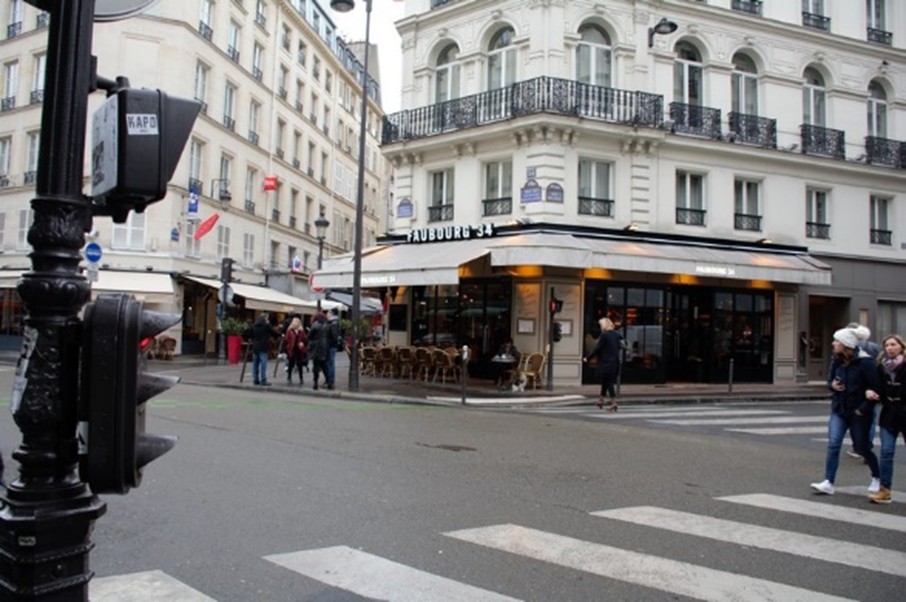
In the next episode of On the Spot, we continue on to Montmartre, where even more interesting medical-literary history awaits us.
Arko Oderwald
Sofie Vandamme
Literature
Charles Baudelaire: The Flowers of Evil
Walter Benjamin: The Arcades Project
Louis-Ferdinand Céline: Journey to the End of the Night
Louis-Ferdinand Céline: Death on Credit
Tardi/Céline: Journey to the End of the Night
Emile Zola: Nana
Emile Zola: The Drunkard (L’Assommoir)
Emile Zola: Thérèse Raquin
Emile Zola: Money (L’Argent)