On the Spot – Paris (7) – Jardin Luxembourg
Start of the walk: Boulevard Saint-Michel, Luxembourg RER station
Cost: free
Around 1922, Ernest Hemingway lived in Paris. He was 24 years old, married to Hadley, and soon had a young son. He lived on Rue Cardinal Lemoine, near Rue Mouffetard. In A Moveable Feast, he recounts his stay in Paris.
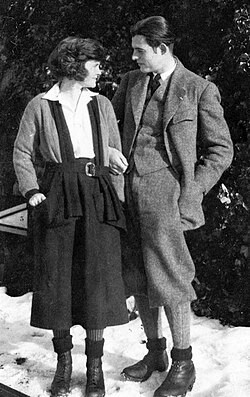
Ernest Hemingway with his wife Hadley
Then there was the bad weather. It came unexpectedly one fine day after autumn had passed. We had to close the windows at night to keep out the rain, and the cold wind tore all the leaves from the trees on Place Contrescarpe. The leaves lay soaked in the rain, and the wind whipped the rain against the big green bus at the terminal, and the Café des Amateurs was packed, and the windows were fogged up from the heat and smoke inside. It was a sad, desperately run-down café where the neighborhood drunks gathered, and I stayed away from it because of the stench of filthy bodies and the sour smell of drunkenness. The men and women who frequented the Amateurs stayed drunk the whole time, or at least as long as they could pay; mostly on wine they bought by the half-liter or liter. There were advertisements for many drinks with strange names, which few could afford, except as a sort of base on which they could then build their drunkenness with wine. The female drunks were called poivrottes, the feminine word for drunkard.
The Café des Amateurs was the cesspool of Rue Mouffetard, that wonderfully narrow, crowded street leading to Place Contrescarpe. The tiny toilets of the old tenement buildings, one on each floor next to the staircase, with their two cement shoe-shaped cleats on either side of the opening to prevent the tenant from slipping, opened onto cesspools that were emptied by pumping the contents into horse-drawn tankers in the evening. In the summer, with all the windows open, we could hear the pumping, and the stench was no small matter. Those tankers were painted brown and saffron-colored, and when they operated in the moonlight on rue Cardinal Lemoine, those wheeled, horse-drawn cylinders looked like paintings by Braque. But no one came to empty the Café des Amateurs, and that yellowed notice listing the regulations against drunkenness and the criminal penalties for it had been just as soiled by flies and ignored as the clientele was stagnant and foul-smelling.
It was no wonder that Ernest wanted to escape this depressing environment. He would often go to Gertrude Stein’s. To get there, he had to pass through the Jardin Luxembourg, and that is where our walk begins, at the Porte Gay-Lussac — yes, the one associated with the gasworks.

We enter the park from the bustling Boulevard Saint-Michel.
The Jardin du Luxembourg (‘Luxembourg Garden’) is a city park in Paris. It was laid out in 1612 at the request of Maria de’ Medici as a park surrounding the Palais du Luxembourg in what is now the 6th arrondissement of Paris.
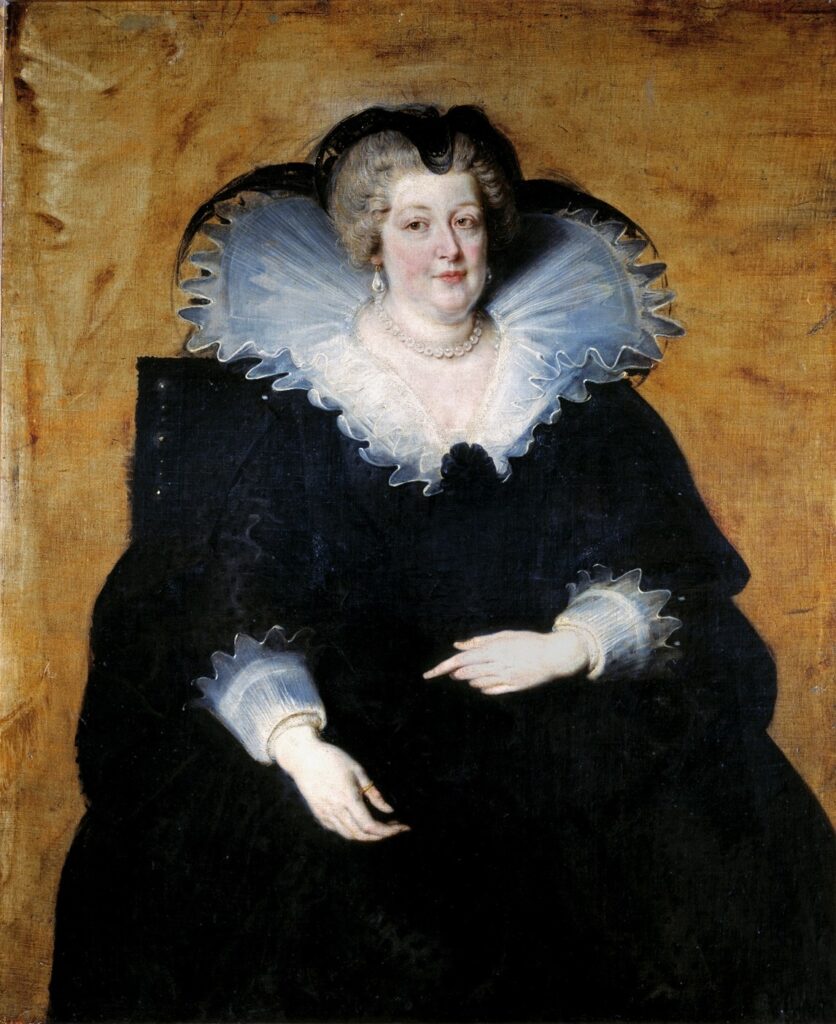
Peter Paul Rubens: Maria de’ Medici, Queen of France, Prado, Madrid
Maria de Medici was married to Henry IV. During the First Empire (Emperor Napoleon), Jean-François-Thérèse Chalgrin restored the park. Since then, it has been owned by the French Senate. Parisians refer to it as le Luco.
The park covers 23 hectares along Boulevard St-Michel, 21 of which are open to the public. The gardens are dominated by a large octagonal pond. In addition to terraces, wide avenues, and statues, the park also features an outdoor café, a puppet theater, tennis courts, a bandstand, and a beekeeping school. The tranquility of the park, located in the center of one of Europe’s largest cities, attracts many students during the week who study or read in the iron chairs around the pond. On weekends, and especially on Sundays, the Jardin du Luxembourg is the domain of families with children.
The park contains more than a hundred statues, including Eugène Oudiné’s series Reines de France et femmes illustres. We enter the park at the same spot where Hemingway did.
When I walked through different streets to the Jardin du Luxembourg in the afternoon, I could stroll through the gardens and then go to the Musée du Luxembourg, where the large paintings hung that have now mostly been moved to the Louvre and the Jeu de Paume. I went there almost every day to see the Cézannes and to look at the Manets and the Monets and the other Impressionists, whom I had first heard of at the Art Institute in Chicago. I learned something from Cézanne’s painting: that writing simple, true sentences was far from enough to give the stories the dimensions I was trying to imbue them with. I learned a great deal from him, but I cannot express myself well enough to explain this to anyone. Besides, it was a secret. But when the lights went out in the Luxembourg, I walked through the gardens and stopped by to see Gertrude Stein, who had her studio and apartment on the Rue de Fleurus.
Ernest Hemingway, A Moveable Feast
The Rue de Fleurus—we’ll get to that later. But first, the park. To the left of the entrance is a statue of George Sand.

George Sand, the pen name of Amantine Aurore Lucile Dupin, lived from 1804 to 1876; she was a writer of novels, as well as plays and political pamphlets. She became known, among other things, for her relationships with Alfred de Musset and Chopin. She went to Venice with the former, and after their relationship ended, they both wrote a book about it.
We can take a moment to look at the statue, but then we have to head back to the entrance. Because we’re not walking straight ahead, like Hemingway, but turning sharply to the right. It’s just a short walk, and we’ll find ourselves in front of a fountain on our left. It’s the Fontaine de Léda.

This fountain dates back to 1809. It is the rear side of the Fontaine de Medicis, which dates from 1630. This fountain was in a state of serious disrepair and was first restored in 1811. In 1864, Baron Hausmann wanted to build a street right through the fountain. The fountain was therefore moved 30 meters, and the Fontaine de Léda was added to the back. The original fountain at the front was given new statues: the Rhône and the Seine at the top, and a faun and a huntress; two masks and Polyphemus discovering the lovers Acis and Galatea.
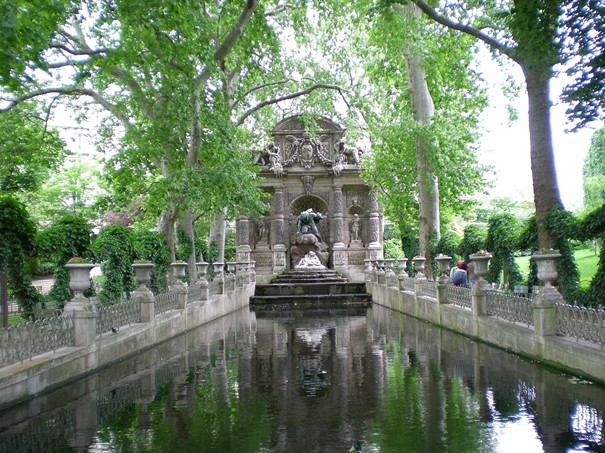
Unlike the somewhat dull fountain on the other side, it is usually busy here. There are benches on the sides that are usually occupied.
On August 19, 1923, during Hemingway’s time, Jan Slauerhoff, a Dutch doctor-poet, we have encountered him earlier in Lisbon, arrived in Paris. A performance of Stravinsky and Ramuz’s L’Histoire du Soldat held little appeal for him, but this fountain struck a chord with his poetic nature.
Fontaine de Medicis
(Jardin du Luxembourg]
The walls, rising to where the water wells up,
Make it seem as though the basin tilts between them
And yet does not flow, lying still as a pure reflection.
The shy nymph no longer flees, consents
To the faun’s embrace, yet remains distant; she folds
Herself into his lap, which he holds wide open.
(Only her breast briefly touches his face.)
How strange, though so different, they can remain in embrace
Just as in balance
The sloping water and the gushing spring.
The sun does not cast its soft shadows forward.
They lie gleaming before the dark gate
(Where all around drops weep, as if for the last time),
Rising above the depths and deeply reflected.
We part, however much we were united;
We shall be lonely, though we were together.
Was it not happiness, when we stood thus transfixed
And could no longer think of the things
That tenderly came between us,
Were not the first, and yet prevailed?
From the Fontaine de Medicis, it’s just a short walk to the large basin. Depending on the season and weather, it’s always busy here, especially when the weather is nice. Many people are sitting there reading, and children are playing with the little boats in the basin.
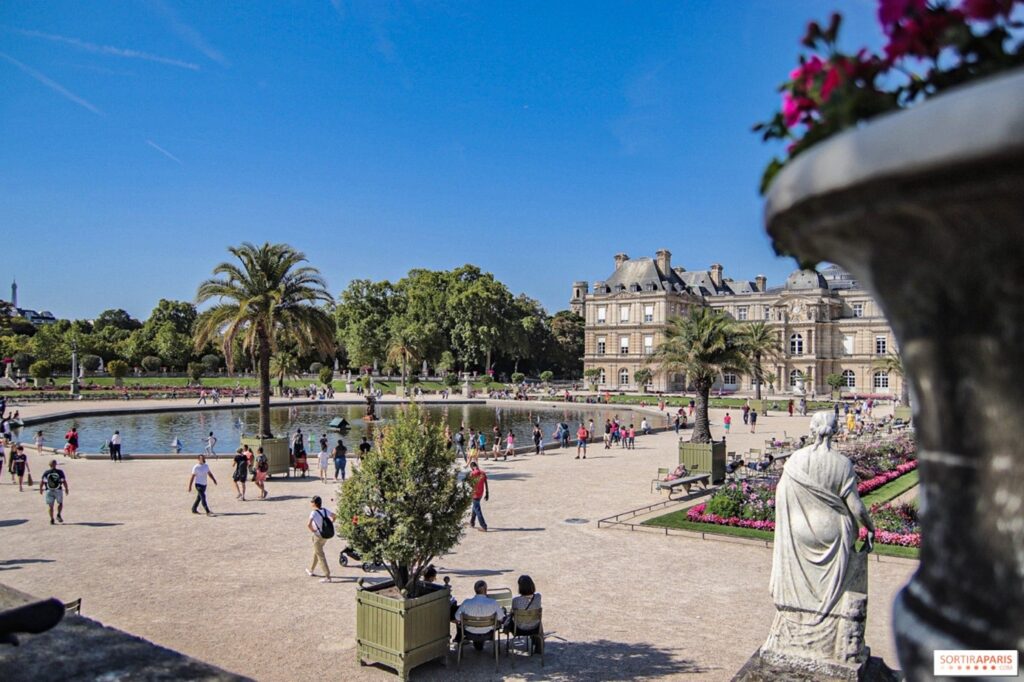
We walk around the basin, now briefly following in the footsteps of Ernest Hemingway. He probably walked straight ahead, directly to Rue de Fleurus. But once we’ve climbed the stairs, we temporarily veer off his route again and turn left, toward a beautiful replica of Frédéric Bartholdi’s Statue of Liberty, made in 1870, though some say this is the original.
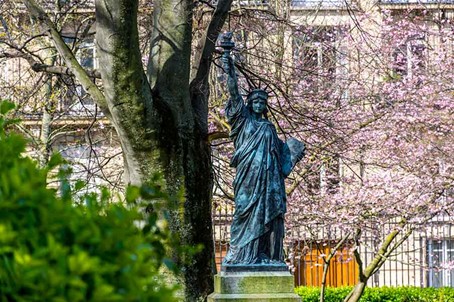
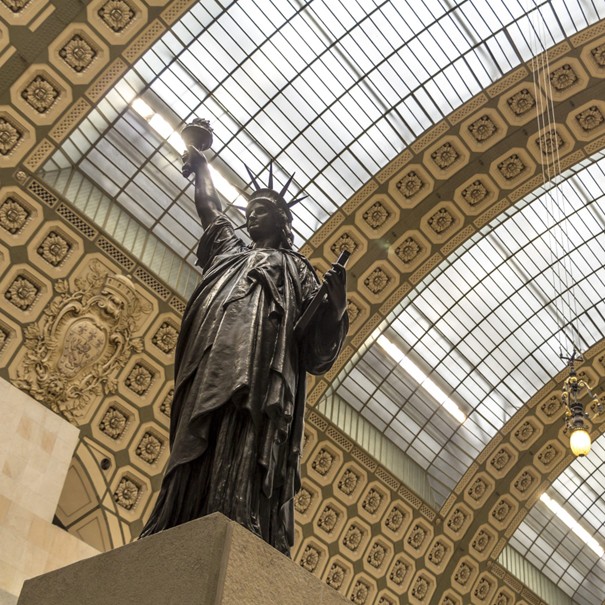
But my information says the original is in the Musée d’Orsay.
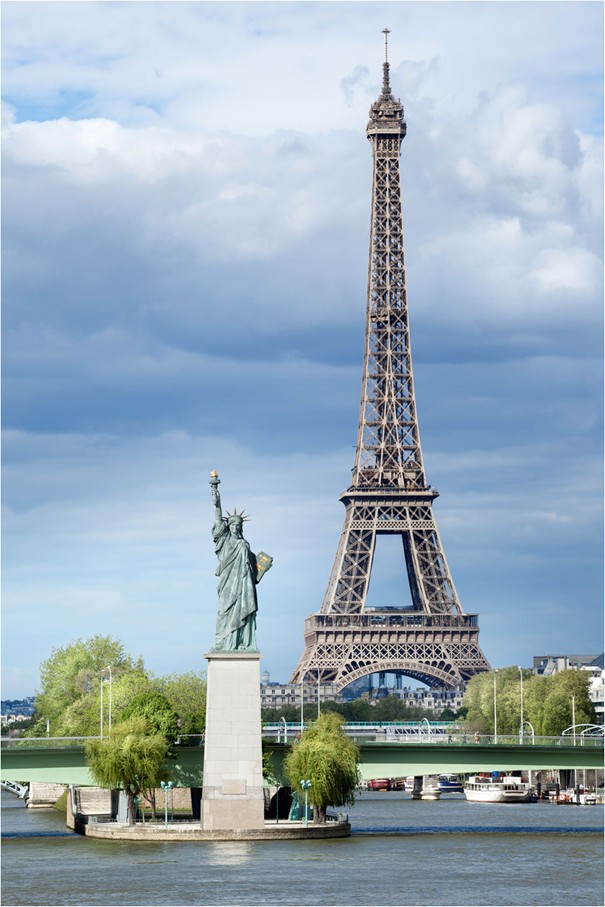
And then there’s another one on the Seine.
And of course there’s also a Statue of Liberty in New York, because while the French are generous in giving away giant statues as gifts, they also keep plenty of them for themselves.
From the Statue of Liberty in the Jardin Luxembourg, we now walk left toward the monument to Frédéric Chopin.
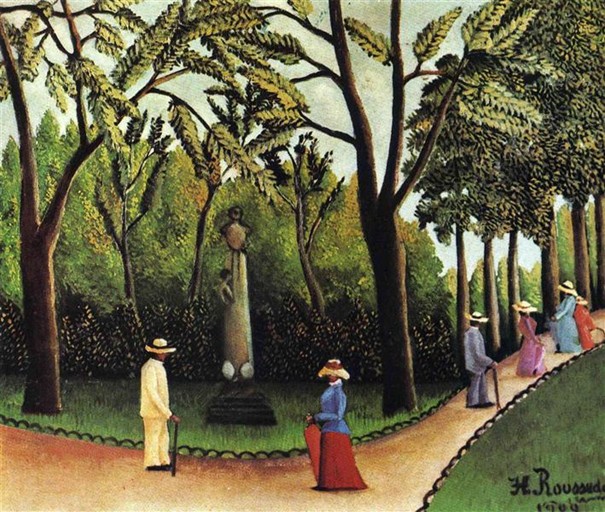
Henri Rousseau, 1909. Hermitage Museum, Saint Petersburg.
Hemingway must have taken this route to Gertrude Stein from time to time, but we’ll be back on his route shortly. Now we leave the park at Rue d’Assas and turn right onto this street. Halfway down, on the left side of the street, Johan August Strindberg lived.
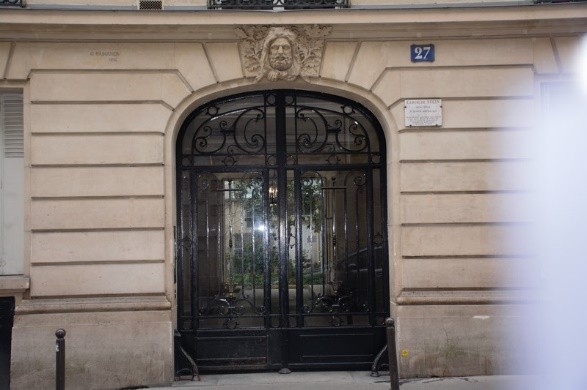
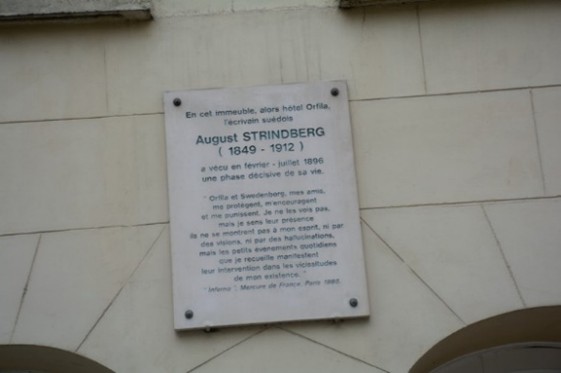
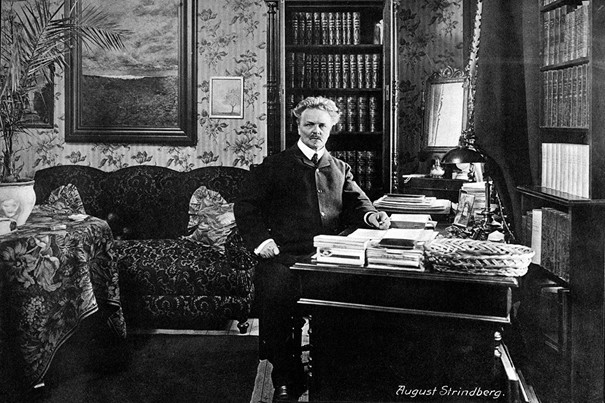
Strindberg (1849–1912) was from Sweden, but like so many people at the time, he moved to Paris, then the center of the art world. He lived in Paris starting in 1892. There, he went through a severe mental crisis. He wrote poetry, but also painted and immersed himself in photography.
We continue on to Rue de Fleurus and turn left there. We’re back on Ernest Hemingway’s trail, on our way to Gertrude Stein.
Gertrude Stein (1874–1946) was an American writer who lived in Paris starting in 1903. Some know her for “Rose is a rose is a rose is a rose” (often incorrectly quoted as: “A rose is…”) from the 1913 poem “Sacred Emily.” An attempt, so they say, to bring Cubism into literature.
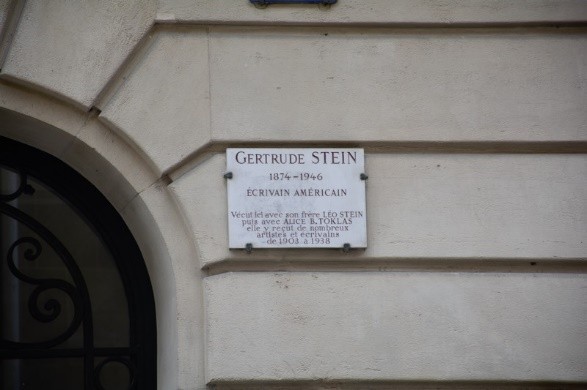
She was in Paris with her brother, the art critic Leo Stein, and was in a relationship with Alice B. Toklas from 1907 until her death in 1946. Stein’s home at 27 Rue de Fleurus was an artistic and literary salon, frequented by many famous artists, such as Pablo Picasso, Henri Matisse, Ezra Pound, John Dos Passos, F. Scott Fitzgerald, John Steinbeck, T.S. Eliot, and Erich Maria Remarque. And indeed, Ernest Hemingway.
Gertrude Stein was the one who, during the interwar period, coined the term “Lost Generation” for a group of American writers who had moved to Paris after World War I. “You are all a lost generation” is the motto of And the Sun Also Rises, Ernest Hemingway’s 1927 novel.
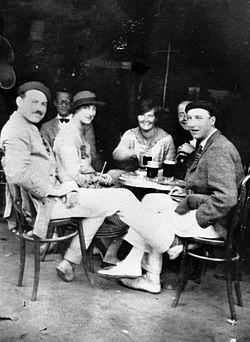
The Lost Generation
In A Moveable Feast, Hemingway explains this:
It was when we had returned from Canada and were living on Rue Notre Dame-des-Champs, and Miss Stein and I were still good friends, that Miss Stein made that remark about the Lost Generation. She was having trouble starting the old Model T Ford she was driving at the time, and the young man working in the garage—who had served during the final year of the war—hadn’t been very efficient, or perhaps hadn’t prioritized Miss Stein’s Ford over all the other vehicles waiting to be repaired. In any case, he hadn’t been serious and had been severely reprimanded by the garage owner after Miss Stein had protested. The owner had said to him, “You all belong to a lost generation.” “That’s exactly what you are. That’s what you all are,” said Miss Stein. “All those young people who served in the war. You are a lost generation.” “Oh, really?” I said. “That’s what you are,” she insisted. “You have no respect for anything. You drink yourselves to death…”
(Ernest Hemingway, A Moveable Feast)
Portrait of Gertrude Stein is a famous painting by Picasso that was part of the Stein collection. It is now in the Metropolitan Museum of Art in New York.
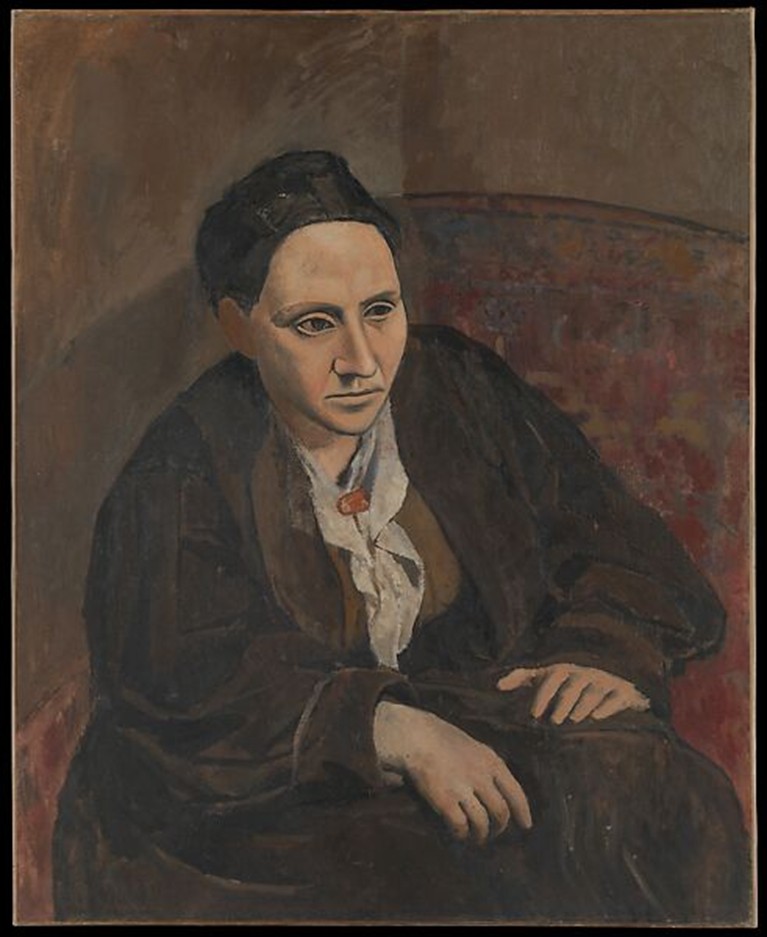
When they came to our apartment, it was as if they liked us even more; but perhaps that was because our place was so small and we were closer together. Miss Stein sat on the bed that lay on the floor and asked to see the stories I had written, and she said she liked them all except one, Up in Michigan. “It’s good,” she said. “That’s not the point. But it’s inaccrochable. That is to say, it’s like a painting that a painter paints and then can’t hang when he has an exhibition, and that nobody buys because they can’t hang it either.” “But what if it’s not trashy, and you’re just trying to use words that people actually use? If those are the only words that can do the story justice and you have to use them? Then you have to use them.” “But you don’t understand what this is all about,” she said. “You mustn’t write anything that’s inaccrochable. It’s pointless. It’s wrong, and it’s foolish.”
(Ernest Hemingway, A Moveable Feast)
We leave Gertrude Stein’s salon again and return to the Jardin Luxembourg. If Hemingway had still been living on Rue Cardinal Lemoine, he would have walked straight ahead, but he lived in many places in Paris, and we are now walking to one of those places. As we enter the park, we therefore turn left and walk past the statue of Paul Verlaine.
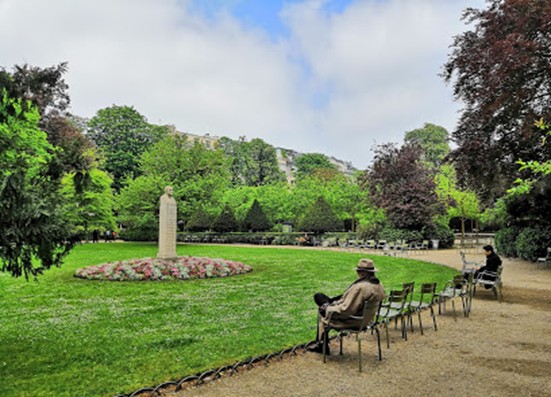
Paul Verlaine (1844–1896) studied law in Paris, but literature drew him in and he dropped out of school. He took a job at City Hall and devoted the rest of his time to poetry. He drank mostly absinthe, which apparently isn’t good for you. It led to violent outbursts against his mother and his wife. In 1871, he began a relationship with the 17-year-old poet Arthur Rimbaud, who lived with the family for a short time shortly after his arrival in Paris but later stayed elsewhere in Paris. Paul Verlaine eventually left his wife in 1873 to go with Rimbaud to Belgium and then to England. There they lived in London for a time. Both earned some money there as French teachers, but also lived off the allowance Verlaine was still receiving.
In 1873, Verlaine (while intoxicated) attempted to shoot Rimbaud in their hotel room in Brussels. He hit him in the wrist. As a result of the shooting, he was sentenced to 18 months in prison. Rimbaud then returned to Paris. After his release, they would meet one more time.
In 1884, Verlaine compiled the collection Les poètes maudits, bringing together the works of Corbière, Rimbaud, Mallarmé, and Pauvre Lelian (an anagram of Paul Verlaine). The poems of these poets became very popular with the general public. This was remarkable, because their poems are difficult to read; we will provide an example of this shortly.
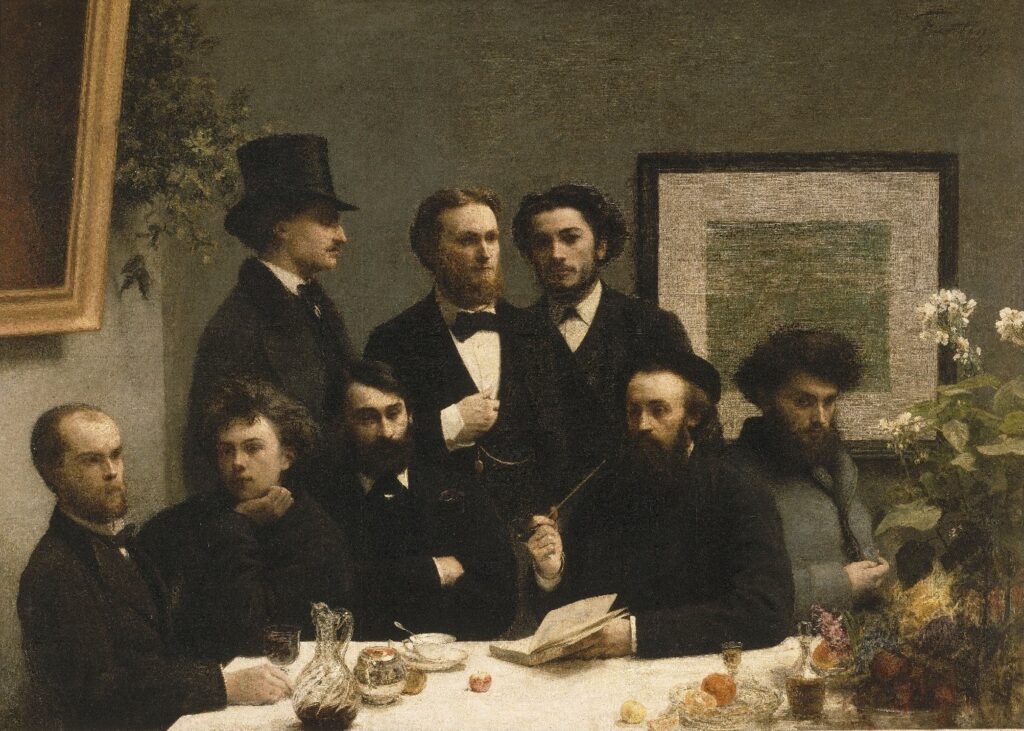
Les poètes maudits. Henri Fantin-Latour, 1872, Musée d’Orsay
Seated from left to right: Paul Verlaine, Arthur Rimbaud, Léon Valade, Ernest d’Hervilly, and Camille Pelletan; Standing: Pierre
Elzéar, Émile Blémont, and Jean Aicard.
With the statue of Verlaine on our left, we turn right and then immediately left again, onto a wide road leading to a side exit. On the right is the Senate’s Orangery. On the left is a statue of Stefan Zweig, the cosmopolitan who felt at home everywhere in Europe—a feeling that came to an end when Hitler came to power.
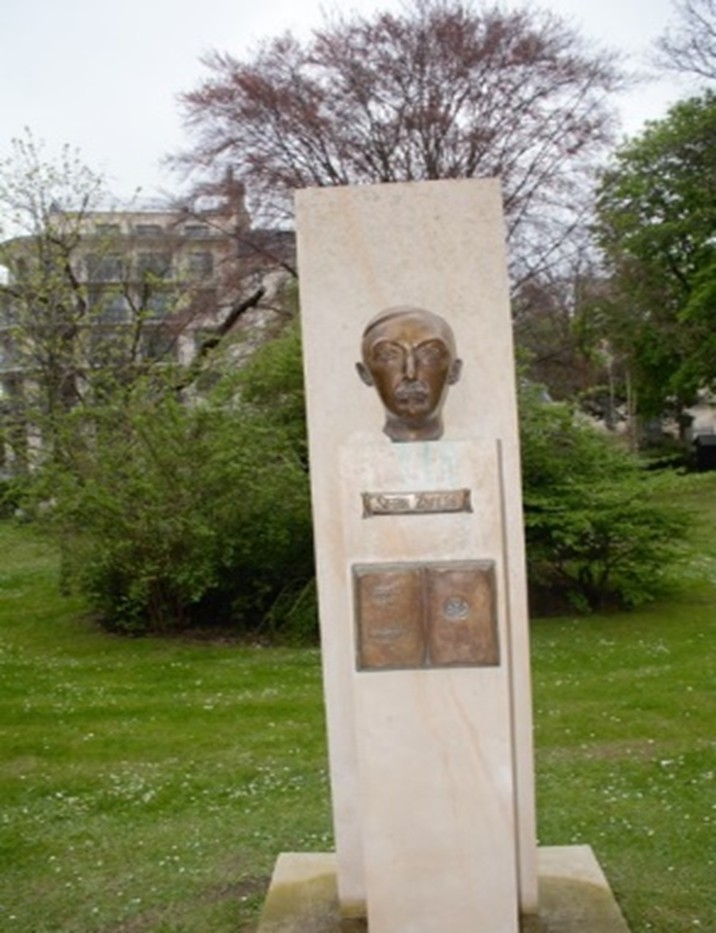
Stefan Zweig was in Paris in 1904 and describes it in The World of Yesterday
When I first got to know the city, it had not yet been fused into a single entity as it is today thanks to the metro and the car; the enormous omnibuses, drawn by heavy, steaming horses, still dominated the traffic. Incidentally, there was hardly a more pleasant way to discover Paris than from the “imperial”—the first floor of these wide carriages—or from the open hire carriages, which didn’t drive all too hastily either.
But getting from Montmartre to Montparnasse was still quite a journey back then, and given the frugality of the Parisian petty bourgeoisie, the legend seemed entirely credible to me that there were still Parisians from the Right Bank who had never been to the Left Bank, and children who had only played in the Jardin du Luxembourg and had never seen the Tuileries or the Parc Monceau. The true bourgeois or concierge preferred to stay chez soi, in his own quartier; he created a Little Paris for himself within Greater Paris, and as a result, each arrondissement still retained its own, even provincial, character. For a stranger, therefore, it meant making a clear decision about where to set up camp.
In Paris, he met that other European, Rainer Maria Rilke.
He always had very few possessions around him, but there were always bright flowers in a vase or a bowl, perhaps given to him by women, perhaps carefully brought home by himself. There were also always the colors of books along the wall, beautifully bound or carefully dusted, for he loved books as he loved silent pets. On his writing desk lay pencils and pens in a perfectly straight line, and sheets of blank paper arranged in a rectangle; a Russian icon and a Catholic crucifix—which, I believe, accompanied him on all his travels—gave his workspace a slightly religious character, although his religiosity was not bound to any dogma. In every detail, you could sense that it had been carefully chosen and meticulously maintained. If you lent him a book he didn’t know, he’d return it neatly wrapped in tissue paper, like a gift tied with a colorful ribbon. I still remember how he brought the manuscript of Weise von Liebe und Tod to my room as if it were a precious gift, and I’ve kept the ribbon that wrapped it to this very day. But the best thing was to go for a walk with Rilke in Paris, because that meant you saw the meaning in even the most insignificant things as if your eyes had suddenly opened; he noticed every little detail, and he even liked to say brand names on signs aloud if they seemed to sound rhythmic to him; Knowing Paris, as the only city, down to its very corners was a passion for him, the only one I ever discovered in him. (…)
Our paths crossed many times after that, but whenever I think of Rilke, I see him in Paris; he was spared having to experience that city’s saddest hour.
On the other side of this park stands a bust of Beethoven, but why is not entirely clear to me.
We are now at the side entrance of the Jardin Luxembourg. We cross Rue de Vaugirard and walk into Rue Ferou. Here was one of Ernest Hemingway’s other homes. He lived at number 19, fifth floor.
You’d get terribly hungry if you didn’t eat enough in Paris because the pastry shop windows were filled with such delicious things, and people were eating outside at tables on the sidewalk, so you could see and smell the food.
If you’d given up journalism and weren’t writing anything anyone in America would want to buy, and you’d told people at home you were going out to lunch with someone, the best place to go was the Luxembourg Gardens, where from the Place de l’Observatoire all the way to Rue de Vaugirard you saw or smelled nothing to eat. You could always go into the museum, and if your stomach was empty and you felt hollow with hunger, all the paintings came into sharper, clearer, and more beautiful focus. When I was hungry, I understood Cezanne much better and only then truly saw how he created landscapes. I wondered then if he was also hungry when he painted; but I thought it was probably just because he had forgotten to eat. It was one of those absurd yet enlightening thoughts you get when you haven’t slept or are hungry. Later, I came to believe that Cézanne was likely hungry in an entirely different way. When you came out of the Luxembourg Gardens, you could walk down the narrow Rue Ferou to the Place Saint-Sulpice, and even then you wouldn’t come across any restaurants, just the quiet little square with its benches and trees.
(Ernest Hemingway, A Moveable Feast)
On the left, on a long wall, is a poem by Arthur Rimbaud, Verlaine’s companion.

Rimbaud wrote Le Bateau Ivre in the summer of 1871. He was not yet seventeen years old at the time. He had just met Verlaine, a Breton, in his hometown of Charleville, and after receiving some of his verses, Verlaine wrote to him: “Venez, chère grande âme, on vous attend, on vous désire.” At the end of September, Rimbaud answered this call
The Dutch foundation TEGEN-BEELD from Leiden installed this wall poem in 2012. The initiators chose this long, blank wall because in 1871, not far from here, the then 17-year-old Rimbaud recited the poem for the first time.
The poem describes an imaginary sea voyage on a sinking boat. The boat recounts its wandering journey filled with strange, sometimes terrifying experiences, its imaginative and hallucinatory associations, heading toward nowhere. A sort of escape story from life itself. A portion of the poem is translated below.
The Drunken Boat
As I drifted along the tranquil rivers,
I saw the hunters along the path for the last time:
Redskins, to celebrate their lust for killing,
Had nailed them naked to the colorful totem pole.
Whether I had a crew or not, I couldn’t care less,
Stowed with English cotton or Dutch grain.
When I could no longer bear the bickering of the tugboat folk,
The rivers let me go wherever I pleased.
That winter, deaf even to the minds of youths,
In the furious churning of the untamed flood,
I sailed! And never had the runaway captains
Met such a triumphant vessel.
The storms blessed my maritime vigil;
Many a victim, they say, was swindled;
I did not miss the eye of a foolish beacon,
And danced upon the sea as light as a piece of cork.
Sweeter than a tart apple to a child
The green water seeped through the pinewood hull,
It washed away the vomit and the wine that stained me,
And cast the tiller and the anchor overboard.
Milky-white seas whose sparks resembled stars,
From that moment on, I bathed in Your Poem,
The green azure, where like a loose, pale
Float a drowning man sometimes pensively sinks.
This is where this walk ends. In the next On the spot, we will continue the walk and venture into the Paris of the existentialists (and Hemingway returns as well).
Arko Oderwald
Ps I could not find a authorized English translation of Le bateau Ivre.