Start: Rue Faubourg Montmartre, exit/entrance to the Verdeaux passage
Alternative start: Place Blanche
Cost: free, or for a special exhibition at the Musée de la vie romantique.
We have just left the last passage and are now on our way to Montmartre. It is still a long walk (and uphill), but if you walk this route separately, i.e. not in connection with the passages, you can also start at Place Blanche. You can get there by metro 2, getting off at Place Blanche. However, you will miss the Musée de la vie romantique, as well as the walk.
Turn left onto Rue du Faubourg Montmartre. Continue straight ahead and cross Rue de la Fayette. You are now on Rue Notre Dame de la Lorette. Continue along this road. On your left, you will pass the Notre Dame de la Lorette church.

If you take a look inside, you might see Gérard de Nerval sitting there with a lobster on a string (although that was probably in the Palais Royal).
It was too late for the visit I had wanted to make. So I walked back through the streets to the center of Paris. Near Rue de la Victoire, I met a priest and, in my distress, I wanted to confess to him. He said he was not from that parish and that he was on his way to an evening at someone’s home; if I wanted to speak to him the next day at Notre Dame, I only had to ask for Father Dubois. Desperate and crying, I made my way to Notre-Dame-de Lorette, where I threw myself on my knees before the altar of the Holy Virgin to ask forgiveness for my sins. Something inside me said: The Holy Virgin is dead and your prayers are useless. I knelt down at the back of the choir and slipped a silver ring from my finger with a stone engraved with these three Arabic words: Allah! Mohammed! Ali! Immediately, several candles were lit in the choir and a service began, which I tried to participate in spiritually. When they reached the Ave Maria, the priest stopped in the middle of the prayer and started again seven times without me being able to remember the next words. Then the prayer ended and the priest gave a speech that seemed to apply exclusively to me. When all the candles were out, I got up, went outside, and headed in the direction of the Champs-Elysees.
Gerard de Nerval: Aurélia or the Dream and Life
We are not going to the Champs Elysees, but further up the hill. We are still walking on Rue Notre Dame de la Lorette. We pass a roundabout and the Saint Georges metro station.

There are some beautiful houses here. Continue along Rue Notre Dame de la Lorette. At the intersection with Rue Jean Baptiste Pigalle, turn diagonally left into Rue Chaptal. On your right, you will see a gem, La musée de la Vie Romantique. This former home of the Dutch painter Ary Scheffer (1795–1858) from Dordrecht was a meeting place for actors, philosophers, and writers.
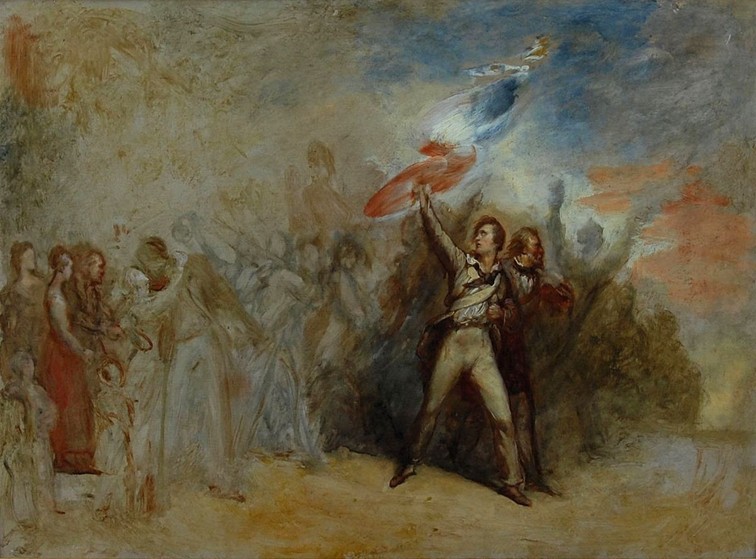
Ary Scheffer la Marseillaise, 1825, Dordrecht Museum
Today, the museum is partly dedicated to George Sand. In the museum, you can admire her writing materials, a print of her hand, jewelry, and paintings by… once again, her hand. As an added bonus, we would like to mention the adjacent tea house under the trees. Everyone sits together at the table, there are a few ladies painting, and the audience is very book-loving. The museum has been renovated and will reopen on February 14, 2026. The permanent collection is free to visit, but special exhibitions are subject to a fee.
George Sand, pseudonym of Amantine Aurore Lucile Dupin (1804–1876), also known as Baroness Dudevant through her marriage, was a French writer and feminist avant la lettre. She wrote novels, novellas, fairy tales, plays, an autobiography, literary critiques, and political texts, among other things. She also played a political role by indirectly participating in the provisional government of 1848.
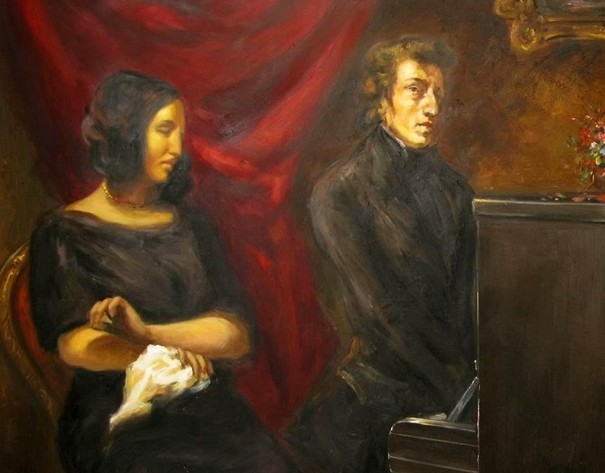
Georges Sand and Frédéric Chopin by Eugène Delacroix. This painting was cut in two after Delacroix’s death. Chopin’s portrait hangs in the Louvre in Paris. Sand’s portrait hangs in the Ordrupgaard Museum in Copenhagen.
When leaving the museum, turn right and at the intersection turn right into Rue Blanche until you reach Plache Blanche. There, on the left across the street, is the famous Moulin Rouge.
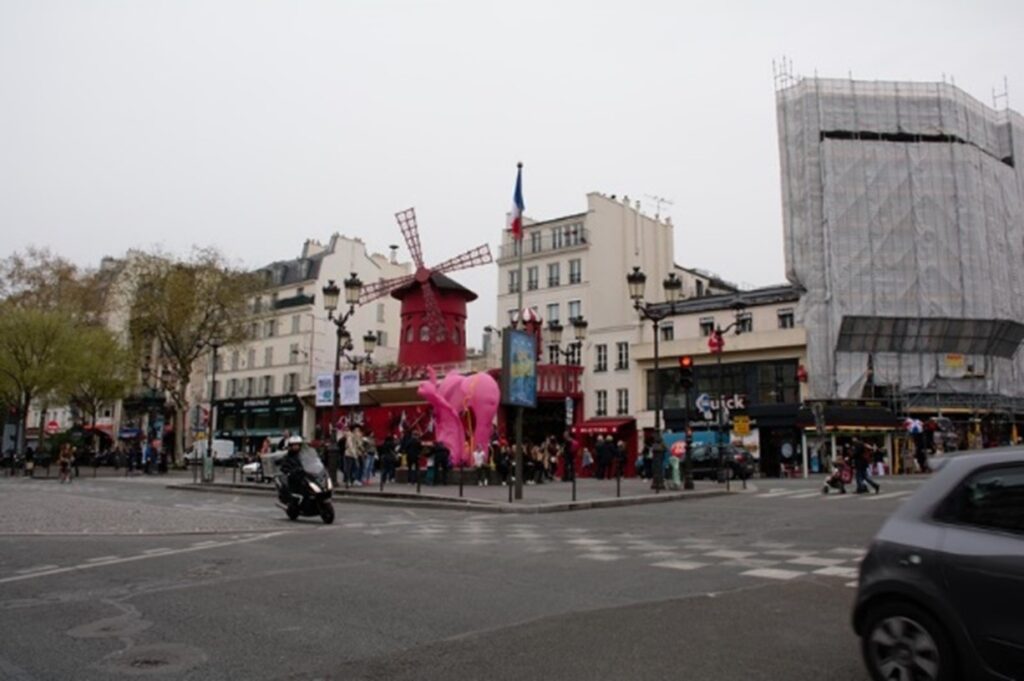
Paris was buzzing with rumors about a new music temple that would open in October 1889. The owners of this new establishment, Joseph Oller and Charles Zidler, who had christened their business ‘Moulin Rouge’ (red mill), nicknamed it ‘Le Premier Palais des Femmes’ (the first palace of women) and claimed that the Moulin Rouge would soon become a temple of music and dance.
The Moulin Rouge quickly gained a reputation as the place to see young Parisian women whose dance moves were as loose as their morals. And even though the Can-Can dance had been known to the working class since the 1830s, it was the Moulin Rouge that made it massively popular. At that time, the dance was somewhat obscene, performed by women to please their male clientele. It was during this period that the artist Henri de Toulouse-Lautrec was a frequent guest there. Many of his works of art depict scenes from the famous Moulin Rouge.
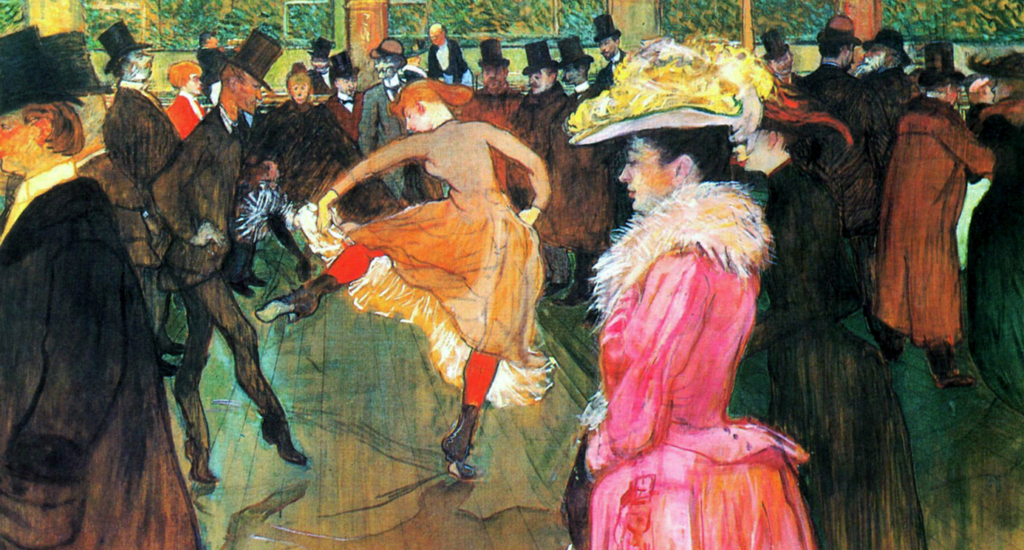
Henri Toulouse Lautrec In the Moulin Rouge, the dance. 1890. Philadelphia Art Museum.
Later, the Moulin Rouge became much more respectable and lost its reputation as a house of ill repute. Instead, it became a temple of music known for its exuberant cabaret shows, which attracted an upper-class audience. Hopefully, the recently blown-off blades of the windmill have been repaired.
Before we continue our climb, let’s first take a look at the place where Boris Vian and Jacques Prévert lived, in a small street to the left of the Moulin Rouge. That street leads to the Cité Veron.
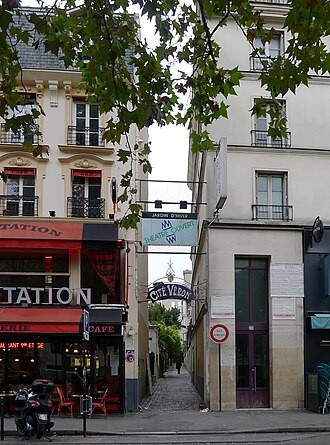
Boris Vian (1920–1959) was a French writer, engineer, poet, anarchist, chansonnier, and jazz trumpeter. His work was often controversial, especially in 1950s France. He wrote 11 novels, four poetry collections, various plays, film scripts, chansons, etc. Vian translated the work of Raymond Chandler into French.
“Hmm…” said the professor, “there’s something wrong with her right lung. But I don’t know what it is…” “You can hear a strange sound in her lung,” said the professor. He looked a little concerned.
Boris Vian L’écume des jours
As a trumpet player, he often performed at the jazz club “Tabou.” Vian wrote about 400 chansons. Serge Reggiani, Juliette Gréco, Nana Mouskouri, Yves Montand, Magali Noël, and Henri Salvador sang them.
Jacques Prévert was initially a surrealist and communist. He left both movements but remained artistically very versatile. He wrote plays, screenplays for films (a precursor to film noir), and poetry. A number of his poems, such as Les Feuilles mortes, Barbara, Page d’écriture, La grasse matinée, and Chanson des escargots qui vont à l’enterrement, were set to music by Joseph Kosma and sung by people such as Yves Montand, Édith Piaf, Les Frères Jacques, Serge Reggiani, and Juliette Gréco.
According to our information, Boris Vian’s apartment is still in its original condition, but not accessible. A little further down Boulevard de Clichy, at number 104, was the entrance to the Cormon studio, where Van Gogh took lessons for three months. The Moulin Rouge did not exist at that time—Seurat and Signac lived a little further down the boulevard.
We walk back to Place de Clichy and turn left up the steep Rue Lepic. Nowadays, the Tour de France passes by a few times on the final day, after a great success at the 2024 Olympic Games.
The route goes all the way up to the Sacré-Coeur, and we follow it upwards, but because of the medical-literary highlights. Many painters and writers lived here. We encounter them all.
We walk up the hill. At no. 15 is the café, Les Deux Moulins, made famous by the film The Fabulous Destiny of Amélie Poulain. We follow Rue Lepic all the way to the top, turning left at the intersection with Rue des Abessesses. On the right, at 54 Rue Lepic, 4th floor, left two windows, Theo and Vincent van Gogh lived there from June 1886 to February 1888, when Vincent left for Arles. There are always a few tourists in front of the front door.
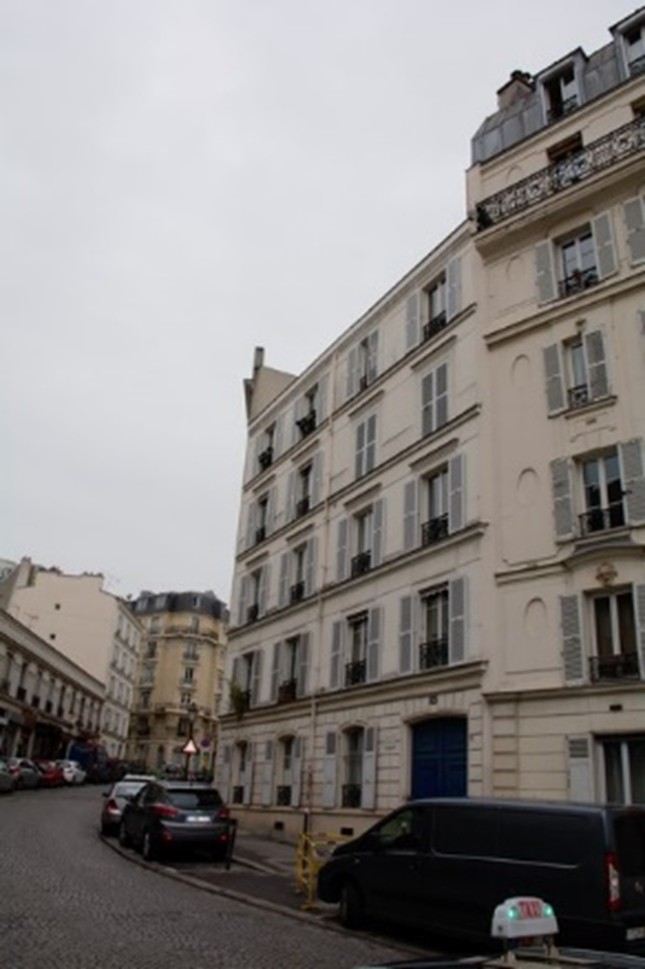
We continue climbing. Toulouse-Lautrec lived on the left in the rue Tourlaque. Louis-Ferdinand Céline lived at number 98 on Rue Lepic.
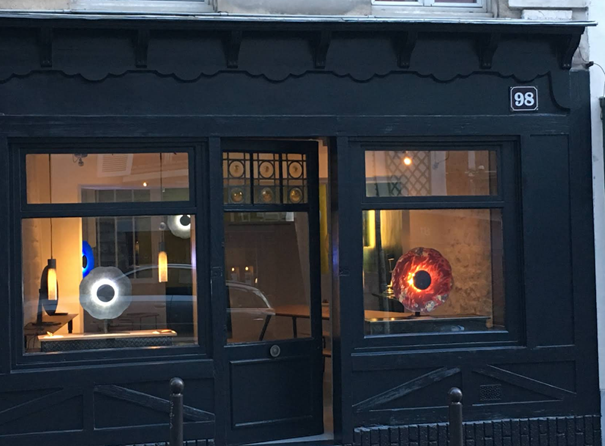
Already on Rue Lepic, you encounter people who are going up to the city to seek some merriment. They are in a hurry. When they reach the Sacré-Cœur, they look down at the night, which forms a large dark hole, with all the houses packed tightly into it. On the small square, we entered a café that we thought looked the cheapest. Tania let me kiss her wherever I wanted, out of gratitude and as consolation. She also loved to drink. Half-drunk partygoers were already dozing on the benches around us. The clock on top of the church began to strike, one stroke after another, it went on and on. We had reached the end of the world, that much was becoming increasingly clear. You couldn’t go any further, because beyond that there was only death. Close by, from the Place du Tertre, they departed, the dead. We could see them very well from where we were sitting. They went
straight over the Galeries Dufayel, east of us.
(Journey to the End of the Night)
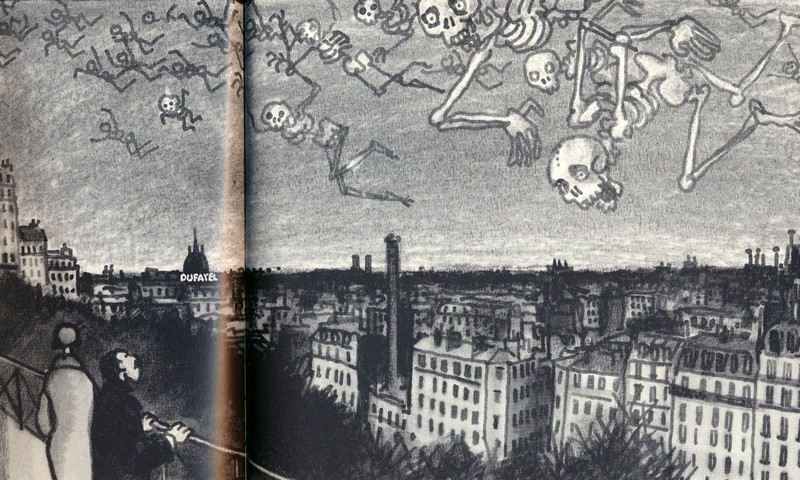
Tardi, Journey to the End of the Night
Dr. Gruby, one of Theo & Vincent’s doctors, lived at 100 rue Lepic. He had his practice elsewhere in Paris, but lived at 100 rue Lepic. There is still a small dome on his house, because he was also an amateur astronomer.

And then you come to the famous windmills, Moulin de la Galette and the smaller Radet, on the corner with rue Girardon.
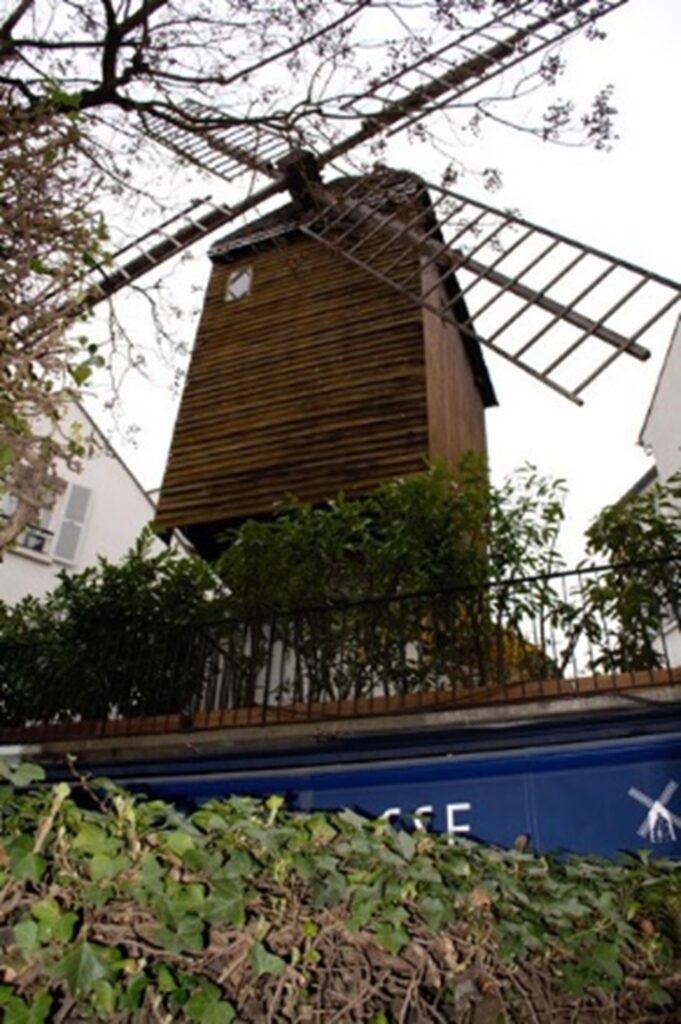
Vincent van Gogh also painted them, and it is striking how rural Montmartre still was at that time.

Vincent van Gogh. Moulin de la Galette. Oil on canvas, 46.5 x 38.0 cm. Paris: Summer, 1886. Tokyo: Artizon Museum
Now we turn into Rue Girardon and arrive at Place Dalida, with the statue of Dalida, the singer with the sultry voice, who lived here.

Recently, there was a discussion about why Dalida’s breast is such a different color. Actually, that wasn’t the discussion, because we already know the answer

The discussion was, of course, about how we can avoid this, especially the little tongue.
On the left is Allée des Brouillards number 13, where we can walk to and see where Gerard de Nerval stayed in a psychiatric institution run by Dr. Blanche. Dr. Blanche moved regularly. He also had an institution on Rue de Norvins (we’ll get there) and in Passy, near Balzac’s house. Dr. Blanche’s building is now the Turkish embassy.
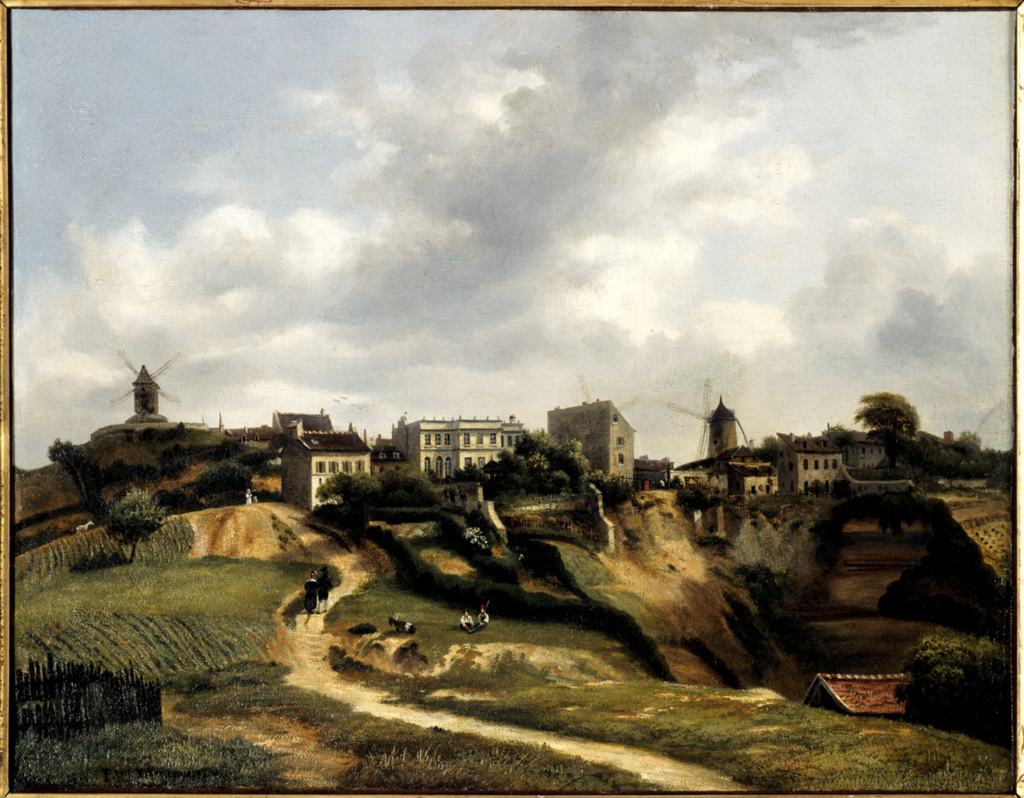
1835 The ‘butte’ of Montmartre with Dr. Blanche’s first house. Painting by Paul Glon.

Dr. Blanche
Gerard de Nerval (1808 – 1855) was one of the members of Le club des Haschichiens. We will encounter this 19th-century club again in another walk through the Marais. He traveled to the Netherlands and Belgium, among other places, about which he wrote travelogues. He also wrote novellas and librettos, and translated Heine (1848). But he was unstable and was admitted to Doctor Blanche’s care.
Thanks to the medical care, I was completely healthy again, but in my mind, the normal functioning of the human intellect had not yet been restored.
The institution where I was staying was located on a hill and had a large garden with rare trees. The pure air on that hill, the first scents of spring, and the pleasant company of extraordinary people gave me long days of inner peace.
The first leaves of the maple tree delighted me with their bright colors. They looked like plumes of golden pheasants. From morning to evening, the view stretched across the plain to a lovely horizon, whose blending shades pleasantly occupied my imagination. I populated the slopes and clouds with divine figures, whose shapes I thought I could clearly distinguish. I wanted to give my dearest thoughts a more solid form, and with the help of pieces of coal and brick that I found on the ground, I soon covered the walls with a series of paintings in which my impressions took shape. One figure always stood out above the others: the figure of Aurelia, depicted as a goddess, as she had appeared in my dream. A wheel turned beneath her feet and the gods formed her entourage. I managed to color that group by squeezing juice from herbs and flowers. How often did I stand dreaming before this beloved idol! I did even more. I tried to mold the body of the woman I loved out of clay; every eight days I had to start over, because the madmen, jealous of my happiness, took pleasure in destroying the statue.
Gerard de Nerval Aurélia or The Dream and Life

Gérard de Nerval
During this period (1853–1854), on the advice of Dr. Blanche, Nerval wrote his most famous works: Les Filles du feu and Aurélia ou le rêve et la vie.
On January 26, 1855, he was found hanging from the bars of a fence that enclosed a sewer in the Rue de la Vieille-Lanterne, in the “most filthy corner he could have found,” according to Baudelaire. (This street no longer exists, having disappeared with the demolition of the Hallen). His friends circulated the assumption that he had been murdered by vagrants during one of his usual walks through disreputable neighborhoods, but there is no doubt that it was suicide. However, doubts remain, as he was found with his hat on his head, while it is likely that it would have fallen off during the struggle caused by suffocation.
We now turn right and walk into Rue de l’abreuvoir. The street pattern is still original in this area.
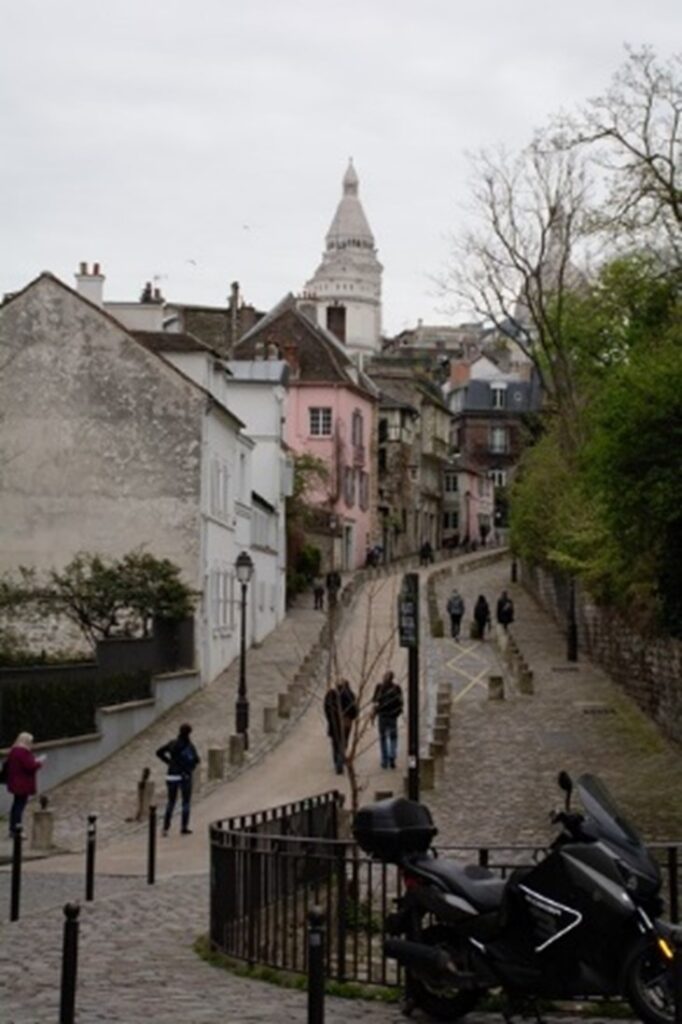
2023

1907
At the intersection with Rue des Saules is the house where the painter Utrillo lived, la maison rose.

Maurice Utrillo (1883–1955) was the son of the unmarried Suzanne Valadon, who was herself the child of an unmarried mother. She managed to work her way up from being a painter’s model to becoming an artist herself. We do not know who Maurice’s father was. A Spanish artist, Miquel Utrillo, assumed legal paternity.
Maurice’s mother left his upbringing to her mother. Maurice suffered from epileptic seizures at a young age. At the age of 17, Maurice started working, but that did not go very well. He was repeatedly fired because of his angry outbursts.
In 1905 and 1906, after being admitted to an institution, he mainly painted landscapes.
In 1923, when he exhibited with his mother at the Galerie Bernheim-Jeune, he made his breakthrough with the general public. Despite his success, he occasionally turned to drink again and was admitted to institutions five times. In 1935, he married Lucie Valore (1878-1965), the widow of art dealer and collector Pauwels, and moved to Le Vésinet, just outside Paris. In the last years of his life, he was in such poor health that he could no longer paint outdoors and worked exclusively from memory and from photographs and postcards.
Maurice Utrillo is buried in the Cimetière Saint-Vincent in Montmartre.
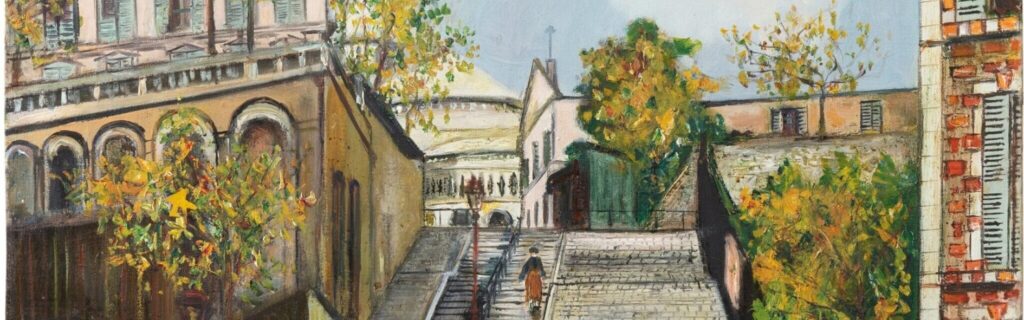
Maurice Utrillo Montmartre
We turn left onto Rue des Saules and walk past the unique Montmartre vineyard on your right until we reach the next intersection. On the corner is the cabaret Le Lapin Agile.
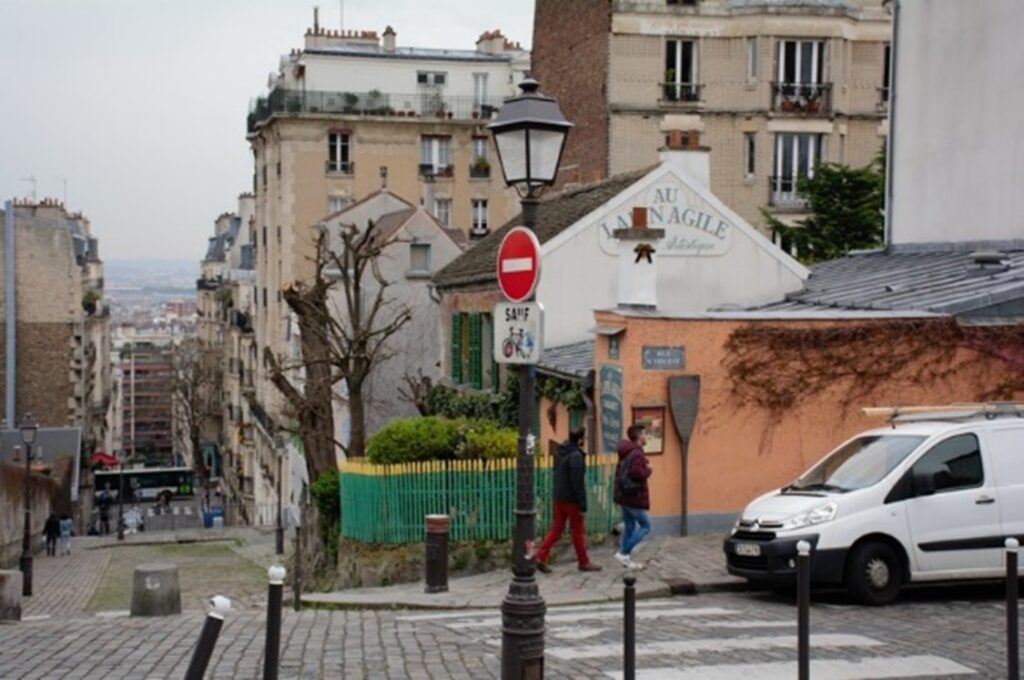
The cabaret got its name from a drawing by humorist André Gil of a rabbit escaping from a pan. Le Lapin à Gil quickly became le Lapin Agile, or the agile rabbit. The singer Aristide Bruant, whose silhouette with black cape and red scarf is etched in our collective memory thanks to the drawings of Toulouse-Lautrec, bought the cabaret in 1902. Braque, Modigliani, and Apollinaire were frequent visitors, and Picasso once paid for a meal with a painting. You won’t find topless dancers here, but you will find French humor, poetry, music, and French chansons. Singing along loudly is allowed.

Henri de Toulouse-Lautrec
We turn right into Rue Vincent. The vineyard is still on the right. We continue walking and cross a staircase on the right and Rue Becquerel diagonally to the left. On this corner is the house of Louis Hector Berlioz (1803–1869).

Berlioz was a composer, music critic, and conductor, and one of the most important and innovative representatives of Romanticism. Berlioz was the son of a country doctor. In 1821, his parents sent him to Paris to study medicine. But he was so impressed by the opera that he decided to become a composer, against his parents’ wishes. He was also a writer of essays. Avonden met het orkest (Evenings with the Orchestra) was published in Dutch. It is a colorful collection of stories, anecdotes, and satires that together paint a very lively picture of musical life in the nineteenth century. His Mémoires (1870), which were only published after his death, have also been translated and are considered classics not only in music but in literature as well.
We continue on our way and turn right onto Rue de la Bonne. We are now walking behind the Sacré-Coeur. You don’t often see this side, because most people who visit the church always come from the other side. The Sacré-Coeur is beautifully white because of the travertine, a type of limestone.
The Sacré-Coeur was built to commemorate the 58,000 dead of the Franco-Prussian War of 1870-1871. The first stone was laid in 1875 and the building was completed in 1914, just as another war with Germany was breaking out. No wonder that when the Germans were in Paris in 1940, they took a photo with a hill full of soldiers, with the Sacré-Coeur in the background. Unfortunately, that photo cannot be used here.
We are almost at the end of our walk. We turn right into Rue du Chevalier de la Barre, which we follow as it curves to the right. At the T-junction with Rue Mont Cenis, we turn left and then immediately right into Rue Saint Rustique. Then we turn left into Rue Norvins, on the corner with Rue des Saules.
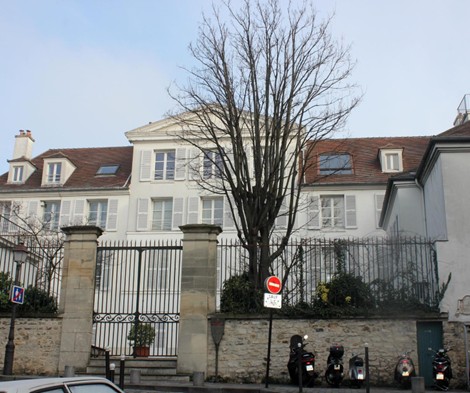
This is where the former psychiatric institution was located, where Gerard de Nerval spent his last years. It was called La folie Sandrin and is located at 22 Rue Norvins. The buildings, some of which date from the 18th century, were first called Bellevue Palace. They were purchased in 1774 by Antoine Gabriel Sandrin.
In 1805, he sold his property to Dr. Prost, a psychiatrist who was a disciple of Philippe Pinel, who rebelled against the inhumane treatment of psychiatric patients. See one of the future On the spot blogs about the Salpetrière hospital.

Philippe Pinel
Dr. Prost shared his meals with the patients and talked to them, a completely new approach compared to the chains used previously. Dr. Blanche took over from him in 1820. Gérard de Nerval described it in “La Boheme Galante” as a “fashionable and even aristocratic villa.”
There (in the institution), my illness manifested itself again with varying intensity. After a month, I had recovered. In the two months that followed, I resumed my wanderings around Paris. The longest trip I made was to Reims to visit the cathedral. Gradually, I began to write again and wrote one of my best novellas. But writing was difficult for me; I almost always wrote in pencil on loose sheets of paper, listening to whatever my musings or my walks happened to inspire in me. The corrections made me very nervous. A few days after publication, I began to suffer from persistent insomnia. I spent the whole night walking on the hill of Montmartre and watching the sunrise. I talked at length with the farmers and the workers. Another time, I walked to the Hallen. One evening, I went to eat at a café on the boulevard and, as a joke, I threw gold and silver coins into the air. Then I went to the Hallen and got into an argument with a stranger, whom I gave a good beating; I don’t understand why that never had any consequences. When I heard the clock of Saint-Eustache strike at a certain time, I was reminded of the struggle between the Burgundians and the Armagnacs and thought I saw the ghosts of the warriors of that time rising around me.
Gerard de Nerval: Aurélia or The Dream and Life
If you now turn left into Rue Norvins, you will come to one of the biggest tourist traps in Paris: the Place du Tertre. The Place du Tertre (“Hill Square”) is a famous little square in Montmartre, located a short distance from the Sacré-Cœur, where painters, portrait artists, and silhouette cutters are at work. Here you can not only buy landscape paintings, but also have your own portrait or caricature made. Picasso’s old house is also located here. His house is now used as a museum.
We continue on to the Sacré-Coeur, but now at the front. There are always a lot of tourists here too. Pause for a moment and enjoy the panorama above the heads of the crowd.
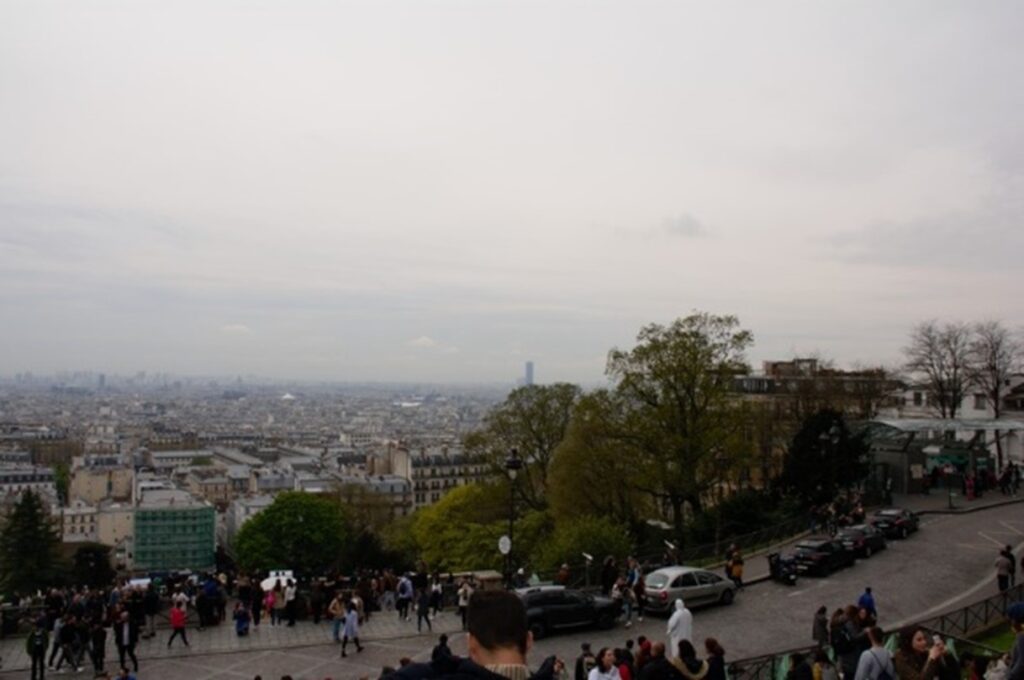
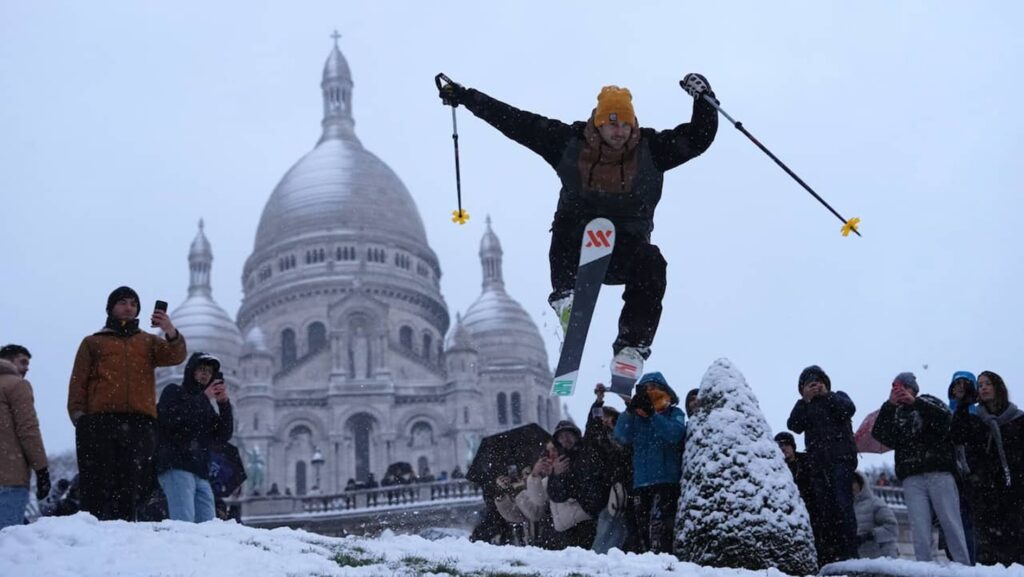
You can now go down by funicular (always very busy) or via the famous winding stairs in front of the Sacré-Coeur, or by the straight stairs next to the funicular, or by ski, as on January 6, 2026.
Arko Oderwald & Sofie Vandamme
Literature
Gerard de Nerval: Aurélia
Boris Vian. L’écume des jours
Louis Ferdinand Céline. Journey to the End of the Night.
Tardi. Journey to the End of the Night