SCOOP 6: July 12, 2025
This new episode focuses on unfulfilled childhood wishes and miscarriages (in the film Kind and the novel Hello Baby), the French comedy On Ira, in which a terminally ill old lady wants to end her life but encounters quite a few communication barriers, and the film Hot Milk about a woman who is burdened by unexplained physical complaints and thus restricts her daughter’s life. But first, the razor-sharp, short Japanese novel Hunchback, in which a woman with congenital myopathy talks candidly and pessimistically about her severe physical disability.
Click here for the pdf.
Novel
Hunchback, Saou Ichikawa,
A permanent state of constriction
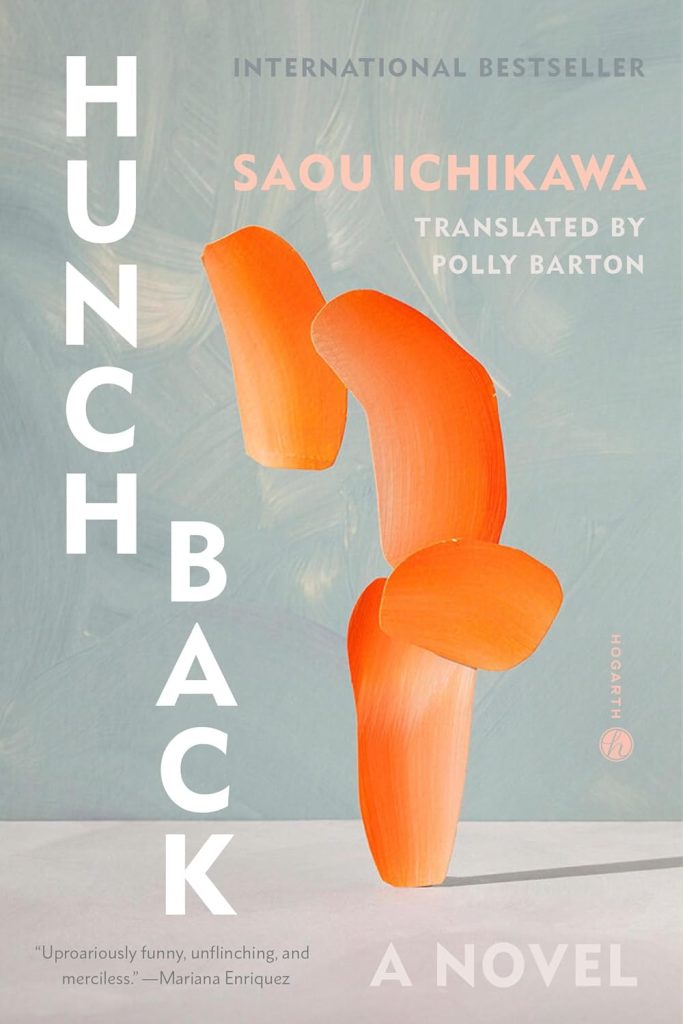
She has, says narrator Shaka Izawa in Hunchback by Japanese author Saou Ichikawa, a myopathic face, because she suffers from myotubular myopathy. Although not a progressive disease, it is one in which muscle tissue wastes away if not used, with no chance of recovery. And that’s not all: she suffers from further physical limitations, because: ‘The S-bend in my spine is so extreme that my right lung is compressed, which in my world gives a special meaning to left and right. This means I can only get out of bed on the left side.” Furthermore, she can only reach things in the refrigerator with her right hand, and only the tips of her toes touch the floor.
All this exceptional discomfort means that Shaka is in a ‘permanent state of constriction’. Speaking is difficult – long conversations literally take her breath away – which is why she prefers to communicate via text messages. After all, there is always the risk of suffocation if accumulated mucus is not cleared sufficiently and her windpipe becomes blocked, and even if that is not the case, her oxygen saturation can suddenly drop to dangerous levels if she keeps moving for too long. Her frustrations are considerable: “Because I didn’t start menstruating until I was nineteen, I looked a lot younger than the forty-something I was. It could also be that my aging curve, like my spine, had started to show the same S-curve since I left the normal growth path.”
Thanks to the enormous amount of money her parents left her, she is financially independent and lives in a care facility that is paid for by those funds. Her existence as a student is her only connection to society, “not counting her side job as an armchair writer.” That “moonlighting” refers to her sexually explicit pulp fiction writings published under a pseudonym— Hunchback begins and ends with them.
Writing is not easy: ‘While I was struggling to finish the article, mucus had accumulated in my windpipe and now the alarm on Trilogy’s ventilator was beeping nervously (…) I inserted the suction catheter to remove the mucus that had been whipped into a foamy mush by the ventilator over the past twenty minutes with a slurping sound, reconnected my tracheostomy tube to the ventilator hose, picked up my iPhone that was lying next to my bed (…).”
When she’s not taking online university courses or writing pornographic stories, she tweets wishes and statements she thinks no one will see, such as: “I would like to know what it’s like to have an abortion,” and “In another life, I would like to work as a high-class prostitute.” But a male caregiver, Tanaka, hints that he has indeed read her tweets and erotic stories. She offers him money to have sex with her. They despise each other, and their unequal social positions certainly play a role in this. This novel is therefore not only about the severe limitations of Shaka’s medical condition, but also about power differences—those who have money can arrange good care for themselves—and about society’s acceptance of people with disabilities. Hunchback makes it clear that in Japan, people like Shaka are effectively excluded from society. For example, it is only since 1996 that disabled people have been allowed to reproduce; before that, they were forcibly sterilized. According to a recent report in the newspaper, this is changing, however.
Ichikawa uses the perspective of her own disability—she herself has congenital myopathy—for her novel, but to describe it as purely autobiographical would be going too far, I think. Her approach is too literary for that. She writes with a sense of subversive humor, sometimes cynical, even nihilistic, always mischievous, provocative, and with a touch of essayistic style. Shaka wonders whether she is a freak, like those who performed in freak shows at the beginning of the twentieth century, and who were later transformed into the familiar Hollywood monsters whose disguises provided people with “a moral buffer that allowed them to gawk at deformed creatures unabashedly and without remorse.”
This passage is in the same contemplative vein: ‘The longer I lived, the more my body deteriorated into a disfigured state. It did not decay in the run-up to death. It deteriorated in order to live—the deterioration of the body as a testimony to the time it had endured. In this, it differed fundamentally from terminal illnesses or infirmities of old age that able-bodied people may experience, and which vary from person to person due to slight variations in the rate of deterioration.”
The jury that nominated Ichikawa’s novel for the International Booker Prize called it an unapologetic and fearless novel that dismantles social and moral assumptions about disabilities while focusing on the joys of the body.
That is no exaggeration.
Henk Maassen
Film
On Ira
Now in theaters
Euthanasia packaged as a road movie
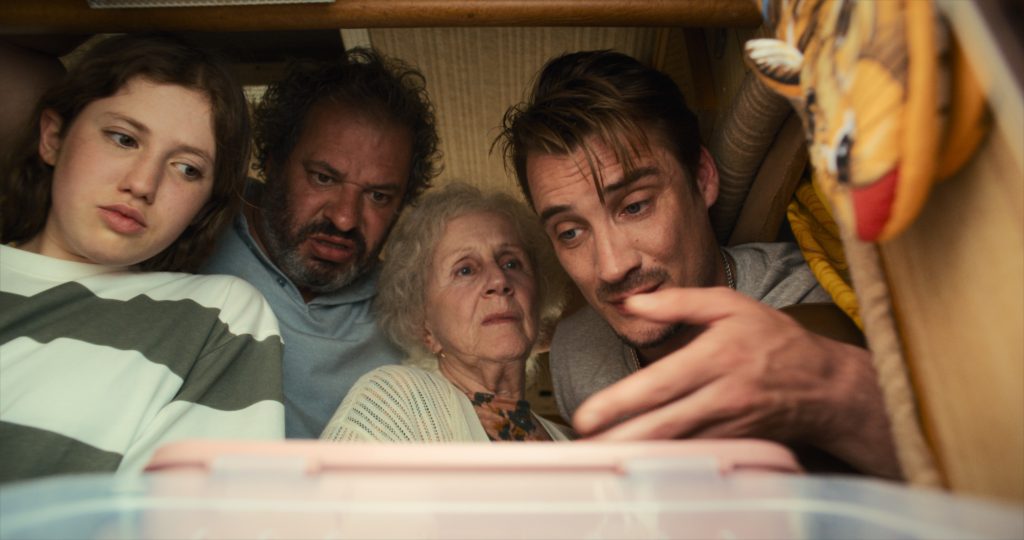
Can you turn a desire for euthanasia into a comedy? Yes, at least French filmmaker Enya Baroux succeeds quite nicely with On Ira, his debut. This comedy of errors is based primarily on miscommunication between 80-year-old Marie, her son, and her granddaughter. Marie is suffering from metastatic breast cancer and has decided to travel to Switzerland to end her life. But on the morning she plans to settle matters with her only son, everything goes wrong, and he doesn’t find out what she is planning or the seriousness of her health condition. She wants to report to Zurich in a week’s time to end her life.
Her new home care worker Rudy—a free spirit with a heart of gold for his patients who is eager to escape the mess of his own life—turns out to be her savior and, against his will, becomes a kind of end-of-life counselor. Marie manages to persuade him to drive her, her son, and her granddaughter to Switzerland in her dilapidated camper van, under the not very credible pretext that they are going to collect an inheritance from a relative who died some time ago. Marie plans to reveal the real purpose of the trip at a suitable moment during the journey. But you guessed it: that moment never comes. The family’s communication is based on lies and unspoken discomfort; you could even call it a pattern. The granddaughter conceals her first period, the son hides his extremely precarious financial situation, and then there’s a running gag involving a rat that travels with them.
Does it work? Yes, because Baroux, who co-wrote the screenplay, tells a well-constructed story, avoids sentimental clichés, and is supported by convincing actors, even if he doesn’t make the whole thing particularly exciting cinematographically.
He dedicated his film to his grandmother, so there is undoubtedly some personal experience behind it. Anyone who has ever seen the film Little Miss Sunshine will also know where Baroux got his inspiration.
Henk Maassen
Film
Kind (Child) (Dutch movie)
Now in theaters and available on picl.nl
Holistic nonsense in obstetric care
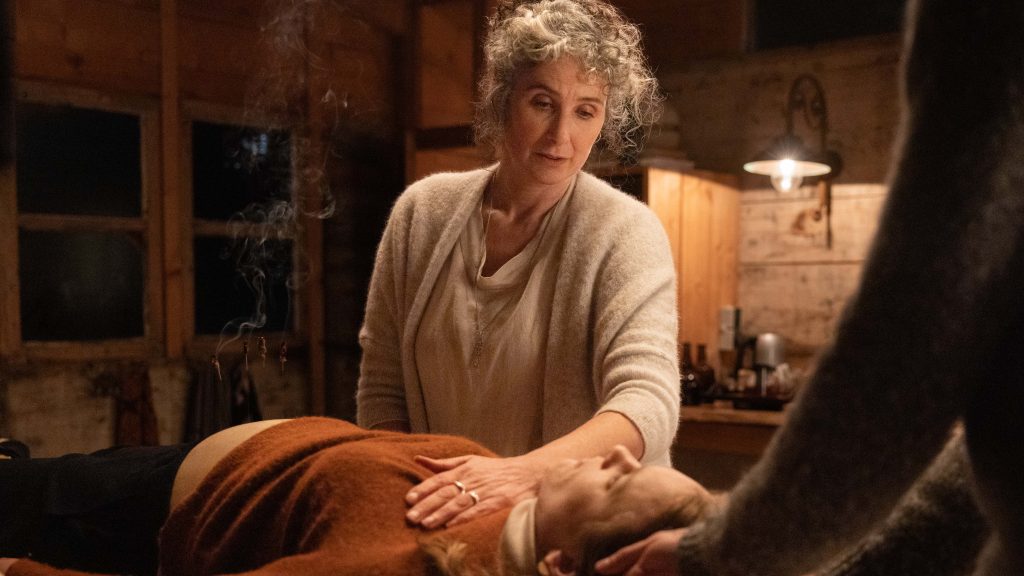
In the 15th week of her pregnancy, Jaimy (played by Noort Herlaar) has a miscarriage. Her gynecologist cannot identify the cause, she says, but that is the case in 85 percent of cases, which sounds reassuring. But after Jaimy and her husband Leon (Vincent van der Valk) insist on further investigation, it turns out that Jaimy is probably going through early menopause and that the chance of another pregnancy is virtually nil. That’s a tough blow. Such is the starting point in Kind by Jan Verdijk and screenwriter Johan Paul de Vrijer. Enter holistic midwife Nicole (Tamar van den Dop). She promises that Jaimy will indeed get pregnant again; what’s more, she even knows it will be a girl. Everything about this unctuous woman with her affable, empathetic smile and her even “friendlier” and gentler assistant exudes danger, yet Jaimy grabs this straw.
Interestingly, at one point Jaimy realizes how deceitful Nicole is and wants to quit, while Leon, in his desperation, seems to have been converted to her “gifts.” Meanwhile, a constant threat hangs over the film, not least because of the occasionally subtly menacing sounds in the soundtrack.
According to its makers, Kind is not intended to be a sermon on spirituality or science, nor is it shock horror with cheap tricks. Verdijk: ‘Horror is not a goal for us, but a form to touch something essential. At its core, Kind is about the deeply human desire for control. How we tend to want to control everything, even during the early stages of pregnancy, when we are largely at the mercy of fate. Kind shows a man who goes beyond himself to maintain control, but as his desperation grows, so does the danger of not being able to let go.”
While developing the script for Kind, Verdijk and his girlfriend were also in the midst of a long, silent struggle to have a child. “We had experienced several miscarriages. We tried everything: tests, diets, supplements, acupuncture, hormone treatment. There was no cause. We received no guidance. Only the advice to try again. ‘Just bad luck,’ the doctors said. And then, out of nowhere, we got pregnant again. This time it went well. No one knew what made the difference this time. For someone like me – down-to-earth, non-religious – that’s hard to comprehend. But somewhere in that vacuum, something resembling faith emerged. Not in something divine, but in the inexplicable.’
This viewer could not see the film as anything other than a warning or an indictment of the nonsense peddled in the alternative sector. But I’m not entirely sure that this is what the makers intended.
Henk Maassen
Novel
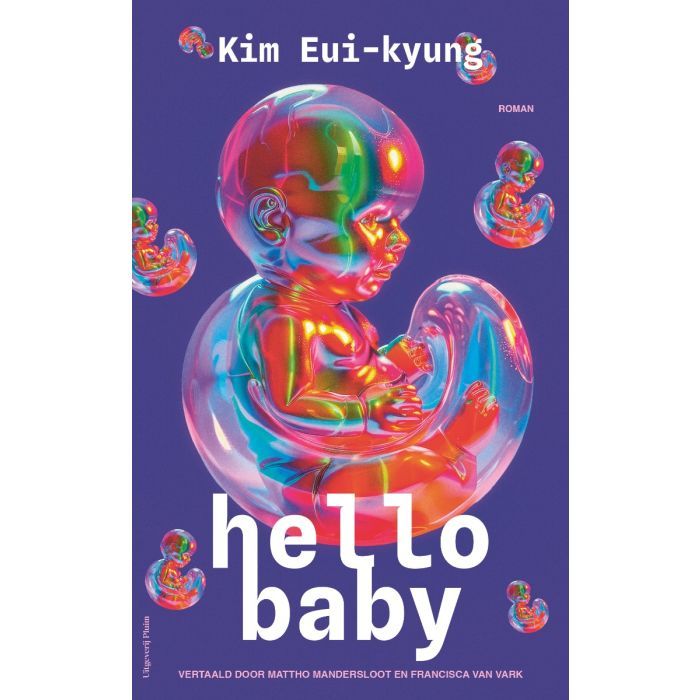
Hello Baby, Kim Eui-kyung. Uitgeverij Pluim, 223 pages, 22.99 euros (Not translated into English)
Six Korean women who want children
Just like in the film Kind, Kim Eui-kyung’s Korean novel Hello Baby features a woman with early menopause, which seriously hinders her deep desire to have children. Five other women populate this book; they are all in a joint chat group and consult the same top clinic in the hope of getting pregnant. All of them have a medical condition and are relatively old—just under or over 40—which makes IVF necessary. Unfortunately, they have suffered multiple miscarriages.
Unexpectedly, one of them gives birth after all. How this is possible, and whether it is true, is irrelevant here. The plot of Hello Baby is extremely predictable. This rather flatly written novel focuses on the six women, who are characterized in separate chapters and situated in their social and family environments, including their relationships with men who are often uninvolved (one of them is single). The novel focuses particularly on what drives them not to give up hope of having a child. They all get their own story.
What is striking is that the author is medically well informed, she knows the various IVF techniques and knows, for example, what polycystic ovary syndrome or obstructive azoospermia is. She also makes it clear how much this issue affects South Korea: in 2020, the country had the lowest fertility rate in the world, mainly because women are having children later in life and prioritizing their careers.
And, as elsewhere in the world, men still have the best of both worlds, as implied by Hello Baby: they pursue careers and are not burdened by IVF procedures. “While women had to endure all kinds of injections and medical procedures, men only had to go to the clinic to masturbate and hand in a jar of semen. Whereas egg retrieval was characterized by pain, sperm collection was all about physical pleasure.”
According to her afterword, Kim Eui-kyung based her novel on her own experiences.
Henk Maassen
Film
Hot Milk
Now in theaters
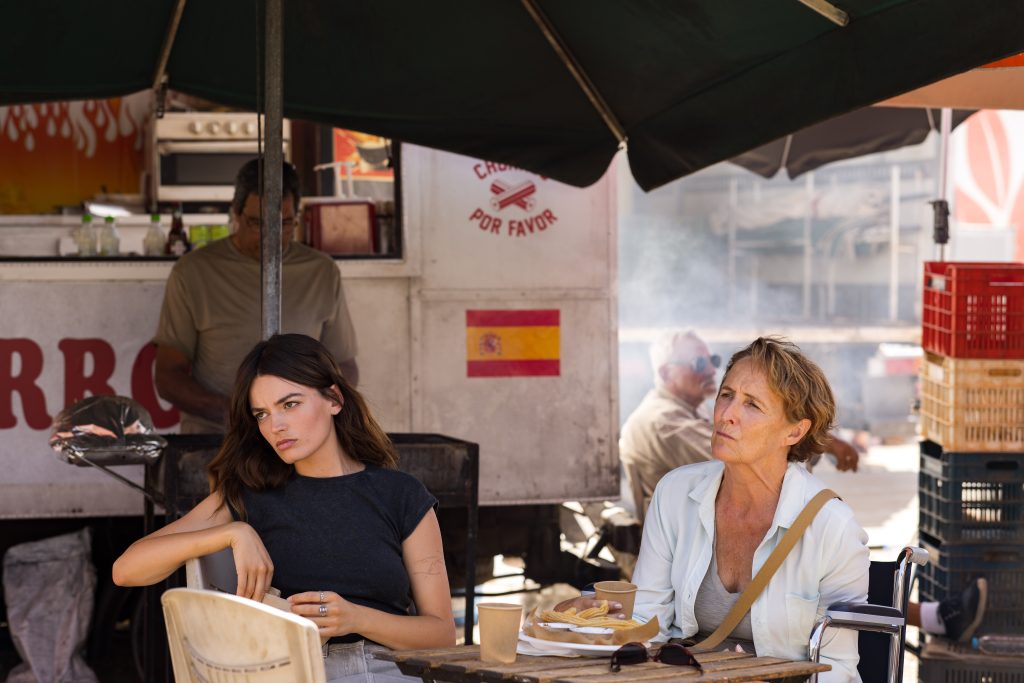
How Persistent Physical Complaints affect more than just the patient
Hot Milk, Rebecca Lenkiewicz’s directorial debut, is an exploration of emotional dependence between mother and daughter and what it means to suffer from somatically unexplained physical symptoms, now referred to as POTS: Persistent Physical Symptoms. The film is based on the novel of the same name by Deborah Levy, which was nominated for the prestigious Booker Prize. As in the above-mentioned Kind, the film is set in a clinic with a somewhat alternative, ‘holistic’ approach to the sick, but here it all seems a bit more sensible and reliable, and horror in any form is fortunately far away.
The focus is on the relationship between Sofia (Emma Mackey) and her mother Rose (Fiona Shaw), who are both spending the summer in the Spanish coastal town of Almería, where Rose has pinned her hopes on Dr. Gómez, who runs a clinic there for “difficult” cases, of which Rose is one. She has been confined to a wheelchair for years, as she is more or less paralyzed (“I can walk once a year at most”) and is in pain everywhere. She has seen several doctors, who thought she might have iron deficiency or diabetes, but found nothing: she is actually in perfect health. Her condition may have something to do with trauma from her past. In the meantime, she forces her daughter into the suffocating role of caregiver. When she doesn’t ask Sofia to arrange some kind of outing, she complains about the heat and insects, but between all the grumpy bluntness, love still shines through between the two.
Sofia has indeed put her anthropology studies on hold to care for her mother, but not entirely willingly, as we see when she crawls behind her laptop. In the hours she spends away from her mother, Sofia gets to know the mysterious, liberal, and above all seductive Ingrid (Vicky Krieps). She, too, it turns out, is burdened by a traumatic past, but unlike Sofia’s mother, she acknowledges and recognizes it. An affair develops between the two.
Hot Milk is a somewhat problematic film. The theme is interesting in principle, but Rebecca Lenkiewicz fails to bring the lives of Rose, Sofia, and Ingrid together. They remain parallel trajectories, while the intention was undoubtedly for them to mirror each other and enrich each other thematically. “The world is dark until you say yes,” is remarked in the film; a dog that terrorizes the neighborhood with its barking for days is freed from its chain by Sofia—these are two of a series of clues as to what this film is really about: rigidity and control versus embracing freedom, independence, and the search for identity.
Lenkiewicz did not quite grasp the theme. Perhaps Levy’s novel was unfilmable. The meaning of the ending is open to speculation: deadly revenge and inhuman? Or a successful, ultimate exhortation to break free from what might best be described as a sick gain?
Henk Maassen