Address: 31 Rue Juliette Dodu
How to get there: Bus 31, from Gare de l’Est
Hospital admission: free
Museum admission: €7.
Visits by appointment, email: musee.moulages.sls@aphp.fr
Monday to Friday 9:00 a.m. – 4:30 p.m.
Whereas in the Netherlands we tend to think that a hospital that is more than 40 years old and located in the city center is actually impossible, in Paris there are still many hospitals, including academic ones, that are not only located in the city center but are also more than 400 years old. South of the Seine, there is the Hôpital Cochin Port Royal, Hôpital de la Pitié Salpêtrière, Hôpital Val-de-Grâce, Hôpital Necker, Hôpital Bicêtre, and, in the Seine, so to speak, the Hôpital Hôtel-Dieu. North of the Seine are the Hôpital Saint-Louis and the American Hospital. All of these hospitals are between 200 and 400 years old (and sometimes even older) and still exist in their original locations. Of course, new buildings have now been constructed alongside (and in place of) the old ones. In a number of episodes of On the spot Parjs, we will visit some of these hospitals. We will start with the Hôpital Saint-Louis.
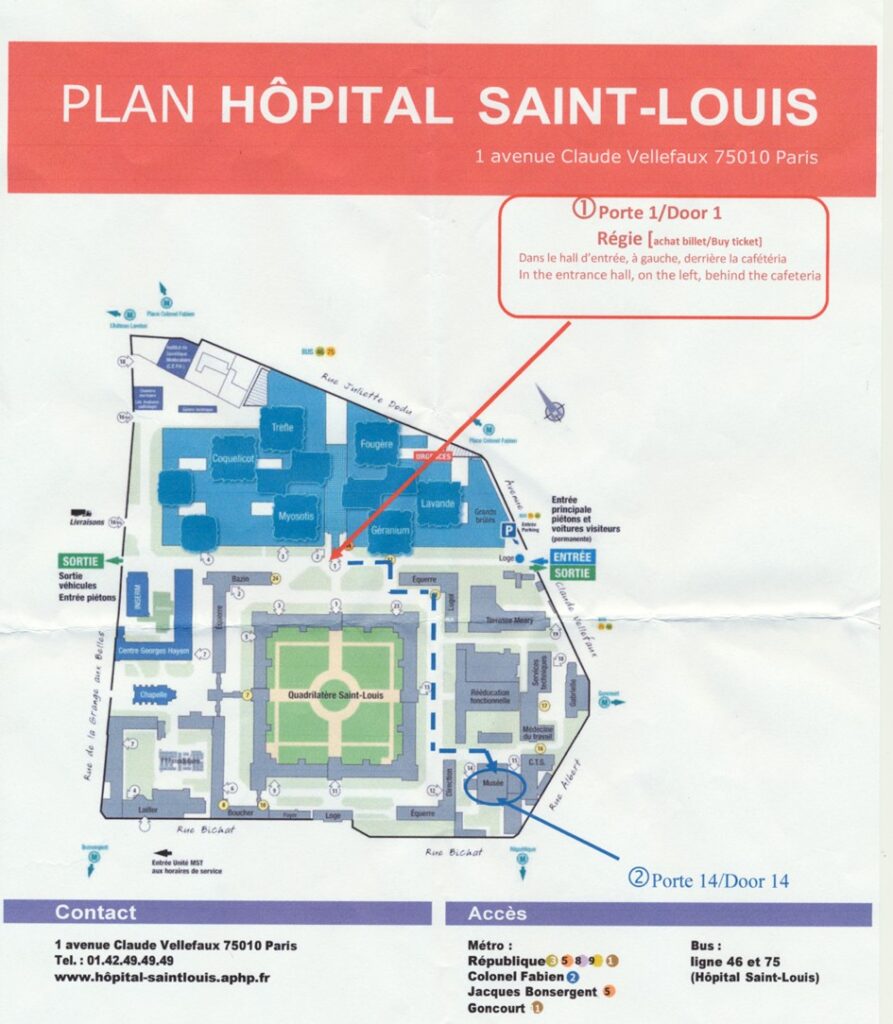
The Hôpital Saint-Louis was founded in 1611. Although it is now located in the center of Paris, when it was founded it was located outside the city, that is, outside the city walls. The hospital was needed because the hospital located in the city, the Hôtel Dieu, became overloaded due to the plague. When you walk onto the grounds from Av. Claude Vellefaux, you first pass a security guard who looks friendly and asks no questions. On the left is the old part of the hospital, now mainly used for administrative purposes. On the right is the new building, which, strangely enough, looks more dilapidated than the old building. This is often the case with Parisian hospitals, by the way.
Hopital Saint-Louis is less well known, but, like many other hospitals in Paris, it has found its way into the arts. For example, the Musée d’Orsay has this painting by Henri Gervaux
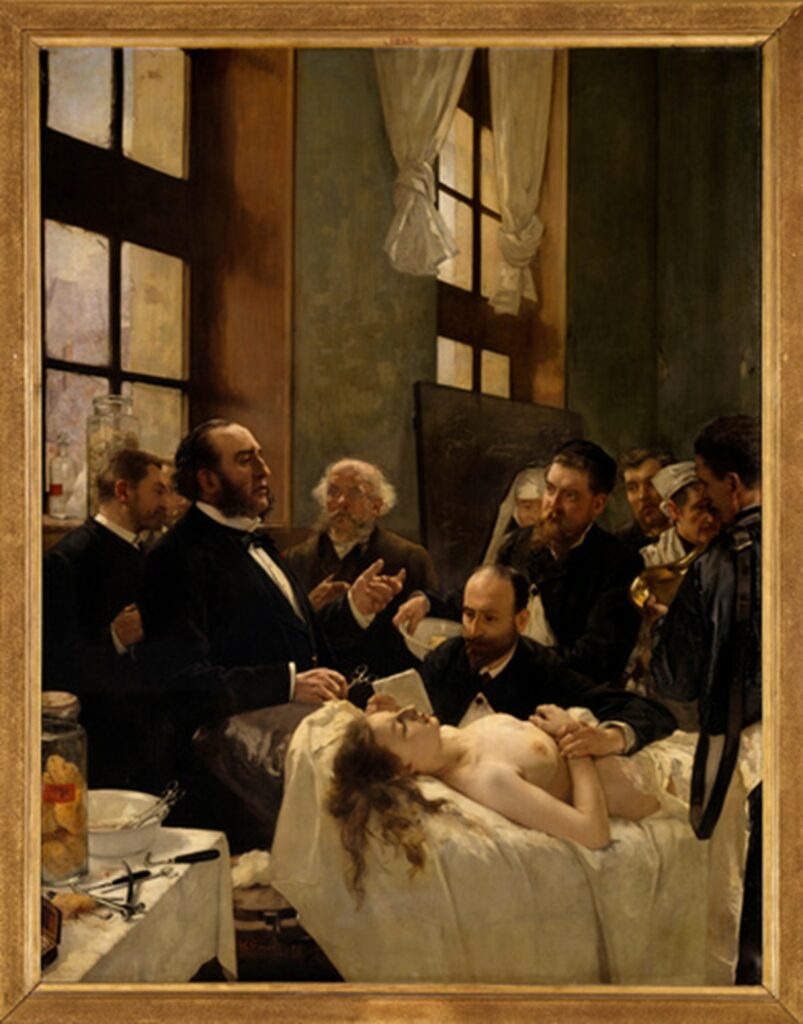
Henri Gervaux Avant L’Opération, 1887, Oil on canvas, 285 x 231 cm Musée d’Orsay
I have never seen it there, so it may be stored in the depot. The museum adds the following text:
Before the operation, with the real title: Doctor Péan teaching at the Saint-Louis Hospital about his discovery of the ligation of blood vessels, presented at the Salon of the Société des artistes français in 1887, was considered by some contemporary critics to be a modern translation of Rembrandt’s Anatomy Lesson.
Like his illustrious predecessor, Gervex depicts the famous doctor in the foreground, surrounded by his assistants and students, next to the body, the subject of the experiment. But unlike his predecessor, he opts for a vertical composition, allowing him to depict the scene in detail and let in an abundance of light that outlines the forms and cuts out the contours, emphasizing the dramatic nature of the scene.
In contrast to the static aspect of Rembrandt’s painting, he presents a pronounced dynamism, clearly expressed in an eccentric composition, in the different postures and movements of the protagonists, who are nevertheless connected by their gazes and gestures. In addition, he adds a series of surgical instruments, particularly in the foreground, lower left, against a white background, showcasing the latest scientific advances.
Through all these means, Gervex elevates this depiction of an event experienced by few people to a historical painting with a message of modernity and hope.
Back to the hospital. Somewhere in the old building is the Musée des moulages, which is worth a visit. If you want to visit the Musée des moulages, you must register in advance by email and then, with the reply to the email as proof, buy a 7 euro admission ticket in the new building. Typing on the keyboard, printing a form, putting two stamps on it, a signature, and then the proof of payment. Before we leave the new building, we should pause for a moment to consider the fact that this hospital has also found its way into fiction. Paris – Austerlitz is a posthumous novel by Rafael Chirbes, a Spanish writer.
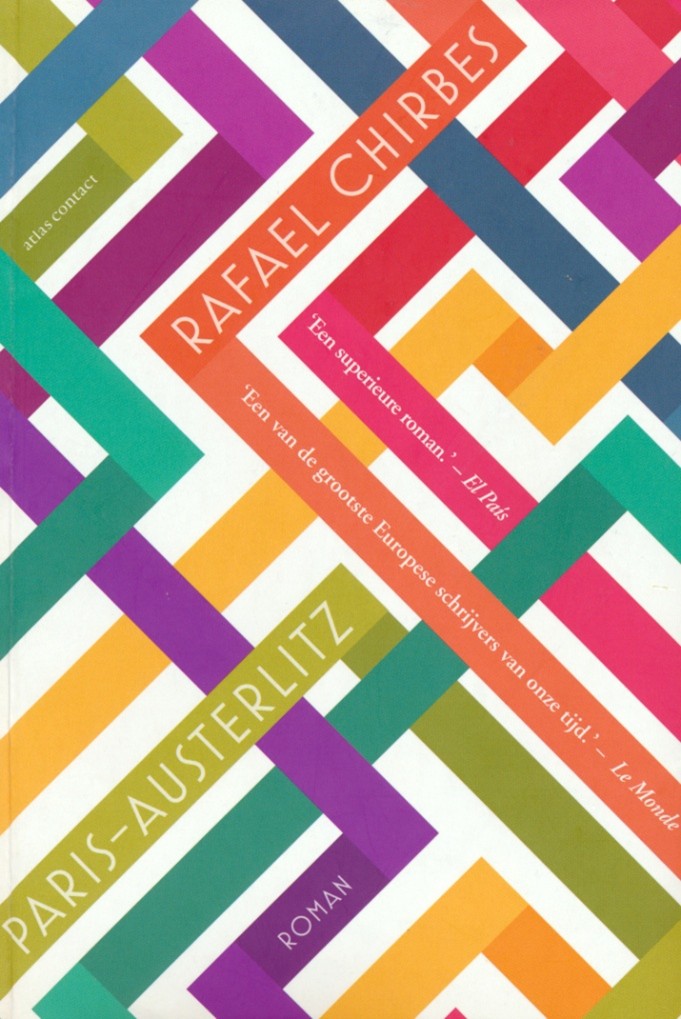
The novel is about the relationship between a younger man, a painter from a wealthy background, the main character, and a much older man who is a laborer. The novel was published in 2016, but is set in the period when AIDS was still fatal. The older man has AIDS and is in this hospital.
The Hôpital Saint-Louis, with its brick and natural stone façade, geometric flower beds, and bare tree trunks behind the window in the room. It is raining softly. A Sunday in February, pale light, the monochrome Parisian pearl gray. The color of pastis with water, Michel would say. At that time, he still moves with a certain ease through the room, goes into the hallway and the toilet to smoke one of the Gitanes I brought him behind the nurses’ backs. He continued to smoke almost until the very end. When I asked him to stop smoking during the months we lived together, because his heavy breathing woke me up at night—Your bronchial tubes are at the end of their rope—he replied: It’s hereditary, my father didn’t smoke and his bronchial tubes wheezed even more than mine. He laughed.
The nurses walking down the hall pretend not to notice, but sitting on the chair at the foot of his bed, I feel like I can still smell the cigarette he is smoking in the bathroom.
Broken bellows. His sentences end in a rattling sigh, and when he lies asleep at night, he not only snores, but occasionally makes a whistling sound, a labored inhalation, in which he seems to be suffocating and which is interrupted by violent coughing fits. He smokes. Gitanes without a filter.
A sad novel, not only because of the description of the harsh fate that AIDS was at the time, but also because of the sad love between the two men.
Back to the present. This new building of Hôpital Saint-Louis dates from after that time, so the patient from the novel was somewhere in the old building, whether or not in the part that has now been demolished.
We leave the new building and cross over to the old part of the hospital. We walk through a gate and arrive at a courtyard with trees and grass. 120 by 120 meters. There are patients here; if you look closely, you can see the IV stand in the photo.
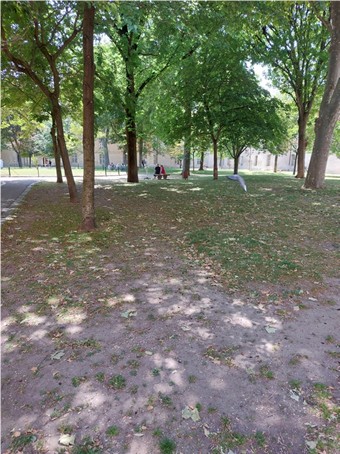
Employees also come here to rest, and I think some people are just sunbathing. Not such a bad idea, in the middle of Paris and very quiet. But on closer inspection, it’s all a bit neglected here, which is contradictory. Preserving the past, but not maintaining it.
We walk through the gate across the courtyard and turn left onto a lane lined with beautiful chestnut trees, trimmed into shape.
At the end of the avenue is the Musée des moulages. Since the 19th century, the hospital has specialized in dermatology. We go inside, but there is no reception. There is a staircase leading upstairs with many portraits from the glorious past.
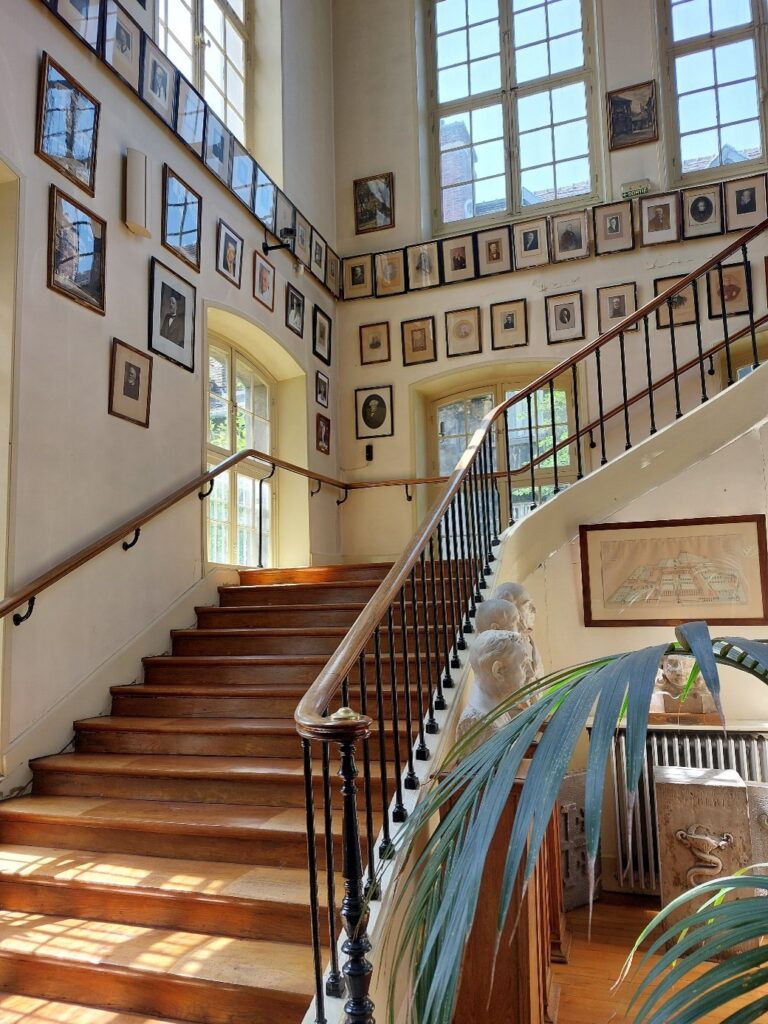
Then we enter a small hall, with a small room on the left and right, and then we enter the large hall.
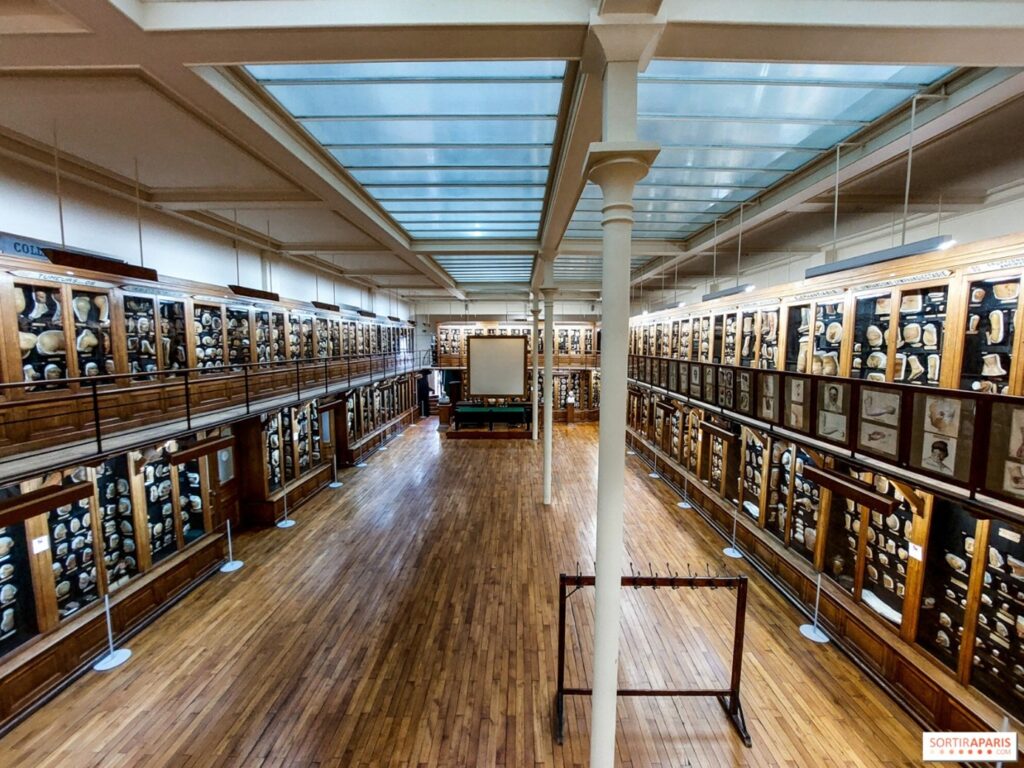
There is a reception desk there. Our form, stamped and signed twice, is quickly taken from us and we are allowed to look around. There are about ten other people in the room, who occasionally utter cries of surprise when certain abnormalities are too grotesque, at least I think so. Of course, it could also be out of admiration.
The photo above is from the internet, because taking photos is not allowed, due to patient privacy, as it says. There is something funny about that statement, because the question arises as to how, say, a syphilitic ulcer, which has been taken out of the context of a body and ultimately immortalized here in wax, can be traced back to the original patient.
The entire patient is nowhere to be found, only, in the case of the ulcer, the affected genital organ. The photo shows it well. Dozens of display cases with wax models. On the ground floor and on the gallery and, not visible in the photo, in a corridor at the back of the visible display cases. And, given the hospital’s dermatological specialization, mainly skin diseases. Dermatology is different from other branches of medicine in that the symptoms often coincide with the disease, although the syphilis example shows that this is not always the case.
The entire field of dermatology is pretty much on display here. The collection was started in 1867 by Dr. Lailler, a doctor at the hospital, who asked Jules Baretta if he could do the waxing. And just as the Spaltholz Anatomy Atlas from 1913 that I got from my father still works perfectly well, these models are still relevant today. Although… I may be mistaken, but I think there is a lack of modern dermatology, which is related to the subject of Rafael Chirbes’ novel: AIDS, in particular Kaposi’s sarcoma, one of the many clinical manifestations of AIDS. But to be honest, I think I may have overlooked it, because Kaposi’s sarcoma was already described in 1872 by Moritz Kaposi, which falls precisely within the heyday of this collection. The technique of wax models is also interesting, but we will save that for another, similar collection, namely the one in the Narrenturm in Vienna.
More than 100 display cases and 4900 moulages later, we leave the building, fortunately not needing to see any more dermatological abnormalities for the time being.